Why Auto Insurance Exists (and Why It's Required)
Auto insurance is fundamentally a risk-sharing contract: you pay a relatively small, predictable premium so that a large, unpredictable loss - a serious crash, a totaled vehicle, a lawsuit - doesn't wipe out your finances. Without it, a single accident involving injuries could expose you to tens or hundreds of thousands of dollars in liability.
That's why nearly every U.S. state mandates some minimum level of coverage as a condition of registering a vehicle and driving legally. These minimums set a floor, not a ceiling. They define the least protection you can carry, and in many states those floors are surprisingly low relative to the real costs of a serious collision.
The insurance requirement also protects other drivers. If you cause an accident, the injured party needs a realistic path to compensation - your liability coverage is that path. This broader social function explains why states regulate auto insurance closely and why driving uninsured carries serious legal and financial consequences.
State Minimums Are a Starting Point, Not a Strategy
State-required minimum liability limits are often set well below the actual costs of a serious accident involving injuries and property damage. Carrying only minimum coverage may satisfy the legal requirement while leaving you personally liable for significant costs above those limits. Review your assets and risk tolerance when deciding how much liability coverage to carry.
The Core Coverage Types at a Glance
A personal auto policy is not a single blanket protection - it is a bundle of distinct coverage types, each designed to address a different category of loss. You can think of each type as a separate module that turns on or off depending on what you purchase and what situation you're in.
- Liability coverage pays for injuries and property damage you cause to others. It does not cover your own vehicle or your own injuries.
- Collision coverage pays to repair or replace your vehicle after an accident with another car or object, regardless of who was at fault.
- Comprehensive coverage covers vehicle damage from events other than collisions - theft, fire, hail, flooding, or animal strikes.
- Uninsured/Underinsured Motorist (UM/UIM) coverage protects you if the at-fault driver carries no insurance or insufficient insurance to cover your losses.
- Medical Payments (MedPay) or Personal Injury Protection (PIP) covers medical expenses for you and your passengers, regardless of fault. PIP is broader and required in no-fault states.
For a deeper look at how liability, collision, and comprehensive interact in real-world scenarios, see the core coverage types explained.
Liability coverage
Insurance that pays for injuries or property damage you cause to other people in an accident. It does not pay for your own vehicle or your own medical costs.
Deductible
The fixed dollar amount you pay out of pocket on a claim before your insurance company covers the rest.
Coverage limit
The maximum amount your insurer will pay out for a specific type of covered loss. Any costs above this limit are your responsibility.
Comprehensive coverage
Pays to repair or replace your vehicle after non-collision events like theft, hail, fire, flooding, or an animal strike.
Uninsured motorist coverage
Protects you if another driver who caused your accident has no insurance or not enough coverage to pay for your damages and injuries.
Declarations page
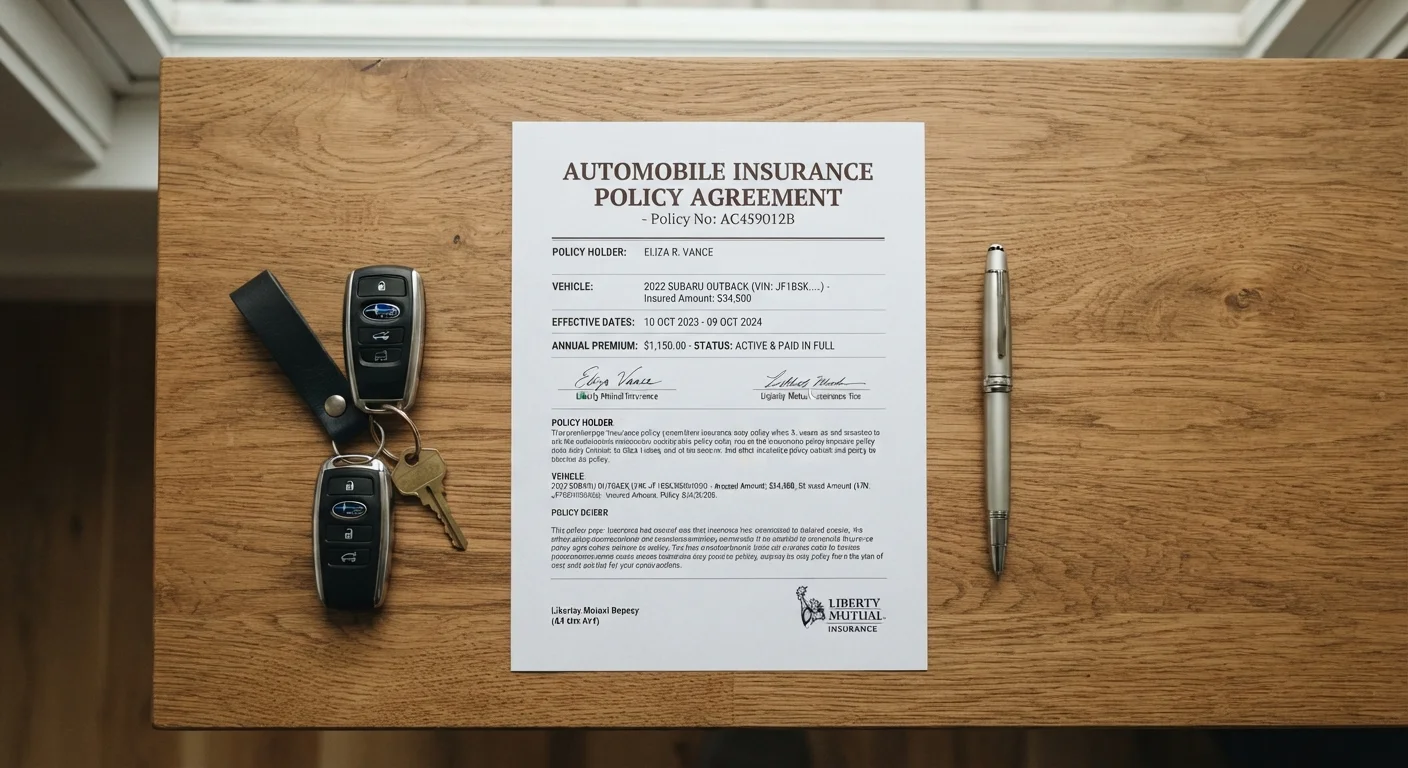
The summary page at the start of your policy document listing all your selected coverages, limits, deductibles, insured vehicles, and policy dates.
Key Terms You'll See on Every Policy
Insurance policies are dense documents, but most of the confusion comes from a handful of recurring terms. Knowing them before you read a policy - or talk to an agent - puts you in control of the conversation.
- Premium
- The amount you pay to keep the policy active, usually billed monthly, semi-annually, or annually.
- Deductible
- Your share of a covered loss before the insurer pays. A $1,000 deductible on a $4,500 repair means you pay $1,000 and the insurer pays $3,500.
- Coverage limit
- The maximum dollar amount your insurer will pay for a covered claim. Limits are often written in pairs - for example, 50/100 means $50,000 per person and $100,000 per accident for bodily injury liability.
- Declarations page
- The summary sheet at the front of your policy that lists your coverages, limits, deductibles, vehicles, and policy period.
- Exclusion
- A specific circumstance or type of loss the policy does not cover. Reading exclusions carefully is as important as reading what is covered.
The auto insurance glossary covers a full range of policy terms in plain language - worth bookmarking before you review any policy document.
What Actually Affects Your Premium
Insurers calculate your premium by estimating the likelihood and potential cost of a future claim. They use a range of factors to build that estimate, and understanding them helps you see why quotes differ - and where you may have room to influence your rate.
- Driving history: At-fault accidents, traffic violations, and DUI convictions increase perceived risk. A clean record is consistently one of the most influential factors in keeping premiums lower.
- Vehicle type: Repair costs, safety ratings, theft rates, and engine size all factor into how much it costs to insure a specific vehicle.
- Location: Urban areas with higher traffic density, theft rates, or severe weather patterns typically produce higher premiums than rural areas.
- Coverage selections and deductibles: The types of coverage you carry, your chosen limits, and your deductible amounts directly determine a significant portion of your premium.
- Credit-based insurance score: Most states permit insurers to use a credit-based score (distinct from a lending credit score) as one pricing factor. A small number of states prohibit this practice.
- Annual mileage: Drivers who log fewer miles statistically file fewer claims, and many insurers price accordingly.
None of these factors work in isolation - insurers weight them differently and use proprietary models. That's why the same driver can receive meaningfully different quotes from different carriers.
How to Approach Shopping for Coverage
Shopping for auto insurance effectively means going beyond the monthly premium and evaluating the complete value of what each policy offers. A lower premium that carries inadequate limits or significant exclusions can cost far more at claim time than a slightly higher premium with solid protection.
Before you request quotes, take stock of your situation: your vehicle's value, your assets that could be at risk in a lawsuit, whether you have a loan or lease requiring comprehensive and collision, and how often and how far you drive. These factors shape which coverage types and limits make practical sense for you.
When you compare policies, look at coverage limits side by side - not just the bottom-line price. What to compare beyond price outlines the specific elements worth scrutinizing, including claims service reputation and policy exclusions. Once you have a policy in hand, reading your policy without getting lost walks you through the document itself so you know what you actually agreed to.
Also worth reading before your next renewal: common auto insurance myths - several widespread misconceptions about coverage can lead drivers to make decisions that leave them underprotected.
This article provides general educational information about auto insurance and is not personalized insurance, financial, or legal advice. Coverage terms, requirements, and pricing vary by state and insurer. Consult a licensed insurance agent or adviser for guidance specific to your situation.