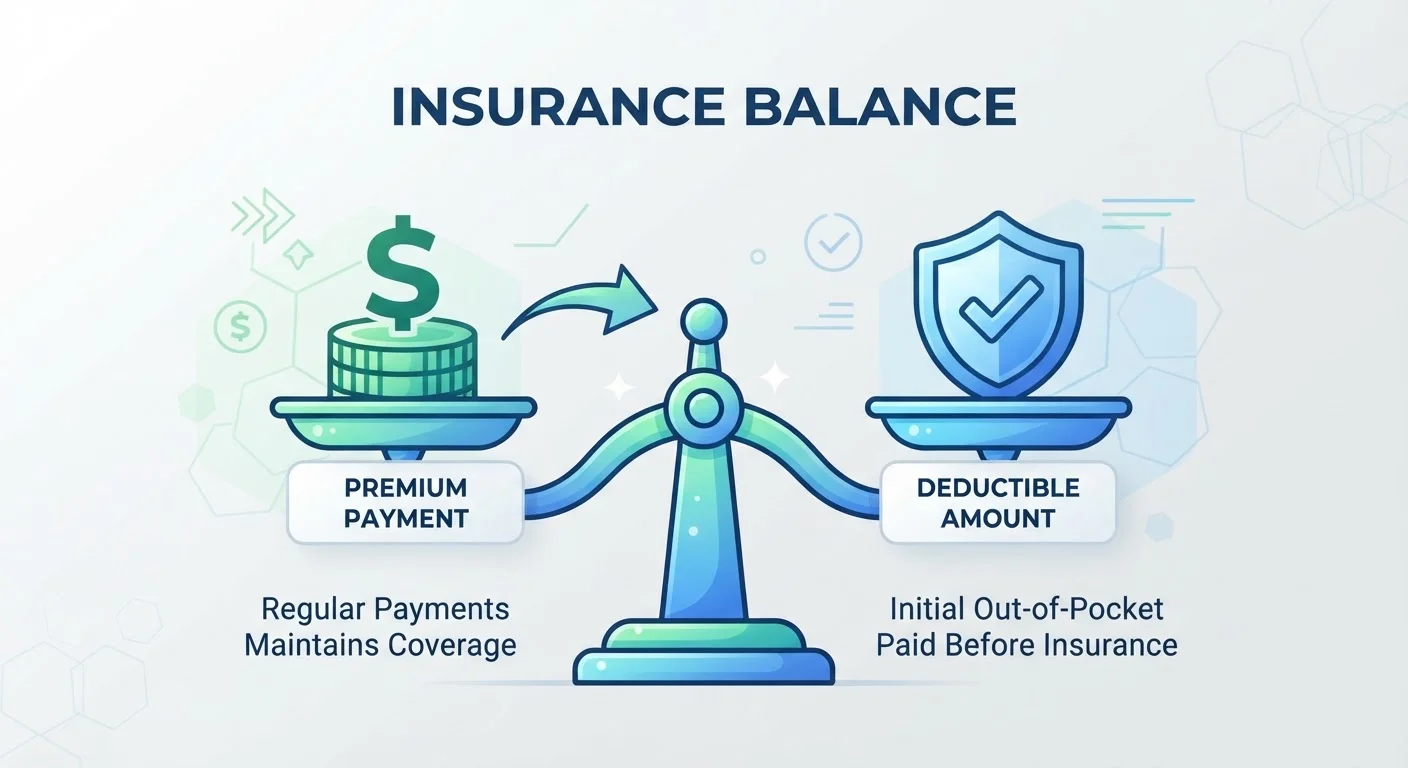
What Each Term Actually Means
Your premium is the cost of maintaining coverage - think of it as a subscription fee for financial protection. You pay it whether or not you ever file a claim. Your deductible is the out-of-pocket share you absorb on a covered claim before your insurer steps in.
Say you have a $750 deductible and your vehicle sustains $4,000 in collision damage. You pay $750; your insurer covers the remaining $3,250. If the repair bill were only $600 - less than your deductible - no insurance money changes hands at all, and filing a claim would be pointless.
Understanding this interplay is foundational to reading any policy intelligently. For a broader view of what shapes your rate overall, see the factors that shape your premium.
Deductibles Apply Per Claim, Not Per Year
Unlike health insurance, where an annual deductible resets each year, auto insurance deductibles apply every time you file a covered claim. If you file two collision claims in the same year, you pay your deductible twice. This per-claim structure is an important factor when weighing how often you might realistically need coverage.
The Math Behind the Trade-Off
Insurers price deductibles on a straightforward principle: the more you're willing to absorb on a claim, the less risk they carry, so they charge you less upfront. The relationship is real but not linear - the premium savings tend to be largest when moving from a very low deductible to a moderate one, and diminish as you push into higher ranges.
A useful way to evaluate the trade-off is a simple break-even calculation:
- Find the annual premium difference between two deductible options.
- Subtract the lower deductible from the higher one to get your additional out-of-pocket exposure per claim.
- Divide the extra exposure by the annual savings. The result is the number of claim-free years needed to come out ahead.
For example: if raising your deductible from $500 to $1,000 saves $120 per year, and a claim would cost you an extra $500 out of pocket, you need roughly 4.2 claim-free years to break even on that decision. The more confident you are in your driving record and the less you need to file claims, the more attractive a higher deductible becomes.
10-30%
Typical premium reduction when doubling a deductible
Industry guidance from insurance education resources suggests moving from a $500 to $1,000 deductible can reduce collision or comprehensive premiums by roughly this range, though results vary widely by insurer and profile.
$500
Most common auto insurance deductible in the US
Consumer surveys and insurance industry data consistently show $500 as the most frequently selected deductible level for collision coverage among US drivers.
When a Higher Deductible Makes Sense - and When It Doesn't
A higher deductible is generally worth considering when:
- You have a reliable emergency fund that could cover the deductible amount without financial stress.
- Your vehicle is older or lower in value - meaning the gap between deductible and potential payout is smaller anyway.
- You have a clean driving history and low annual mileage, reducing your statistical likelihood of filing a claim.
A lower deductible may serve you better when:
- Your savings are limited and an unexpected $1,000 expense would create genuine hardship.
- You live or commute in a high-traffic, high-theft, or severe-weather area where claims are more probable.
- Your vehicle is financed or leased - lenders often impose maximum deductible limits in the financing agreement.
There's no universal right answer. The decision is a personal financial calculation, not a one-size-fits-all rule. For further context on legitimate ways to adjust your coverage costs, see legitimate ways to lower your auto insurance costs.
Putting It All Together When Comparing Policies
When you're comparing quotes, the premium figure alone is incomplete information. Two policies at similar price points can have very different deductibles, coverage limits, and exclusions - making one a far worse deal in the event of a real claim.
Always look at the full picture: what you'd pay monthly, what you'd owe at the moment of a claim, what scenarios are actually covered, and how the insurer handles the claims process. What to compare beyond the price when shopping around covers this in detail.
If you want to understand how insurers arrive at their numbers in the first place, how car insurance premiums are actually calculated breaks down the methodology. And once you're ready to dig into a policy document itself, reading your auto insurance policy without getting lost walks you through the key sections to review before signing.
This article provides general educational information about auto insurance concepts and is not personalized insurance or financial advice. Coverage terms, deductible options, and premium impacts vary by insurer, policy, and individual circumstances. Consult a licensed insurance agent or adviser for guidance specific to your situation, and always review your actual policy documents carefully.