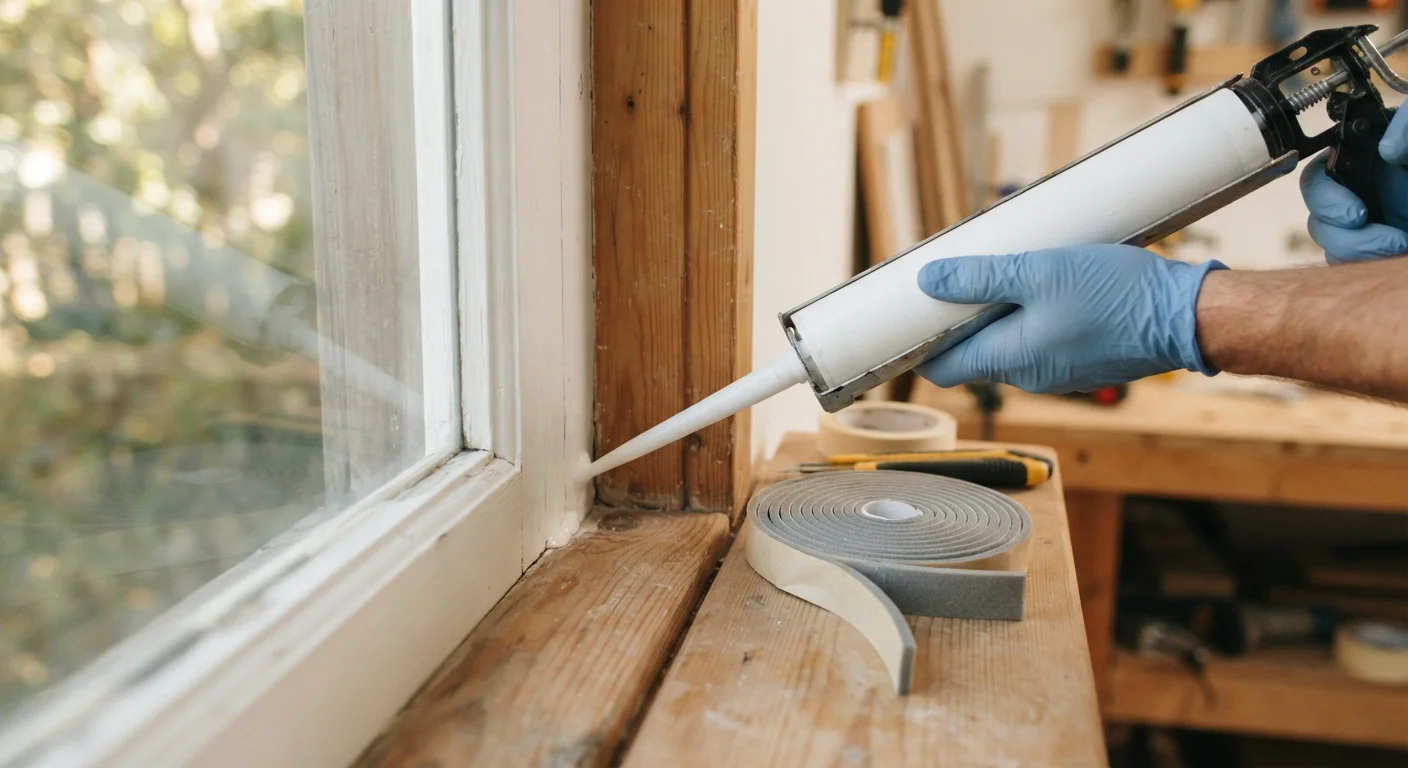
Understanding What Each Product Actually Does
Both caulk and weatherstripping block unwanted airflow, but they're engineered for fundamentally different scenarios. Confusing the two is one of the most common draught-sealing mistakes homeowners make.
Caulk is a flexible sealant - typically silicone, latex, or polyurethane - that's applied wet and cures into a solid, slightly elastic bead. It adheres to two adjacent surfaces and fills the gap between them. Once cured, it cannot tolerate repeated mechanical movement without eventually cracking.
Weatherstripping refers to a range of compressible materials - foam tape, V-strip (also called tension seal), door sweeps, and rubber or silicone gaskets - that create a physical barrier when two surfaces close together. Unlike caulk, weatherstripping is engineered to be compressed and released thousands of times.
The key question to ask before reaching for either product: Does this gap stay still, or does it open and close? That single answer should guide your entire decision.
| Criterion | Caulk | Weatherstripping |
|---|---|---|
| Best application | Stationary gaps and joints | Moving doors and windows |
| Movement tolerance | None - cracks under repeated flex | High - designed to compress repeatedly |
| Typical lifespan | 10-20 years when properly applied | 2-10 years depending on material |
| Skill level required | Low to moderate (prep is key) | Low (most types are peel-and-stick) |
| Reversibility | Difficult - residue remains after removal | Easy - most types peel away cleanly |
| Gap-filling ability | Excellent - fills irregular gaps | Limited - needs fairly even surfaces |
| Indoor vs. outdoor use | Both (product type varies) | Both (material choice varies) |
Where Caulk Works Best - and Where It Fails
Caulk excels anywhere two stationary surfaces meet and leave a gap. Classic locations include:
- The joint between a window or door frame and the surrounding wall or trim
- Baseboards meeting the floor or wall
- Gaps where pipes or cables enter through exterior walls
- The seam between a door threshold and the floor on fixed installations
For exterior use, silicone or siliconized latex caulk is generally recommended because it resists moisture and temperature swings. Interior applications often work well with paintable acrylic latex caulk.
Where caulk fails is equally important to understand. Never apply caulk to the edges of an operable door or window sash. The repeated movement will shear the bead apart within one season, leaving gaps that may be harder to reseal because residue remains on the surface.
Check Local Codes Before Sealing Utility Penetrations
When caulking around pipes, wires, or vents that pass through exterior walls, be aware that some penetrations - particularly gas lines or combustion-air openings for heating equipment - have specific sealing requirements under local building codes. Using the wrong material or fully blocking certain openings can create safety hazards. When in doubt about a utility penetration, consult a licensed contractor or your local building department before sealing.
Where Weatherstripping Belongs - and Its Limits
Weatherstripping is the right tool for any seal that must compress and recover repeatedly. Key locations include:
- The top and sides of an exterior door frame (door stop areas)
- The bottom of an exterior door, using a door sweep or automatic door bottom
- The sash edges of double-hung, casement, or sliding windows
- Attic hatch perimeters, which open and close but still need an airtight seal
Different weatherstripping materials suit different gaps. Foam tape is inexpensive and easy to install but compresses permanently over time and typically lasts two to five years. V-strip or tension-seal weatherstripping is more durable and works well in door-stop channels. Rubber or silicone gaskets installed on door frames offer longer service life and a firmer seal.
Weatherstripping's main limitation is that it cannot fill irregular or wide gaps the way caulk can. If a door frame has shifted or a gap is uneven, weatherstripping alone may leave cold spots.
25-30%
Home heating energy lost through air leaks
The U.S. Department of Energy estimates that air leakage through gaps, cracks, and openings accounts for roughly 25-30% of heating and cooling energy use in a typical home.
~$200
Estimated annual savings from sealing air leaks
The U.S. Environmental Protection Agency's ENERGY STAR program has cited figures suggesting homeowners can save around $200 per year on average by sealing and insulating, though actual results vary by home and climate.
Applying Both Products Together for a Complete Seal
In most real-world applications, caulk and weatherstripping are complementary rather than competing. An exterior door, for example, benefits from weatherstripping along the door stop and a door sweep at the bottom - but the gap between the door casing and the siding or wall should be sealed with caulk.
A systematic approach helps:
- Inspect the full perimeter of each door and window on a windy day. Hold your hand near edges to feel for airflow, or use a lit incense stick to observe smoke movement.
- Identify stationary joints - these get caulk. Remove any old, cracked caulk with a utility knife or oscillating tool before reapplying.
- Identify moving surfaces - these get weatherstripping. Remove old foam or gaskets and clean the surface with rubbing alcohol before applying new material.
- Apply caulk in a smooth, continuous bead and tool it with a wet finger or caulking tool immediately after application. Allow full cure time before exposing to moisture.
- Size weatherstripping correctly so the door or window still closes and latches without excessive force - a seal that's too thick can cause alignment problems or hardware strain.
Together, the two products address the full range of air leakage paths that single-product approaches miss. Many energy auditors recommend treating both during the same project for the most measurable improvement in a home's airtightness.