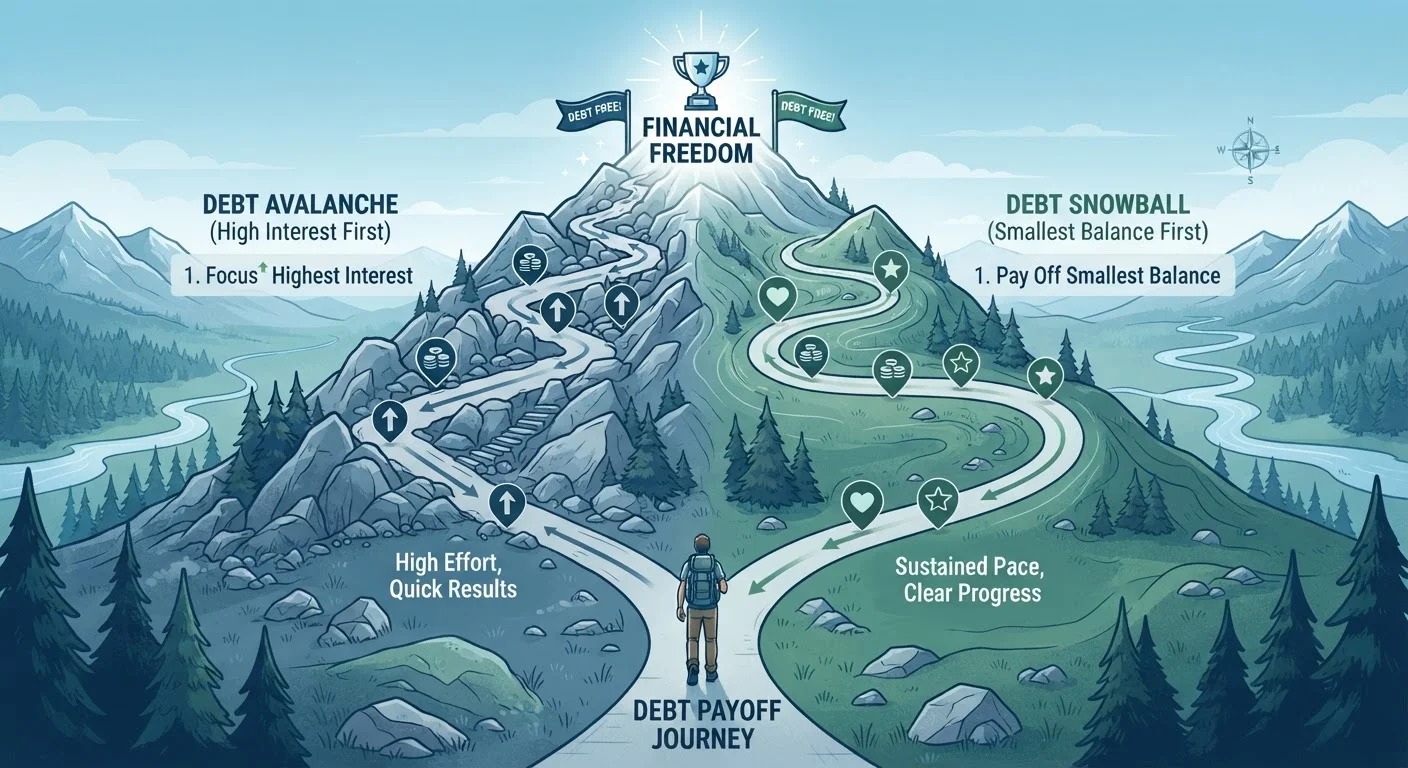
How Each Method Works
Both the debt avalanche and debt snowball assume the same foundational discipline: you make minimum payments on all debts, then direct any remaining available funds toward one target debt at a time. Where they differ is in which debt gets that extra payment.
Debt Avalanche: List your debts by annual percentage rate (APR), highest to lowest. Pay minimums on everything, then throw every extra dollar at the highest-rate balance. Once it's gone, roll that freed-up payment to the next highest-rate debt. Repeat until all balances reach zero.
Debt Snowball: List your debts by balance, smallest to largest - ignoring interest rates entirely. Pay minimums on everything, then focus all extra funds on the smallest balance. Once eliminated, roll that payment to the next smallest balance. Each payoff adds momentum to the next.
For a practical overview of how debt accumulates in the first place, see the complete guide to understanding and managing personal debt.
| Criterion | Debt Avalanche | Debt Snowball |
|---|---|---|
| Payoff order | Highest APR first | Smallest balance first |
| Total interest paid | Lower (mathematically optimal) | Higher (depends on rates) |
| Time to first payoff | Potentially longer | Faster early wins |
| Psychological momentum | Builds slowly | Builds quickly |
| Best suited for | High-rate debt, disciplined savers | Multiple small balances, motivation-driven |
| Complexity | Low - rank by rate | Low - rank by balance |
The Math Behind the Avalanche
The avalanche's efficiency advantage is straightforward: interest charges accrue on outstanding balances daily (for most consumer debt). The higher the rate on a balance, the faster that balance grows if left unattended. By eliminating high-rate debt first, you interrupt compounding at its most expensive point.
Consider a simplified example - two debts: a $3,000 credit card at 24% APR and a $6,000 personal loan at 10% APR, with $200 per month available beyond minimums. Directing that $200 toward the credit card first clears the higher-rate balance faster, which reduces the total interest that accrues across both accounts. The exact savings vary by balance, rate, and payment amount, but the directional outcome is consistent: attacking the highest rate first costs less over time.
~$1,000+
Potential interest savings with avalanche vs. snowball
Estimates vary widely by debt mix, but NerdWallet and similar financial education tools have illustrated scenarios where the avalanche saves over $1,000 compared to the snowball across typical consumer debt portfolios.
77%
Americans carrying some form of debt
According to Experian's 2023 State of Credit report, the vast majority of U.S. consumers carry at least one form of debt, underscoring the broad relevance of structured payoff strategies.
If your debts span very different rate tiers - say, a 28% store card alongside a 7% auto loan - the avalanche's advantage can be substantial. If rates are closer together, the gap narrows.
The Psychology Behind the Snowball
The snowball's case rests not on math but on behavior. Research in behavioral economics has explored how small, early wins build commitment to longer-term goals - a pattern relevant to debt payoff. When a borrower eliminates a debt account entirely, they experience a concrete reward: one fewer bill, one fewer creditor, a visible reduction in account count.
A study published in the Journal of Marketing Research found that consumers who focused on paying off individual accounts (rather than reducing total balances proportionally) were more likely to eliminate their debt entirely. The motivational effect is real, even if it comes at a cost in interest.
That trade-off is worth naming clearly: for some borrowers with high-rate debt, the snowball's extra interest cost over the life of repayment can be meaningful. For others - especially those with a history of starting and abandoning payoff plans - that cost may be worth paying in exchange for a method they'll actually complete. Understanding your own track record is part of choosing wisely. If you're still building foundational credit habits, this guide to credit and debt from scratch covers core concepts that provide helpful context.
When to Consider Other Options Alongside Either Strategy
Both the avalanche and snowball assume you're working with your current debt structure as-is. In some situations, restructuring that debt first - through consolidation or balance transfers - can change the calculus meaningfully. If you can lower the interest rate on a high-rate balance before applying either strategy, both methods become more effective.
Debt consolidation combines multiple debts into one, potentially at a lower rate. Whether that makes sense depends on your credit profile, the available terms, and fees involved - it isn't automatically advantageous. It's also worth distinguishing debt payoff strategy from broader money management philosophy. How you structure your monthly budget - whether savings come first or expenses are tracked and then allocated - will determine how much extra you have available to direct toward debt each month. Not all debt is equally urgent, either. If you're unsure how to prioritize across different types of obligations, understanding the distinction between good debt and bad debt can sharpen that thinking.
This article is for general informational and educational purposes only and does not constitute personalized financial or legal advice. Consult a licensed financial professional for guidance specific to your situation.