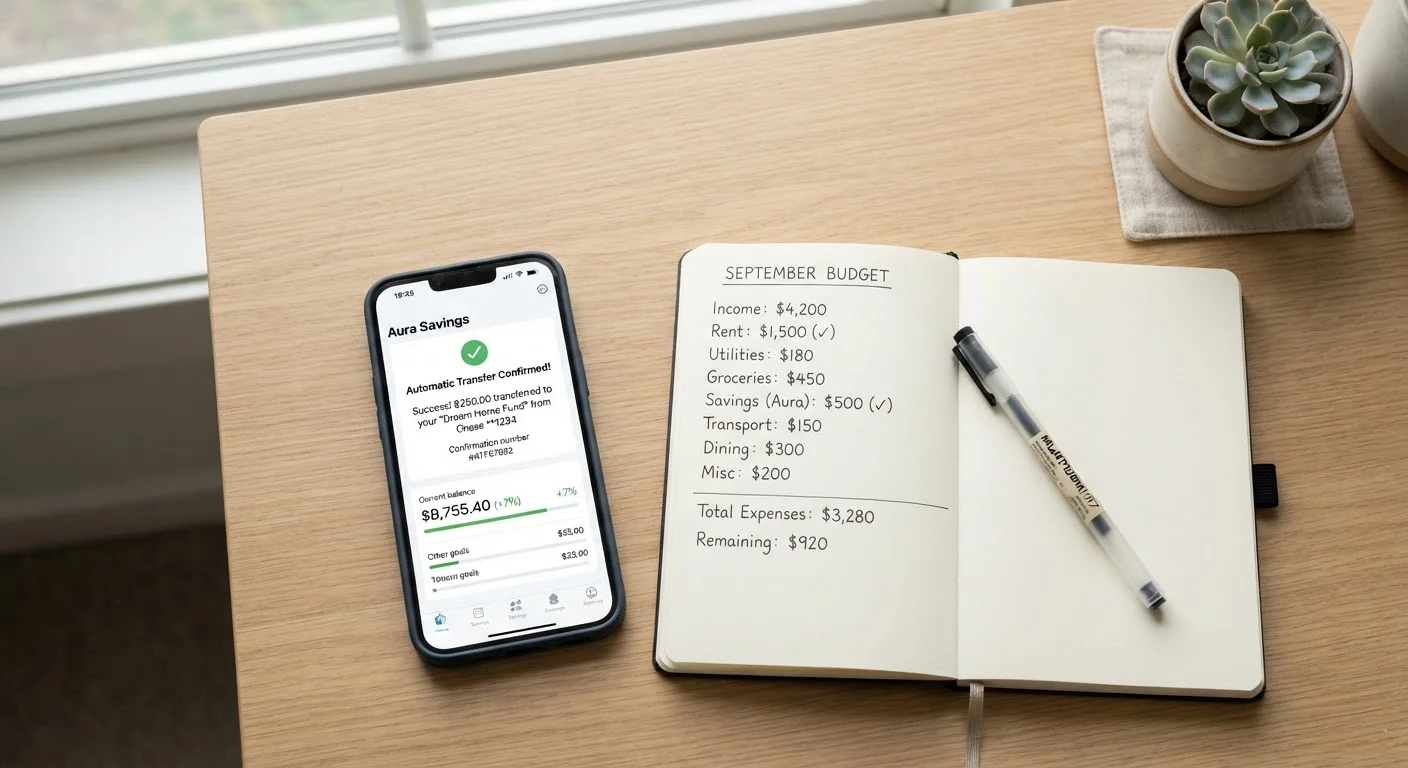
How Savings Automation Actually Works
Savings automation simply means instructing your bank, credit union, or employer to move a defined amount of money into a savings account on a fixed schedule - usually each payday. The transfer happens before you see the balance in your checking account, which is precisely why it tends to work.
The most common methods are: splitting your direct deposit so a portion goes directly to savings; setting a recurring transfer from checking to savings through your bank's online tools; or using an employer-sponsored retirement contribution like a 401(k) deduction. None of these require a third-party app, though apps exist that layer on additional features.
The underlying principle is the same as pay-yourself-first budgeting: savings come off the top, and you manage day-to-day expenses with what remains. This is fundamentally different from trying to save whatever is left at month-end - a habit that research consistently shows produces smaller and less predictable outcomes.
The Real Advantages of Automating
The strongest case for automation isn't about discipline - it's about removing a recurring decision. Every time saving requires a conscious choice, there's an opportunity to rationalize skipping it. Automation eliminates that friction entirely.
Removes reliance on willpower or memory
Because transfers happen automatically, saving doesn't compete with other spending decisions in the moment. This structural advantage tends to produce more consistent outcomes than intention-based saving.
Builds compounding habits over time
Regular small contributions accumulate steadily, and in interest-bearing accounts, the compounding effect grows over years in ways irregular manual transfers don't replicate as reliably.
Easily tied to specific financial goals
You can run multiple automated transfers to separate accounts - one for emergencies, one for a planned purchase, one for retirement - keeping goal-based savings clearly delineated without manual sorting.
Reduces the temptation to spend first
When money moves to savings before you interact with your checking balance, your perceived spending money is lower from the start, which tends to reduce impulsive expenditures.
Available through most banks at no added cost
Recurring transfers and direct deposit splitting are standard features at most U.S. banks and credit unions, requiring no paid subscription or third-party service to implement.
~55%
Americans saving less than they'd like monthly
Federal Reserve surveys consistently find that a substantial share of U.S. adults report saving less than their stated savings goal, with irregular or manual saving habits cited as a contributing factor.
$25-$35
Typical bank overdraft fee per event
The Consumer Financial Protection Bureau has documented average overdraft fees in this range, meaning a single miscalculated automated transfer can eliminate weeks of savings progress.
Automation also makes it easier to direct money toward specific goals - a sinking fund for a planned expense, a high-yield savings account, or a retirement account - without remembering to do it manually each month. Over time, the compounding effect of consistent contributions tends to outpace sporadic lump-sum transfers, even if the monthly amounts are similar.
The Pitfalls Worth Taking Seriously
Automation's biggest weakness is the same as its strength: it keeps running whether or not your circumstances still fit the original setup. A transfer amount set when you had a higher income or lower expenses can trigger overdraft fees if cash flow tightens. Many banks charge $25-$35 per overdraft event, which quickly erodes any savings benefit.
Can trigger overdraft fees if cash flow tightens
If your balance dips before a scheduled transfer, an overdraft charge can cost more than the transfer amount itself. This risk rises during months with uneven expenses or reduced income.
Contribution amounts can become outdated quickly
An amount that worked twelve months ago may be too low to meet a new goal or too high relative to current expenses. Without periodic review, the automation runs on stale assumptions.
May create a false sense of financial awareness
Automated saving can reduce how actively you engage with your full financial picture, making it easier to miss rising expenses, underperforming accounts, or fees quietly accruing elsewhere.
Withdrawal frictions can work against you in emergencies
Accounts at separate institutions - a common recommendation to curb casual withdrawals - can slow access when you genuinely need funds quickly.
Doesn't substitute for a savings strategy or clear goal
Automation is a delivery mechanism, not a plan. Without a defined purpose and target amount, transfers may accumulate in low-yield accounts with no intentional direction.
There's also a subtler risk: automation can create a false sense of financial engagement. Knowing transfers are happening in the background may reduce how closely you monitor your full picture - which is where a monthly money audit becomes a useful counterweight.
Getting the Setup Right From the Start
The most common automation mistake is setting an amount that's either too aggressive (triggering cash shortfalls) or too conservative (making negligible progress). A practical starting point: calculate your monthly take-home pay, subtract non-negotiable expenses, and automate a transfer that represents a realistic fraction of what remains. If you're working with a tight budget, even a small consistent amount is more effective than a larger amount you'll frequently pause or cancel.
Starting Small Is a Valid Strategy
There's no minimum required for a savings transfer to be worthwhile. Starting with an amount small enough that you won't notice - even $25 or $50 per paycheck - builds the habit and the account simultaneously. You can increase the amount later without disrupting the underlying system. Consistency over time tends to matter more than the size of any individual transfer.
Timing matters too. Schedule transfers to land within one or two days of your paycheck clearing - not mid-month, when your balance may already be lower from regular expenses. If your income varies, consider automating a smaller fixed amount and making manual top-ups in stronger months rather than tying automation to an income level you don't always hit.
Finally, consider which account the money goes to. A savings account that's easy to access from your checking account may be too tempting to raid. Placing automated savings at a separate institution - even one with a slightly different login - introduces just enough friction to discourage casual withdrawals. For a comparison of philosophical approaches to managing money, see pay-yourself-first vs. expense tracking.
When to Revisit Your Automated Setup
Automation is not a one-time configuration. It should be reviewed when your income changes, when a major expense begins or ends, or when you reach a savings milestone and need to redirect funds. A reasonable cadence is once per quarter - brief enough to stay manageable, frequent enough to catch problems early.
Check that your contribution amounts still reflect your current income and goals. Verify that saved funds are in accounts appropriate for their purpose (liquid emergency fund, goal-specific savings, or retirement account). And confirm that no automated transfer is sitting in an account you've stopped monitoring - idle savings earning nothing or accruing fees are a quiet drain.
This article is for general informational and educational purposes only and does not constitute personalised financial, tax, or investment advice. Readers should consult a qualified financial professional regarding their specific circumstances.