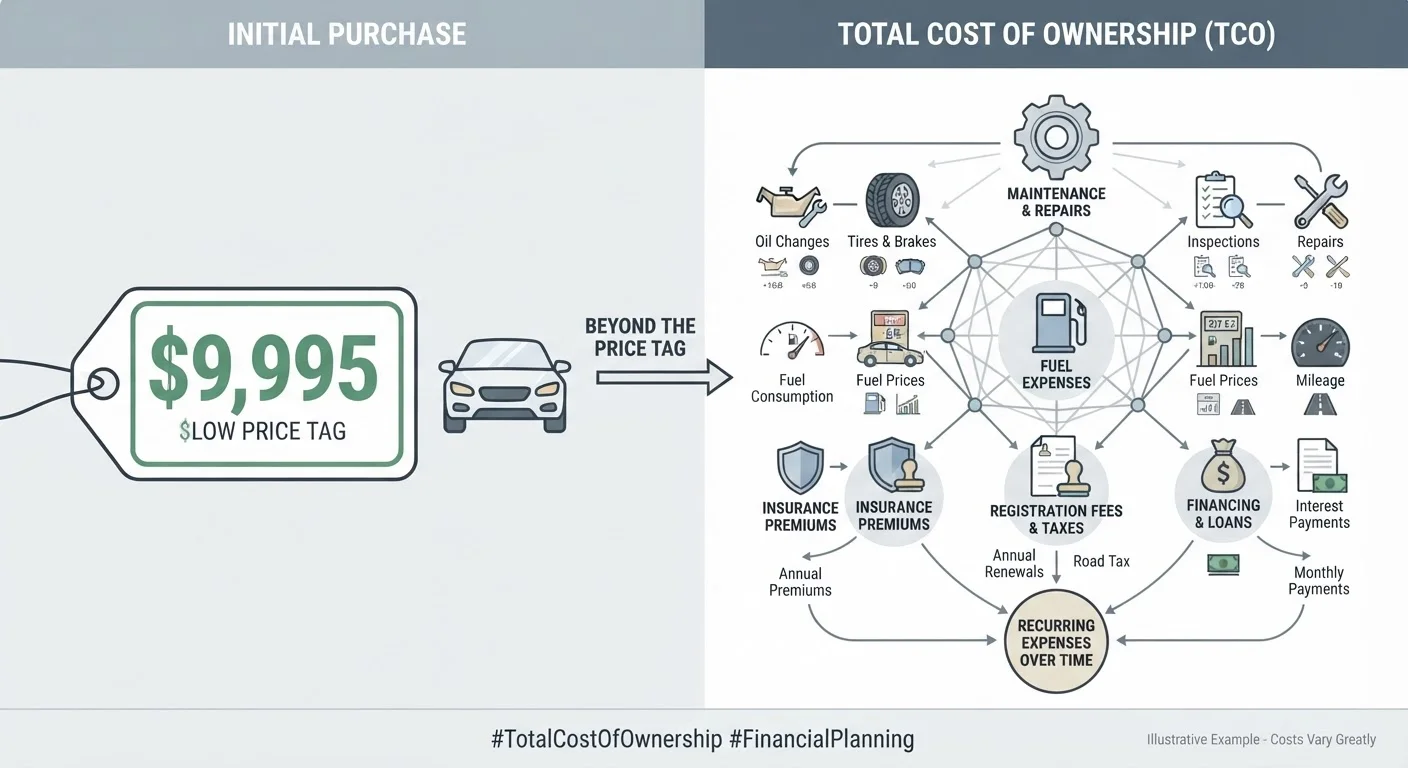
Why Purchase Price Is the Wrong Starting Point
When most people compare prices, they compare sticker prices. It's intuitive - the lower number looks like the better deal. But purchase price captures only the moment of acquisition. It says nothing about what happens during the months or years you actually use the thing you bought.
This gap is where TCO becomes essential. Two refrigerators sitting side by side in a store might differ by $200 upfront. But if one draws significantly more electricity over a decade, that gap can reverse entirely. The same pattern repeats across product categories: vehicles, HVAC systems, power tools, printers, even mattresses. Running costs are silent at the point of sale and loud in your monthly budget.
For a broader foundation on comparing prices intelligently, see how price comparison tools work before diving deeper into TCO.
2-3×
Vehicle lifetime costs vs. purchase price
Industry analyses of consumer vehicle ownership consistently find that total lifetime costs - fuel, insurance, maintenance, and depreciation - run two to three times the original purchase price over a typical ownership period.
~30%
Appliance lifetime cost from energy use
The U.S. Department of Energy has noted that energy consumption accounts for a significant share of an appliance's lifetime cost, often rivaling or exceeding its purchase price over a decade of use.
The Components of a Complete Ownership Cost
A practical TCO estimate for any durable purchase breaks down into five categories:
- Acquisition cost: Purchase price plus taxes, delivery, installation, and any setup fees.
- Operating costs: Fuel, electricity, water, or consumables consumed during normal use.
- Maintenance: Scheduled servicing, filter replacements, software subscriptions, and routine upkeep.
- Repairs and unplanned costs: Parts, labor, and the cost of downtime when something fails.
- Disposal and resale: What you recover at end of life - or what it costs to dispose of the item responsibly.
Not every category applies to every purchase. A cordless drill has negligible operating costs but meaningful battery replacement costs. A vehicle is dominated by fuel, insurance, and depreciation. Identifying the two or three categories that carry the most weight for your specific purchase focuses the analysis where it matters.
For vehicle ownership specifically, reducing vehicle ownership expenses covers practical ways to control those recurring line items once you're past the purchase decision.
How to Build a Simple TCO Estimate
You don't need a spreadsheet template or financial software. A back-of-envelope TCO estimate has three steps:
- Set an ownership horizon. How long do you realistically expect to own this item? Three years for a laptop, ten for an appliance, five to eight for a vehicle are reasonable defaults.
- List and quantify annual costs. Energy costs are often available from Energy Star ratings or manufacturer specs. Maintenance schedules appear in owner's manuals. Insurance quotes are obtainable in minutes - for auto coverage, understanding car insurance costs provides useful context.
- Account for resale or disposal. Check used-market prices for comparable models at your expected exit point. Subtract that figure from total costs to get net TCO.
Divide the net figure by your ownership years to get an annual cost. That number is what you're actually comparing between options - not the price on the tag.
Start With the Two Biggest Cost Drivers
For any durable purchase, identify the two categories most likely to dominate lifetime cost - for vehicles it's typically fuel and depreciation, for appliances it's energy. Estimating just those two accurately gets you 80% of the way to a useful TCO comparison without requiring exhaustive research on every line item.
TCO in Practice: Where It Changes the Decision
TCO analysis most often reverses conventional price comparisons in a handful of categories. Vehicles are the clearest example - depreciation, fuel, insurance, and maintenance routinely total two to three times the purchase price over a typical ownership period. A vehicle priced modestly but with high fuel consumption and expensive parts can cost substantially more than a pricier model with the opposite profile.
Appliances are a close second. Energy-efficient models carry a premium at retail but return it through utility savings. Home heating and cooling systems follow the same logic at larger scale: installation cost and efficiency rating together determine decade-long expense far more than the equipment price alone.
Electronics - particularly printers - are a well-documented case where the hardware price actively obscures the real cost structure, which sits almost entirely in consumables.
For a fuller grounding in the vocabulary behind these comparisons, key price comparison terms and effective comparison strategies are worth reviewing alongside TCO methodology.
“The price you pay to acquire something is rarely the price you pay to own it. Consumers who evaluate only the former are systematically misinformed about the true cost of their choices.”
— Consumer Financial Education Research, General principle cited across personal finance and consumer economics literature