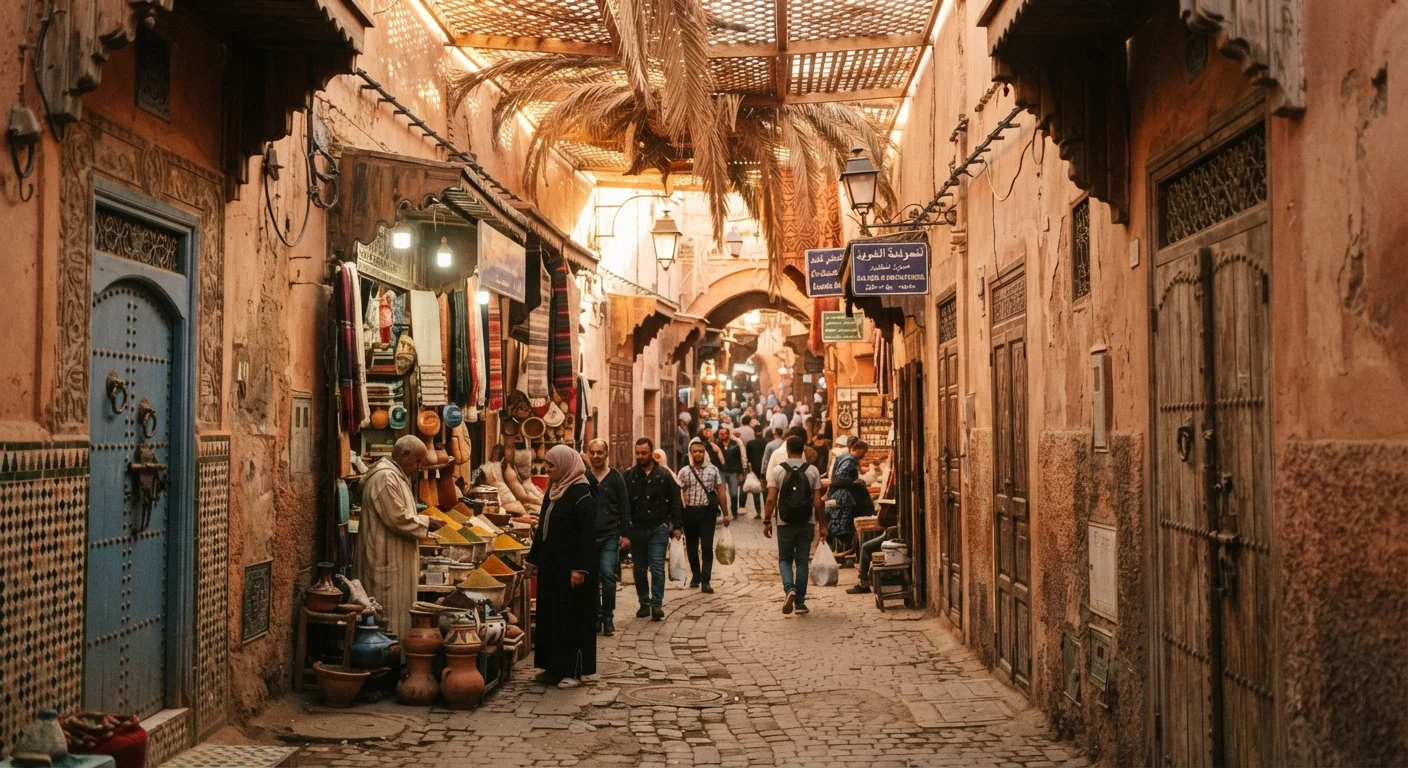
Why Medinas Feel Deliberately Confusing
Medinas were engineered over centuries to serve the communities living inside them, not to orient outsiders. The layout follows a functional logic: major arteries (derbs) connect the main gates to the central mosque and market, while smaller residential lanes branch off into dead-ends that served specific family compounds or craft guilds. A street that sells nothing but copper lanterns isn't a quirk - it reflects centuries-old zoning by trade.
Walls are high to keep summer heat out. Lanes are narrow to provide shade. Turns are frequent to slow wind. Once you recognize that the design was rational for its context, the medina stops feeling chaotic and starts feeling like a system - just one that requires patience to decode.
Medinas Are Not Uniform Across Morocco
Visitors often assume the medina experience is consistent across Moroccan cities, but size, density, and commercial character vary considerably. Fez's medina is vast and complex; Asilah's is compact and easily walkable in an afternoon. Researching the specific medina you're visiting - not just 'Moroccan medinas' generally - will give you much more accurate expectations for navigation and time planning.
The Anatomy of a Moroccan Medina
Every substantial medina shares a rough organizational structure, even if the specifics vary by city:
- Bab (gate): The main entry points through the old city walls. Knowing which bab is nearest to your accommodation is your most important navigational anchor.
- Jemaa or central mosque: The main mosque anchors the medina's geographic and social center. Major commerce clusters nearby.
- Souks: Markets organized by product type - textiles, spices, leather, metalwork. Different souk zones are often geographically clustered.
- Fondouks: Historic caravanserai-style buildings that once housed traveling merchants. Many still exist in Fez and Marrakech as workshops or cultural spaces.
- Derbs: Residential lanes, often gated or narrowing sharply, that indicate a transition from commercial to private space.
When you understand this hierarchy, you can use it to reorient: heading toward noise and foot traffic usually means moving toward the commercial core, while narrowing lanes and fewer vendors signal residential territory.
~280 ha
Area of Fès el-Bali, one of the world's largest car-free urban zones
UNESCO documentation estimates the Fez medina covers approximately 280 hectares and contains over 9,000 streets and lanes.
9
Moroccan medinas listed as UNESCO World Heritage Sites
Morocco has multiple UNESCO-recognized historic urban areas, including Fez, Marrakech, Meknes, Tétouan, and Essaouira, among others.
5
Daily prayer calls that shape medina rhythms
Islamic prayer times - which occur five times daily - visibly affect commercial activity and foot traffic patterns throughout Moroccan medinas.
Practical Orientation Strategies That Actually Work
Before entering any large medina, take 15 minutes to study an offline map and identify: the gate nearest your hotel, the location of the main mosque or central square, and at least one distinctive landmark (a large fountain, a painted doorway, a specific souk entry). These three points create a mental triangle you can navigate between even when lanes seem to loop back on themselves.
Inside the medina, move deliberately. Pausing to check your phone in the middle of a narrow lane blocks foot traffic and signals uncertainty - find a doorway alcove to step into. If you need directions, ask shopkeepers rather than individuals who approach you first. Shopkeepers are stationary, have long-term reputations in the neighborhood, and tend to give reliable answers.
Use Landmarks, Not Street Names
Most medina lanes have no posted signage, and street names that appear on maps often don't appear on walls. Instead, anchor your navigation to visible, stable landmarks - a blue-tiled fountain, a particular souk archway, a painted gate. These are far more reliable than address-based navigation in a pre-modern urban grid.
On your first full day, walk one route repeatedly - from your accommodation to one destination and back - until it becomes automatic. This creates a navigational baseline that makes all subsequent exploration less disorienting.
Social Norms Visitors Frequently Miss
Medinas operate on social codes that aren't posted anywhere but are consistently observed by residents. A few that matter most for visitors:
- Photography requires judgment: Photographing people - particularly women, religious spaces, or private courtyards - without explicit consent is considered intrusive. Ask first, and accept a refusal graciously.
- Negotiation has boundaries: Bargaining in souks is standard practice, but opening an extended negotiation without genuine intent to buy wastes a seller's time and is considered disrespectful. Browse freely, but only engage in negotiation if you're seriously interested.
- Entering private derbs: If a lane narrows significantly and you see a gate or children playing, you're likely at the edge of a private residential derb. Technically these aren't public thoroughfares - turn back.
- Prayer times affect access: During the five daily prayers, some vendors close briefly and movement near mosques slows. Build flexibility into your schedule rather than treating these periods as obstacles.
None of these norms require elaborate preparation - they're extensions of basic spatial and social awareness. Residents generally extend patience to visitors who demonstrate genuine respect, even when language is a barrier.