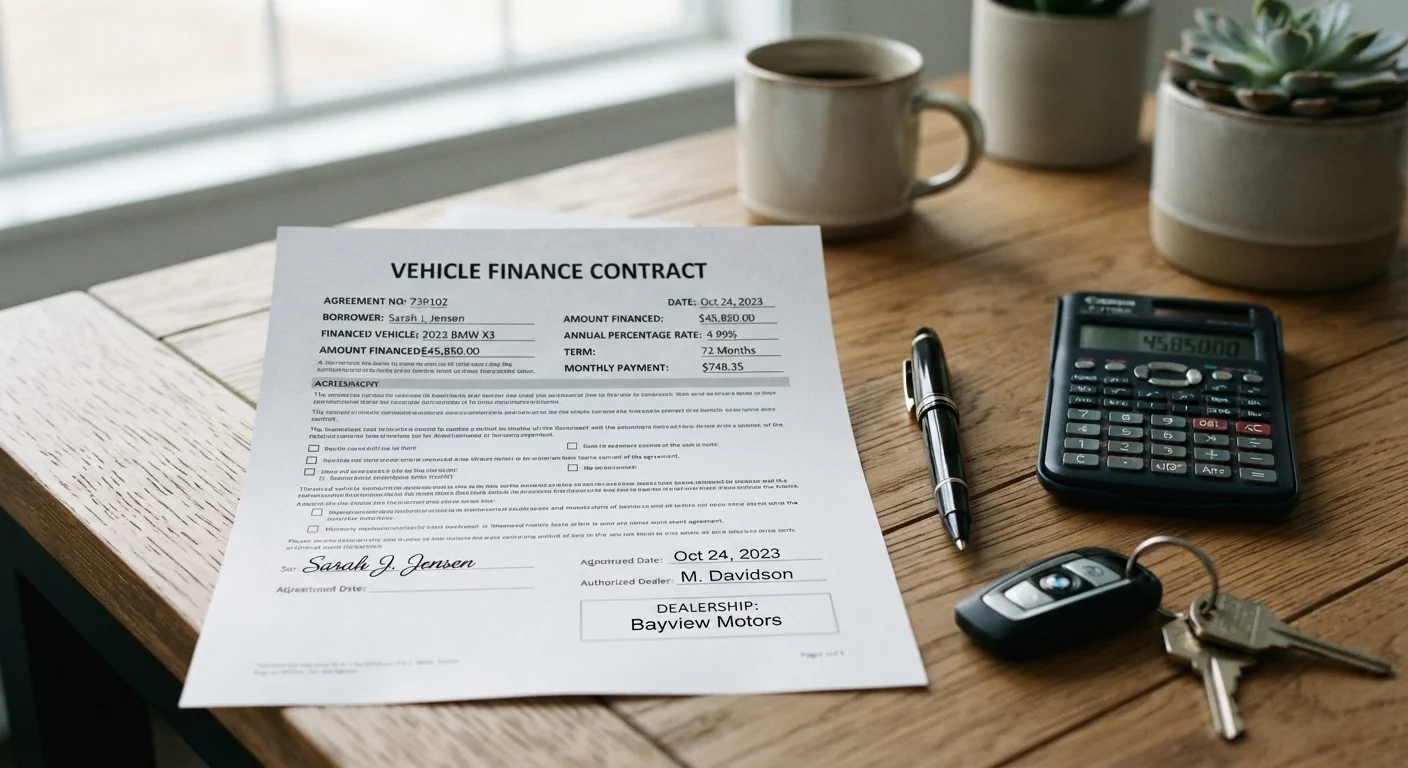
How an Auto Loan Actually Works
An auto loan is a secured installment loan: you borrow a fixed amount (the principal), agree to repay it over a set number of months, and pay interest on the outstanding balance along the way. The vehicle itself serves as collateral, meaning the lender can repossess it if you default.
Each monthly payment is split between interest and principal. Early in the loan, a larger share goes toward interest. As the balance falls, more of each payment chips away at principal - this is called amortization. Understanding this front-loaded structure explains why paying extra early in a loan has an outsized effect on total cost.
For context on how your overall debt picture connects to an auto loan, see our complete guide to managing personal debt.
Principal
The original amount of money you borrow, not counting any interest. Your payments gradually reduce the principal over the life of the loan.
APR (Annual Percentage Rate)
The yearly cost of a loan expressed as a percentage, incorporating both the interest rate and most lender fees. Use APR - not just the interest rate - when comparing loan offers.
Amortization
The process of paying off a loan through scheduled payments over time. Early payments skew toward interest; later payments skew toward principal.
Loan Term
The length of time you have to repay a loan, usually expressed in months. A longer term means lower monthly payments but more total interest paid.
Loan-to-Value Ratio (LTV)
The loan amount divided by the vehicle's value. A lower LTV - achieved with a larger down payment - reduces lender risk and may help you qualify for a better rate.
Underwater (Negative Equity)
When you owe more on a loan than the asset is currently worth. This can happen with long-term auto loans because vehicles depreciate faster than early loan balances shrink.
What APR Really Means
APR (Annual Percentage Rate) is the yearly cost of borrowing, expressed as a percentage, that folds in both the stated interest rate and most lender fees. It is the single most useful number for comparing loan offers apples-to-apples because a loan with a low interest rate but high origination fees can end up costing more than one with a slightly higher rate and no fees.
For example, a $25,000 loan at 6% APR over 60 months produces a fixed monthly payment of roughly $483, with approximately $4,000 in total interest paid. The same principal at 9% APR over the same term costs about $520 per month and roughly $6,200 in total interest - a difference of over $2,200 for the same vehicle.
APR vs. Monthly Payment: Don't Confuse the Two
Dealers often present financing in terms of monthly payment rather than APR, because a lower payment sounds appealing even if the loan is more expensive overall. Always ask for the full APR, the loan term, and the total amount repaid before comparing offers. These three numbers together tell the real story.
When shopping, ask lenders for the APR in writing, not just the monthly payment figure. A low payment stretched over a long term can disguise a high APR.
How Loan Term Length Affects Total Cost
Loan terms for new vehicles commonly range from 36 to 84 months. Stretching a loan reduces the monthly payment, which appeals to budget-conscious buyers - but the math works against you over time.
| Term | Monthly Payment (est.) | Total Interest Paid (est.) |
|---|---|---|
| 48 months | ~$587 | ~$2,200 |
| 60 months | ~$483 | ~$4,000 |
| 72 months | ~$415 | ~$4,900 |
Estimates based on a $25,000 loan at 6% APR. Actual figures vary by lender and credit profile.
There is also an equity risk with long terms: vehicles depreciate faster than loan balances shrink in the early years, leaving some borrowers temporarily underwater - owing more than the car is worth. This becomes especially relevant if you need to sell, trade in, or if the car is totaled. For a side-by-side view of financing versus leasing, see Leasing vs. Buying a Car.
Key Factors That Influence Your Rate
Lenders weigh several variables when setting your APR:
- Credit score: This is typically the dominant factor. Higher scores signal lower default risk and unlock lower rates. See Credit Scores Explained for a plain-language breakdown of how scoring works.
- Loan-to-value (LTV) ratio: A larger down payment reduces LTV, reducing lender risk.
- Loan term: Longer terms often carry slightly higher rates because lender risk increases over time.
- Vehicle age: Rates on used vehicles tend to be higher than on new ones because older cars depreciate faster and are harder to value as collateral.
- Lender type: Banks, credit unions, and dealership financing arms each have different risk models and rate structures. Credit unions in particular often offer competitive rates to members.
Get Pre-Approved Before You Shop
Arriving at a dealership with a pre-approval letter from a bank or credit union puts you in a stronger negotiating position. It sets a concrete APR ceiling and keeps the conversation focused on vehicle price rather than monthly payment manipulation. Most pre-approvals involve only a soft or single hard credit inquiry.
Strategies to Reduce Total Interest Paid
You have more leverage over your total loan cost than most buyers realize. A few practical approaches:
- Put money down. Even 10% down on a $25,000 vehicle reduces your financed principal to $22,500, trimming total interest from the start.
- Choose the shortest term you can comfortably afford. The monthly payment will be higher, but total interest paid drops significantly.
- Make one extra payment per year. Apply it directly to principal. On a 60-month loan this can shave several months off the term at no additional cost.
- Check your credit before applying. Errors on your report can artificially lower your score. Dispute inaccuracies before lenders pull your file.
- Get pre-approved before visiting a dealer. Pre-approval gives you a benchmark APR and shifts the negotiation toward total vehicle price rather than monthly payment.
Understanding auto loan math is also useful context when comparing your car financing costs against total vehicle ownership expenses, including auto insurance coverage.
This article is for general informational purposes only and does not constitute personalized financial or legal advice. Loan terms, rates, and eligibility vary by lender and individual circumstances. Consult a licensed financial professional before making borrowing decisions.