A Term Without a Definition
Walk through any grocery store and you'll see "clean" splashed across packaging - clean ingredients, clean label, clean eating approved. Despite its prevalence, "eating clean" carries no standardized, scientific, or regulatory definition. It is a cultural shorthand, not a clinical term.
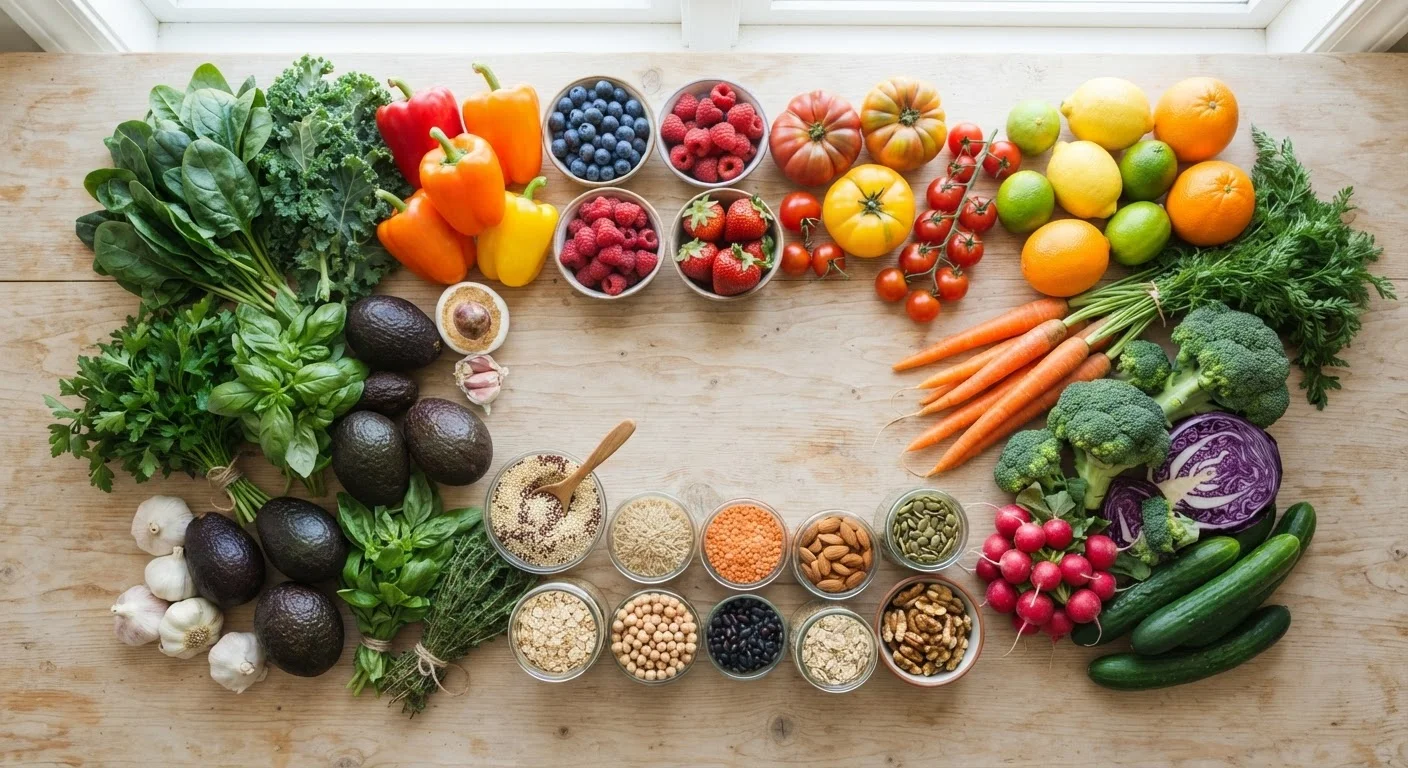
In its broadest, most grounded interpretation, eating clean describes a pattern that emphasizes whole or minimally processed foods - vegetables, fruits, legumes, whole grains, lean proteins, and healthy fats - while limiting foods that are heavily refined, high in added sugars, or contain long lists of additives with little nutritional purpose. That framing aligns reasonably well with mainstream dietary guidance. If you're new to thinking about nutrition, starting with balanced eating fundamentals offers a clearer, evidence-grounded foundation than any single food philosophy.
The trouble begins when the concept is stretched beyond that practical core - into rigid rules, moral judgments about food, and sweeping prohibitions that the science doesn't support.
Common Myths About Clean Eating - Corrected
Because "eating clean" is defined differently by different communities, it has accumulated a set of persistent myths that are worth addressing directly. Understanding what the evidence actually says helps separate useful habits from unnecessary restriction.
Myth
All processed foods are harmful and should be avoided entirely.
Fact
Processing exists on a wide spectrum, and many processed foods are nutritious and safe. The concern centers on ultra-processed foods, not processing itself.
Canned beans, frozen vegetables, pasteurized milk, and rolled oats are all processed - yet all carry well-established nutritional value. Food scientists and public health researchers distinguish between minimally processed foods (which retain most of their original nutrients) and ultra-processed products (industrial formulations with little whole-food content and high levels of added sugar, sodium, and refined fats). Avoiding all processing is neither practical nor necessary. The goal is to understand where on the spectrum a food falls, not to impose a blanket ban.
Myth
Eating clean means following a specific diet, like paleo, keto, or raw food.
Fact
No single named diet owns the concept. Clean eating principles can be applied within many different dietary frameworks.
Proponents of paleo, ketogenic, vegan, Mediterranean, and raw food diets have all claimed the "clean eating" label for their approach. This reveals how loosely the term is applied. Research on long-term dietary patterns consistently finds that several different eating styles - including Mediterranean, DASH, and plant-forward diets - are associated with positive health outcomes. No single framework has a monopoly on healthy eating, and rigid adherence to a named diet is not required to eat nutritiously.
Myth
"Natural" or "organic" labels on packaging mean a food qualifies as clean.
Fact
These labels have specific, limited regulatory meanings that do not equate to overall nutritional quality.
In the United States, the USDA regulates the term "organic" in relation to farming and production practices - it does not certify a food as nutritionally superior. "Natural" has an even weaker regulatory definition and can appear on products that are heavily sweetened or refined. A cookie made with organic cane sugar is still a cookie. Packaging language is designed for marketing purposes; the nutrition facts panel and ingredient list provide more actionable information than front-of-package claims.
Myth
Clean eating requires avoiding all sugar, including sugar from fruit.
Fact
Whole fruits contain fiber, vitamins, and phytonutrients that substantially change how their sugars are metabolized compared to added sugars.
The scientific and public health consensus on added sugars - those added during processing or preparation - is well established: high intake is associated with increased risk of several chronic conditions. Whole fruits, however, are consistently associated with positive health outcomes in population research, even though they contain naturally occurring sugars. The fiber matrix of whole fruit slows sugar absorption and provides additional nutritional benefits. Treating a banana and a candy bar as equivalent because both contain sugar misreads the evidence significantly.
Myth
If you eat clean enough, you don't need to worry about portion size or overall dietary balance.
Fact
The overall pattern and quantity of food consumed matter alongside food quality. No single eating style overrides the need for dietary balance.
Nutritional science has consistently found that total dietary pattern - the variety, quantity, and combination of foods eaten over time - is a stronger predictor of health outcomes than any single food or nutrient. Even foods considered "clean" can contribute to nutritional imbalance if the overall diet lacks variety or disregards proportions. A focus on food quality is valuable, but it works best alongside attention to dietary diversity and overall eating patterns, not as a replacement for them.
What the Evidence Actually Supports
Decades of nutritional epidemiology consistently support a few durable principles that map onto the constructive parts of clean eating: eating more vegetables and fruit, choosing whole grains over refined ones, favoring protein sources that carry other nutrients (like legumes and fish), and limiting ultra-processed foods high in added sugar, sodium, and refined starch.
~57%
Of US calories from ultra-processed foods
Research published in BMJ Open estimated that ultra-processed foods account for roughly 57% of energy intake in the average American diet.
5+ servings
Fruit and vegetable intake linked to lower mortality
A meta-analysis published in Circulation found that consuming five daily servings of fruits and vegetables was associated with lower risk of cardiovascular disease and all-cause mortality.
What the evidence does not support is treating every departure from this pattern as dangerous, or believing that a single category of food - carbohydrates, dairy, gluten for non-celiac individuals - is the primary driver of poor health outcomes for the general population. The distinction between whole foods and processed foods is real and useful, but it exists on a spectrum, not a binary.
Learning to read a nutrition label accurately is a practical skill that serves this goal better than memorizing a list of "forbidden" ingredients. And being aware of common nutrition pitfalls can help you avoid the well-intentioned habits that quietly undermine an otherwise sound diet.
When 'Clean Eating' Becomes Harmful
For some individuals, rigid clean-eating rules can contribute to an unhealthy preoccupation with food purity - a pattern sometimes associated with orthorexia nervosa, a disordered eating behavior. If food choices are causing significant anxiety, social withdrawal, or distress, that is a sign to seek support from a qualified healthcare or mental health professional. Healthy eating should support wellbeing, not undermine it.
This article is for general informational and educational purposes only and does not constitute medical or nutritional advice. Consult a qualified healthcare professional or registered dietitian for guidance tailored to your individual health needs.