How Each Framework Works
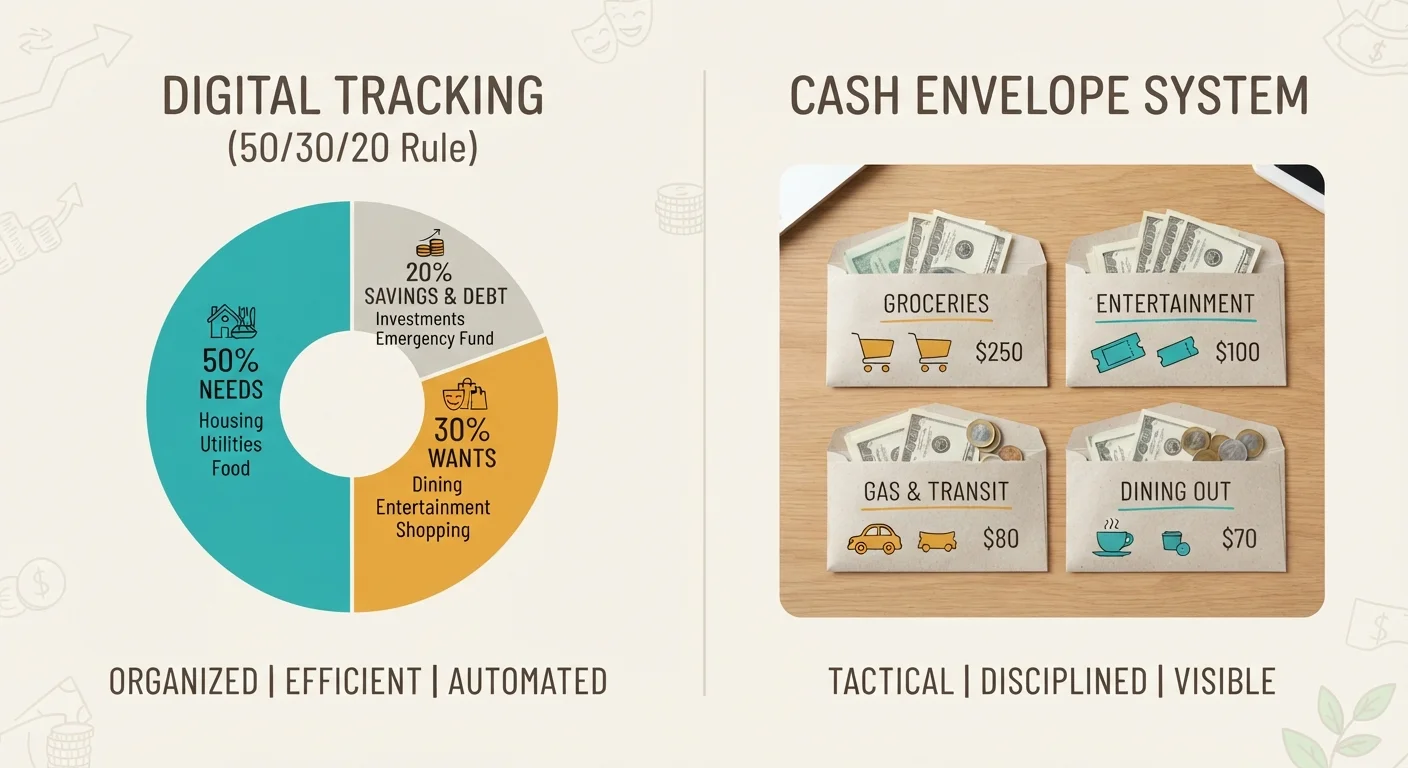
The 50/30/20 rule, popularized in personal finance literature, divides your monthly after-tax income into three broad buckets: 50% toward needs (rent, utilities, groceries, minimum debt payments), 30% toward wants (dining out, subscriptions, entertainment), and 20% toward savings and debt repayment beyond minimums. You track totals against these percentages - category-level line items are optional.
Envelope budgeting works differently. Before the month begins, you calculate your expected income and divide a fixed dollar amount into specific spending categories - groceries, gas, clothing, dining, and so on. Traditionally, these were physical cash envelopes; today, most people replicate the system digitally using spreadsheets or apps. When an envelope empties, spending in that category stops until the next month.
Both frameworks share the same underlying goal: make spending intentional. But they differ sharply in granularity and effort. For a broader look at how these fit within the wider landscape of budgeting approaches, see the complete guide to building a spending plan.
| Criterion | 50/30/20 Rule | Envelope Budgeting |
|---|---|---|
| Core structure | 3 broad percentage buckets | Fixed dollar amounts per category |
| Setup time | 10-15 minutes initially | 30-60 minutes per month |
| Ongoing effort | Low - periodic total check | High - category tracking required |
| Spending control precision | Broad, bucket-level | Granular, category-level |
| Best income type | Stable or variable | Stable preferred |
| Overspending guardrails | Soft - awareness-based | Hard - empty envelope stops spending |
| Flexibility | High - percentages adapt easily | Lower - categories need resetting |
| Learning curve | Minimal | Moderate |
Where Each Method Excels - and Struggles
The 50/30/20 rule's strength is low friction. Because it works with percentages rather than line-item amounts, it survives income fluctuations with minimal recalculation. A freelancer whose pay varies month to month can apply the same percentages to whatever they earn. The trade-off: broad buckets can mask overspending. If 30% of a $5,000 monthly income ($1,500) is allocated to wants, nothing stops someone from spending $900 of that on dining alone - unless they're consciously tracking sub-categories.
Envelope budgeting solves that problem directly. Because each category has its own finite pool, there's no ambiguity: when the dining envelope reaches zero, the spending stops. Research in behavioral economics suggests that when spending feels more tangible - even digitally - people tend to treat money more carefully. The friction is the feature.
The drawback is maintenance. Envelope budgeting requires more upfront setup and monthly recalibration, especially if your income varies. It also demands discipline when envelopes run dry mid-month - the temptation to borrow from another envelope is a common failure point.
~74%
Americans living paycheck to paycheck
A 2023 LendingClub report estimated roughly three in four Americans struggle to save consistently, underscoring the practical need for structured spending frameworks.
33%
Budgeters who quit within 3 months
Research from the National Endowment for Financial Education has consistently found that complexity is a leading reason people abandon budgeting systems early.
For a system that takes granular control even further, zero-based budgeting assigns a purpose to every single dollar of income, leaving nothing unallocated - a useful comparison point when evaluating how much structure you actually need.
Choosing the Right Fit and Getting Started
The most effective budgeting method is the one you'll actually maintain. Use these questions to guide your choice:
- Do you overspend in specific categories? If yes, envelope budgeting's hard limits are likely more effective than broad percentages.
- Is your income stable or variable? The 50/30/20 rule scales more naturally with fluctuating income; envelope budgeting requires recalculating category amounts each month.
- How much time can you realistically commit? If a 15-minute monthly setup is your ceiling, the 50/30/20 rule is the practical choice.
- Are you tracking alone or with a partner? Shared envelope categories create clear, jointly visible rules that reduce household disagreements.
Whichever framework you choose, consider pairing it with a monthly review. A structured self-check - comparing actuals to your targets - catches drift before it compounds. Our monthly budget health check checklist gives you a step-by-step process to do exactly that.
On the tools side, deciding whether to manage your chosen framework in a spreadsheet or a budgeting app matters too. Each has meaningful trade-offs in automation, flexibility, and visibility - a comparison covered in depth in our spreadsheets vs. budgeting apps guide.
Finally, if you're working toward broader savings goals - such as building an emergency fund or cutting everyday costs - the Saving & Deals hub offers practical strategies that complement either budgeting framework.
This article provides general financial information and education only. It is not personalised financial advice. For guidance tailored to your individual situation, consider consulting a licensed financial adviser.