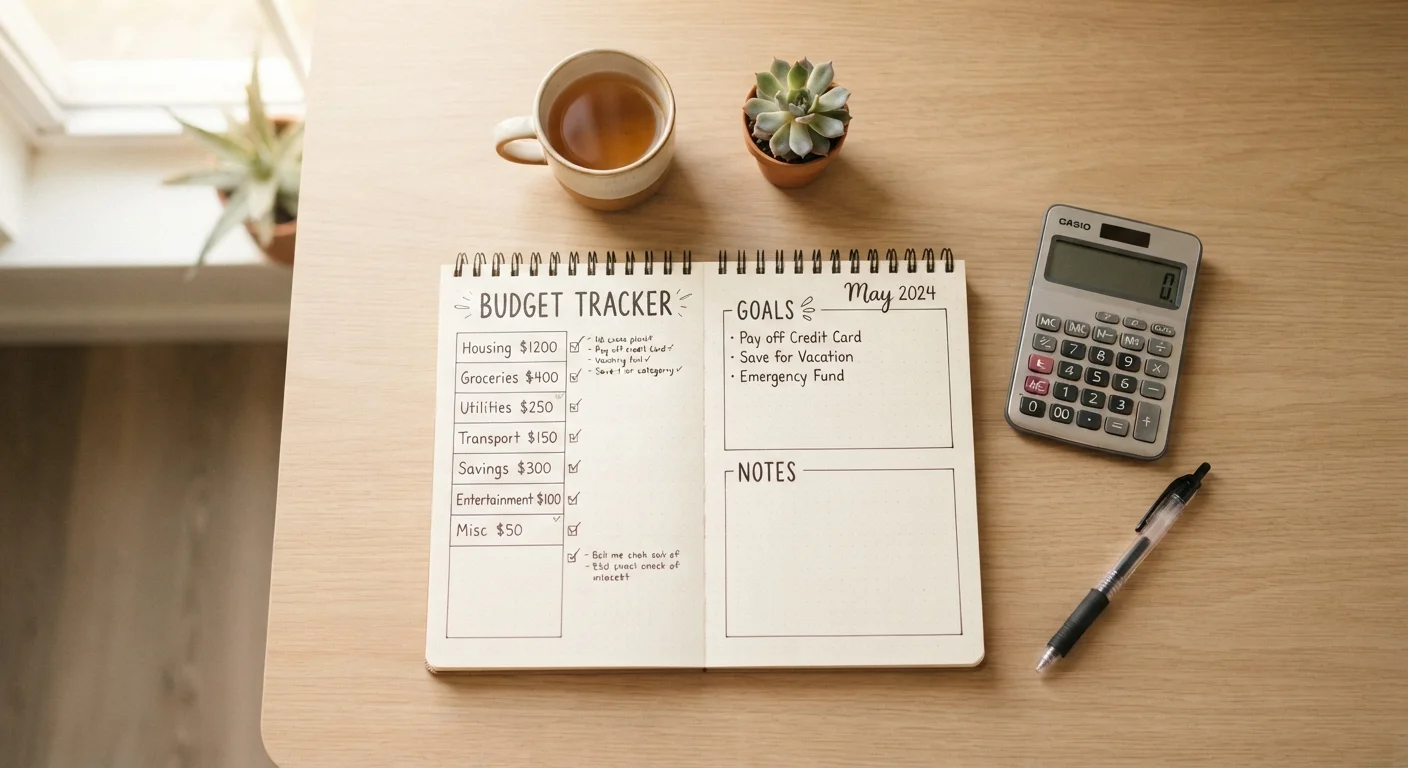
Why a First Budget Is Worth the Effort
Most people overestimate how complicated budgeting is and underestimate how quickly it pays off. A monthly budget is simply a plan that tells your money where to go before the month begins - rather than wondering where it went afterward. If you're new to managing your finances, understanding the fundamentals first can make the steps below click faster.
The goal here isn't perfection. Your first budget will be approximate - and that's fine. What matters is establishing the habit of looking at your numbers clearly and making intentional choices. Even an imperfect budget puts you ahead of operating purely on instinct.
What you will need
How to Build Your Budget: Step by Step
Gather your statements and open your spreadsheet or app. Work through each step in order - skipping ahead tends to produce a budget built on assumptions rather than real data.
Bank and credit card statements
Provide the raw spending data you need to categorize past expenses accurately.
Spreadsheet (e.g., Google Sheets or Excel)
Organizes income and expense categories in a format you can update monthly.
Budgeting app
Automates transaction imports and category tracking, reducing manual data entry.
Calculator
Helps verify totals and percentage breakdowns without relying on mental arithmetic.
Calculate your net monthly income
Begin with what actually lands in your bank account each month - after taxes, insurance premiums, and any other payroll deductions. If you're salaried, this is straightforward. If your income varies (freelance, hourly, commission), use an average of the last three months as your baseline. Include all sources: wages, side income, government benefits, or regular support payments.
List every fixed expense
Fixed expenses are the same amount each month: rent or mortgage, car payment, insurance premiums, loan minimums, and subscription services at a set rate. Pull these directly from your statements. Write down the exact amount and the due date for each. These are non-negotiable line items - your budget must cover them before anything else.
Estimate your variable expenses
Variable expenses change month to month: groceries, gas, dining out, entertainment, clothing, and personal care. Review two to three months of statements and calculate an average for each category. Be honest - underestimating here is the most common first-budget mistake. Group similar items together (e.g., all food-related spending in one category) to keep things manageable.
Apply a budgeting framework to set targets
Once you know your income and spending baseline, choose a structure. The 50/30/20 rule is a practical starting point: allocate roughly 50% of net income to needs (housing, utilities, food, transport), 30% to wants (dining, entertainment, subscriptions), and 20% to savings and debt repayment beyond minimums. Adjust percentages to fit your actual situation - these are guidelines, not rules carved in stone.
If you want every dollar explicitly assigned, explore zero-based budgeting, which takes a more granular approach.
Add a buffer for irregular and unexpected costs
Every budget needs a miscellaneous or emergency buffer - even a small one. Aim for at least $50-$100 per month dedicated to unexpected costs: a co-pay, a parking ticket, a broken appliance. Over time, this buffer builds toward a fuller emergency fund. Treating it as a planned expense (not leftover money) is what separates a budget that survives real life from one that collapses at the first surprise.
Balance income against total expenses
Add up all your budgeted categories - fixed, variable, savings, buffer - and compare the total to your net income. If expenses exceed income, you have a deficit: identify variable categories where you can reduce targets. If income exceeds expenses, that surplus should be deliberately assigned (additional savings, debt payoff, or specific goals) rather than left vague, where it tends to disappear into untracked spending.
Track, review, and adjust monthly
A budget written once and never revisited doesn't work. Set a recurring time each month - even 15 minutes - to compare actual spending against your targets. Note which categories you over- or underspent, and adjust next month's targets accordingly. After two or three cycles, your estimates will become noticeably more accurate. Use the monthly budget health check to make this review systematic.
This article is for general informational purposes only and does not constitute personalized financial advice. Consult a qualified financial professional for guidance specific to your circumstances.
Keeping Your Budget Working Over Time
The seven steps above get your budget built. Sustaining it requires consistency. A few habits that experienced budgeters rely on: review spending weekly in five-minute check-ins, reassign any surplus deliberately at month-end, and revisit your full budget whenever your income or major expenses change significantly.
As your budget matures, you may want to explore related areas - for example, how your vehicle costs fit into your overall plan (see managing car costs and savings), or how to build on your budgeting foundation with practical saving strategies. For a comprehensive look at every phase of the budgeting process, the complete budgeting guide covers it all in one place.
Give Your Budget Three Months to Stabilize
The first month's budget will almost certainly be off - that's expected, not a failure. Most people find their category estimates become reliably accurate after two to three full cycles of tracking and adjusting. Treat month one as a data-gathering exercise, not a pass/fail test.