Where Home Energy Budgets Actually Go
For most US households, energy is one of the largest fixed monthly expenses - yet it rarely gets the same scrutiny as groceries or subscriptions. The U.S. Energy Information Administration (EIA) estimates that heating and cooling alone account for roughly half of a typical home's energy consumption. Understanding the breakdown is the starting point for any meaningful reduction.
| Share of energy used for heating & cooling | ~50% of home energy use (U.S. Energy Information Administration (EIA)) |
| Water heating share | ~18% of home energy use (U.S. Department of Energy) |
| Phantom load (standby power) | Up to 10% of electricity bill (Lawrence Berkeley National Laboratory estimate) |
| Potential savings from thermostat setbacks | Up to 10% on heating/cooling (U.S. Department of Energy guidance) |
| Average US household annual energy spend | Approximately $2,000 (EIA, Residential Energy Consumption Survey) |
The pattern is consistent across climates: thermal control dominates, followed by water heating, then appliances and lighting. Phantom loads - the electricity drawn by electronics in standby mode - add a smaller but persistent layer that compounds over 12 months. Like the small spending leaks that quietly erode a monthly budget, standby power rarely registers as a concern until someone actually measures it.
The Main Waste Sources, Explained
Energy waste at home typically falls into three categories: building envelope failures, inefficient equipment, and behavioral patterns.
Building Envelope
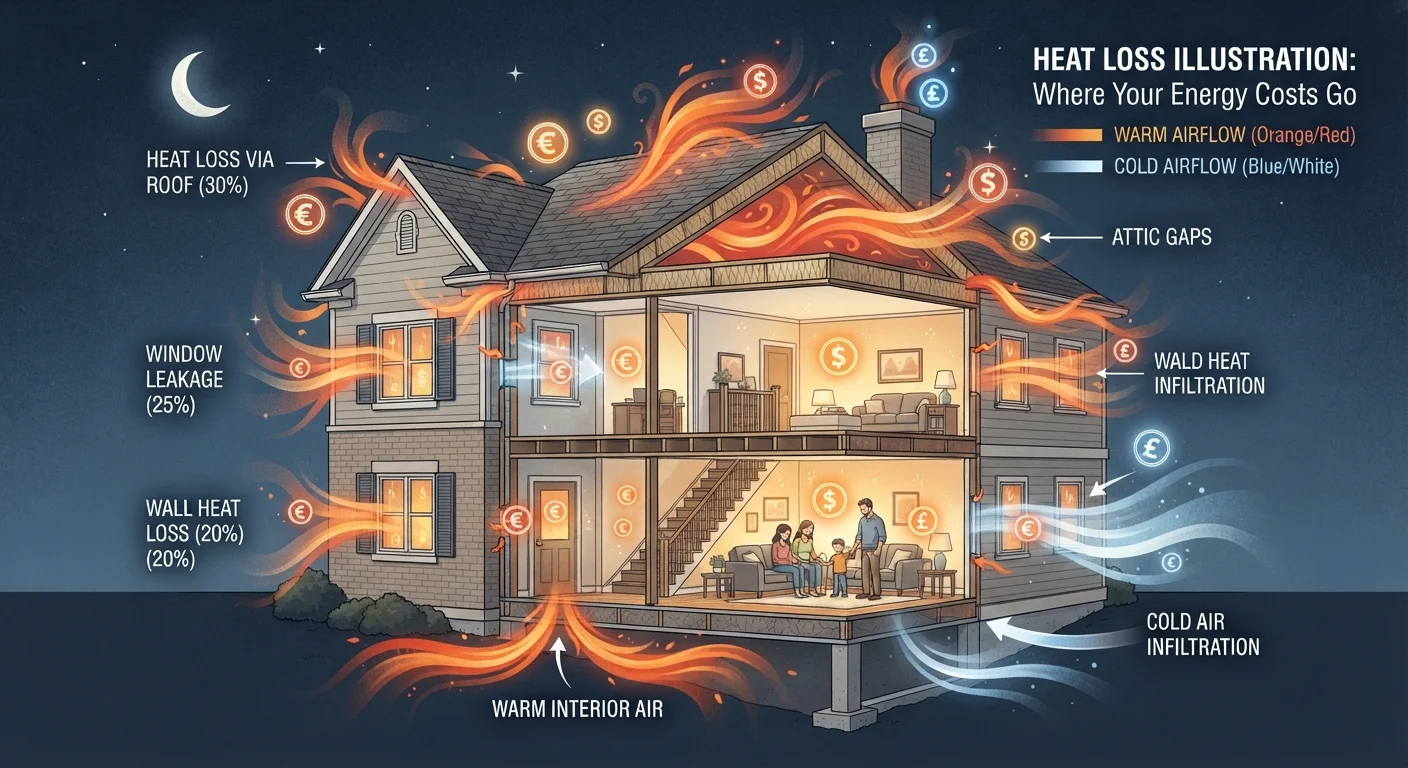
The building envelope - walls, roof, windows, doors, and foundation - is the primary barrier between conditioned interior air and the outside. Air leaks around window frames, door thresholds, and pipe penetrations are among the most common culprits. Attic insulation is a particular leverage point: heat rises, and an under-insulated attic can make a heating system work significantly harder than necessary. The economics of attic insulation are worth understanding before committing to any upgrade, since payback periods vary by climate zone and current insulation levels.
Equipment Efficiency
Older HVAC systems, water heaters, and large appliances often operate well below modern efficiency standards. A furnace from the early 2000s may convert only 78-80% of fuel to heat, while current high-efficiency models can reach 95-98% AFUE (Annual Fuel Utilization Efficiency). Replacing aging equipment is a capital decision, not a quick fix - but knowing your appliances' efficiency ratings helps prioritize future spending.
Behavioral Patterns
Thermostat settings, shower duration, and leaving devices plugged in after full charge all affect the monthly bill. A programmable or smart thermostat that reduces heating and cooling during unoccupied hours is one of the most widely documented behavioral interventions, though exact savings depend on household routine and local utility rates.
Building envelope
The physical barrier between the conditioned interior of a home and the outside environment, including walls, roof, windows, doors, and foundation. A well-sealed envelope reduces unwanted heat transfer.
AFUE
Annual Fuel Utilization Efficiency - a percentage rating that measures how efficiently a furnace or boiler converts fuel to heat over a full year. Higher AFUE means less fuel wasted.
Phantom load
Electricity consumed by devices when they are switched off but still plugged in or in standby mode. Also called standby power or vampire power, it accumulates silently across many devices.
Time-of-use rate
A utility pricing structure where electricity costs vary by time of day - typically higher during peak demand hours and lower overnight. Shifting usage to off-peak hours can reduce bills.
Air sealing
The process of closing gaps, cracks, and penetrations in a home's building envelope to prevent uncontrolled air leakage. Common materials include weatherstripping, caulk, and spray foam.
Practical Steps Worth Prioritizing
Not every energy improvement requires significant upfront investment. A useful framework is to sequence actions by cost-to-impact ratio:
- Air sealing: Weatherstripping and caulking around windows, doors, and pipe penetrations is inexpensive and can be done without professional help in most cases. The EPA's ENERGY STAR program identifies this as one of the highest-return measures available.
- Thermostat management: Lowering the thermostat by 7-10°F for 8 hours a day - while sleeping or away - can yield meaningful savings over a heating season, according to the U.S. Department of Energy. Exact figures depend on home size, insulation, and climate.
- Water heater settings: Many water heaters ship set to 140°F. The DOE recommends 120°F for most households, which reduces standby heat loss and slows mineral buildup.
- Appliance audit: Identifying which older appliances are the heaviest consumers - typically refrigerators, clothes dryers, and older dishwashers - helps inform longer-term replacement planning.
- Utility programs: Many utilities offer free or subsidized home energy audits, rebates on efficient equipment, or time-of-use rate structures that reward shifting consumption to off-peak hours. Checking your utility's website is a straightforward starting point.
Energy overspend fits into the same pattern as other categories where households consistently overpay: the costs feel fixed until someone examines them closely. They rarely are.
This article is for general informational purposes only and does not constitute financial, legal, or professional home-improvement advice. Consult a qualified professional before undertaking significant home modifications or making major appliance investments based on your specific circumstances.