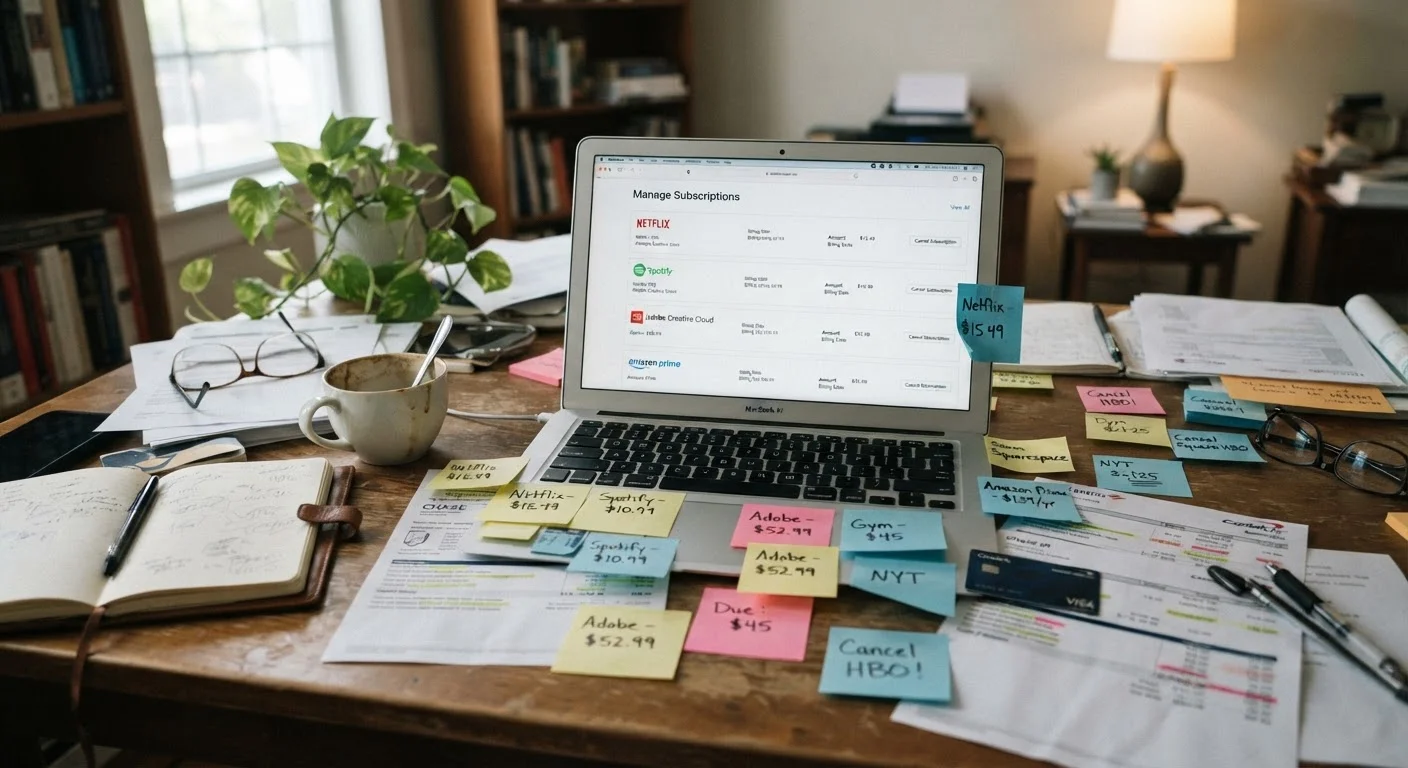
Why Unused Subscriptions Accumulate So Easily
Subscription billing is designed to be frictionless - which is precisely why it's so easy to keep paying for things you've stopped using. Charges are small enough individually that they rarely trigger scrutiny, yet they compound quietly across multiple services. This pattern is one of the most common spending leaks in a monthly budget, alongside convenience purchases and overlooked fees.
The underlying mechanics work against you: services often bill on renewal without a reminder, free trials convert automatically to paid plans, and annual subscriptions can go 11 months without appearing on a statement you're actively reading. The result is that the average household tends to underestimate its recurring software and media costs by a meaningful margin - not because people are careless, but because the system isn't built to surface the full picture.
Free Trials Become Paid Plans Automatically
Many subscription services convert free trials to paid memberships without a prominent reminder. If you signed up for a trial and didn't cancel before the deadline, you may be paying for a service you never actively chose to keep. Always check your statements within the first billing cycle after any trial period ends.
Subscriptions are also far from the only category where this happens. Other everyday spending categories follow a similar pattern of small, routine charges that escape notice until you sit down to look.
What You'll Need Before You Start
This audit doesn't require any special tools, though a few make the process faster.
What you will need
Bank or credit card online portal
Primary source for pulling transaction history and identifying recurring charges by merchant name.
Spreadsheet or notes app
Used to log each subscription, its monthly cost, and your decision to keep, pause, or cancel.
Subscription tracking app
Optional tool that aggregates recurring charges from linked accounts to surface forgotten services automatically.
Email search
Search your inbox for terms like 'subscription', 'renewal', or 'receipt' to catch services not appearing on recent statements.
A subscription tracking app can automate part of the discovery step, but treat it as a supplement rather than a replacement for reviewing your actual statements - aggregation tools sometimes miss charges or misidentify merchants.
How to Audit and Act on Your Subscriptions
Follow the steps below in order. The first three are about discovery; the last three are about decision-making and follow-through.
Pull three months of statements from every account
Log in to each bank account and credit card portal you use and download or review the last three months of transactions. Three months is the right window - long enough to catch quarterly billing cycles, short enough to stay manageable. Look specifically for any charge that recurs at regular intervals: monthly, quarterly, or annually.
List every recurring charge with its amount and frequency
Create a simple log: merchant name, charge amount, billing frequency (monthly or annual), and the date of the most recent charge. Include everything - streaming services, cloud storage, news outlets, fitness apps, software tools, and any membership fees. Don't filter yet; get everything on paper first.
Check your email for additional subscriptions
Search your primary inbox for keywords such as 'subscription', 'renewal notice', 'your receipt', and 'billing confirmation'. Many services send renewal emails but don't appear prominently in recent bank statements - particularly annual plans or services you signed up for with a different payment method than your current primary card.
Score each subscription: Use it, Barely, or Never
For each item on your list, assign one of three labels: Use regularly (keep), Barely use (evaluate), or Never use (cancel). Be honest. 'I might use it' is not the same as 'I do use it.' For anything in the 'Barely use' column, estimate how many times you've used it in the past 30 days and multiply the monthly cost by 12 to see what you're paying annually.
Cancel or pause unused and underused subscriptions
Work through your 'Never use' list first - those are the cleanest wins. For each one, navigate directly to the service's account settings (not a third-party site) and follow the cancellation steps. Then address the 'Barely use' items: decide whether to cancel, downgrade to a lower tier, or pause. Record the cancellation confirmation and expected final billing date for each.
Set a quarterly calendar reminder to repeat the audit
A one-time audit solves today's problem but not tomorrow's. New free trials, app upgrades, and promotional sign-ups will accumulate again. Schedule a 20-minute recurring calendar event every three months to repeat steps 1 through 5. This single habit prevents the problem from quietly rebuilding over time.
Cancelling Doesn't Always Stop Charges Immediately
Some services bill in advance for a full cycle, meaning a charge may still appear even after you cancel. Confirm the cancellation date and check whether a final charge is expected. Keep a screenshot or email confirmation of every cancellation as proof in case of a dispute.
Use a Dedicated Card for Subscriptions
Routing all recurring charges through a single credit or debit card makes future audits far simpler. You only need to scan one statement instead of cross-referencing multiple accounts. It also makes it easier to spot an unexpected new charge quickly.
Once you've completed the audit, consider whether you want to consolidate all recurring charges onto a single card going forward - it dramatically simplifies future reviews. You can find more structured guidance on keeping all recurring costs in check in a monthly money audit checklist that covers subscriptions alongside other recurring expenses.
Putting the Savings in Context
Subscription creep rarely feels significant in the moment - a $12 charge here, an $8 charge there. But cancelling three unused services averaging $10 each adds up to $360 over a year. That's real money, and it's recoverable with a single focused session. For further perspective, hidden recurring costs appear in other parts of the budget too: vehicle ownership carries its own set of underestimated charges, from registration fees to parking, that follow the same slow-drain pattern.
The goal isn't to eliminate every subscription - it's to make sure every charge you're paying is one you've consciously chosen to keep. Running this audit once, and then briefly once per quarter, is sufficient to stay ahead of the problem without turning personal finance into a second job.
This article is for general informational purposes only and does not constitute personalised financial advice. For guidance specific to your financial situation, consider consulting a licensed financial professional.