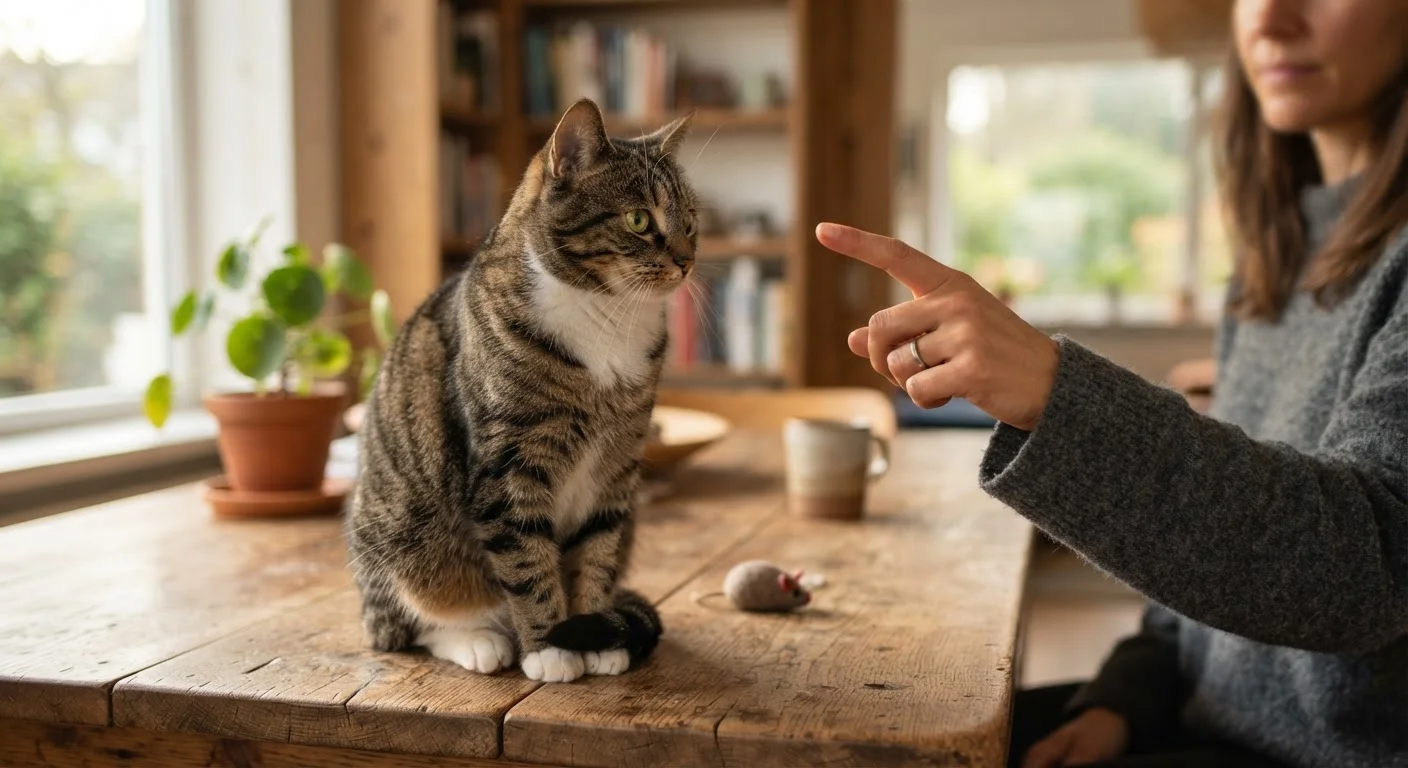
Why Cat Training Myths Persist
Cats have a long-standing reputation for being untrainable - aloof, independent, and indifferent to human instruction. This reputation shapes how millions of owners approach their cats, often leading them to skip training altogether. The result is a self-fulfilling cycle: owners don't try, nothing gets trained, and the myth endures.
The reality is that cats are highly capable learners. Research in animal behavior consistently shows that cats respond to the same fundamental learning principles as dogs, dolphins, and even humans. The difference isn't ability - it's approach. Understanding the key principles behind effective animal training is the first step toward better results with any cat.
Below, we address the most common misconceptions head-on, with accurate corrections grounded in behavioral science.
Myth
Cats are untrainable because they don't want to please their owners.
Fact
Cats are fully capable of learning trained behaviors - they're simply motivated differently than dogs.
Dogs have been selectively bred over thousands of years to be highly responsive to social approval. Cats have not. This doesn't make cats less intelligent or less trainable; it means they respond more reliably to tangible rewards - food, play, or access to something they want - than to praise alone. Behavioral science classifies this under operant conditioning: behavior that produces a rewarding consequence is more likely to be repeated. Cats follow this rule just as reliably as any other animal.
Myth
You have to punish a cat to stop unwanted behavior.
Fact
Punishment is largely ineffective for cats and often makes behavioral problems worse.
Physical correction, spray bottles, and loud noises may startle a cat in the moment, but they don't teach the cat what to do instead - and they frequently cause fear and anxiety that erodes trust. Animal behavior specialists widely agree that positive reinforcement (rewarding desired behavior) combined with management (removing opportunities for unwanted behavior) produces more durable results without negative side effects. If a cat is scratching furniture, for example, providing appealing scratching posts and rewarding their use is more effective than any punishment.
Myth
Older cats can't learn new behaviors.
Fact
Adult and senior cats can learn new behaviors; age alone is not a barrier to training.
The idea that learning ability sharply declines with age is not well supported by feline behavioral research. While kittens may acquire certain social behaviors more readily during sensitive developmental periods, adult cats retain the cognitive capacity to form new associations and learn new responses. Senior cats may have physical limitations - arthritis, for instance, could affect their ability to perform certain movements - but the learning process itself remains intact. Adjusting expectations and session demands to match a cat's physical condition is good practice at any age.
Myth
A cat that ignores you during training is being stubborn or spiteful.
Fact
Disengagement during training usually signals that the reward, timing, or environment needs adjustment.
Cats don't disengage out of spite - a concept that requires a level of premeditated social motivation that doesn't align with how feline cognition works. When a cat walks away or stops responding, it most commonly means the reward isn't motivating enough, the session has gone on too long, the environment is too distracting, or the task difficulty jumped too quickly. Troubleshooting these variables - rather than attributing the problem to the cat's personality - almost always leads to a breakthrough.
Myth
Cats only need training if they have behavior problems.
Fact
Training is a proactive enrichment activity that benefits all cats, not a last resort for problem behavior.
Training provides mental stimulation that many indoor cats lack. A cat that has learned to sit on cue, target a hand, or enter a carrier willingly is easier and safer to handle at the veterinarian, during travel, or in an emergency. Regular training sessions also strengthen the human-animal relationship and can reduce stress-related behaviors like over-grooming or redirected aggression. Think of training as part of routine care - comparable in importance to diet and play. For context on why feline enrichment matters, consider what's known about indoor vs. outdoor cats and their health trade-offs.
Practical Takeaways for Cat Owners
Knowing the facts is one thing - applying them consistently is another. Here's how to move from myth-busting to real progress with your cat.
2-5 min
Ideal cat training session length
Animal behavior specialists generally recommend short, focused sessions to match cats' attention spans and prevent frustration.
3x daily
Recommended training frequency
Multiple brief sessions per day yield better retention than single long sessions, consistent with general principles of spaced learning.
Start with high-value rewards. Discover what your individual cat finds most motivating. Some cats respond strongly to small pieces of cooked chicken or commercial treats; others prefer a brief play session with a wand toy. Motivation is personal, and what works for one cat may leave another indifferent.
Keep sessions short. Two to five minutes per session, up to three times daily, is a realistic and effective schedule. Ending on a successful repetition - before your cat loses interest - leaves both of you in a positive state for the next session.
Use a marker signal. A clicker or a consistent verbal cue like "yes" helps your cat understand exactly which behavior earned the reward. Precise timing matters more than repetition volume. For a deeper look at terminology like marking, shaping, and reinforcement schedules, the common pet training terms every owner should understand is a useful reference.
Address the environment. Training is harder when a cat is stressed, overstimulated, or physically unwell. If your cat is exhibiting sudden behavioral changes, consult a veterinarian before attributing the issue to stubbornness. Some behaviors that look like defiance are actually signs of discomfort or illness. You can also explore broader feline behavior patterns in the context of popular pet health myths that can lead owners astray.
This article is for general informational purposes only and does not constitute veterinary or behavioral advice. If your cat displays concerning behaviors, consult a qualified veterinary professional.