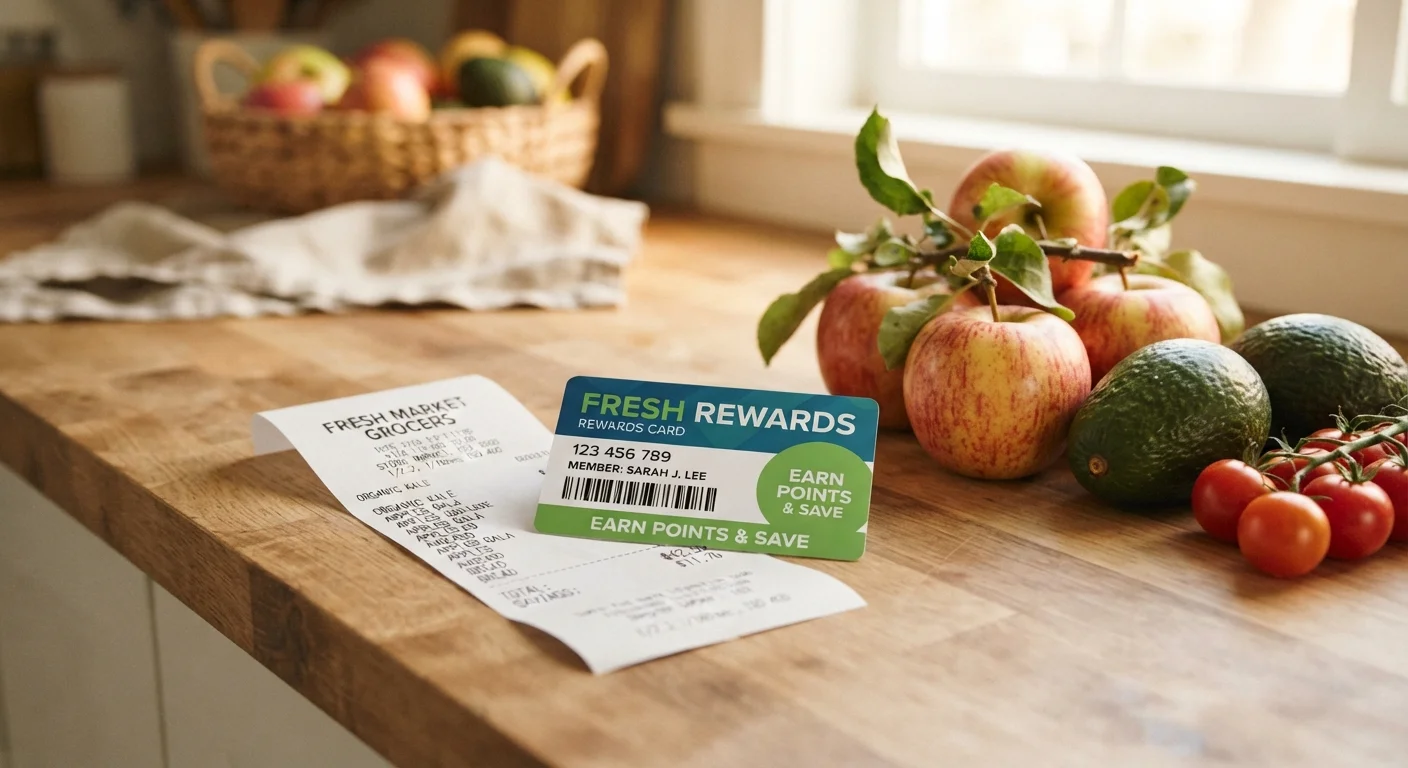
How the Earn Side of Grocery Loyalty Works
At their core, grocery loyalty programmes convert spending into a secondary currency - points. The standard mechanism awards a fixed number of points per dollar (or per defined dollar increment) on qualifying purchases. A common structure might be 1 point per dollar, though some programmes express this differently: 100 points per $1, or 1 point per $0.50 spent. The absolute number is less meaningful than the redemption rate, which determines what those points are actually worth.
Most programmes distinguish between base earn - the default rate applied to all eligible spending - and bonus earn, which applies to specific products, categories, or promotional periods. Manufacturers sometimes fund bonus point events as a promotional mechanism, meaning the retailer passes through an elevated earn rate on selected SKUs for a limited window. These events are where engaged shoppers can significantly outpace the baseline accumulation rate.
Fuel rewards are a common feature at US grocery chains, where points convert to per-gallon fuel discounts at affiliated gas stations rather than (or in addition to) in-store redemption. Understanding what earn pathway aligns with your spending pattern is the first analytical step. For a broader look at how grocery schemes compare to travel and financial reward structures, the comparison of reward programme types across sectors is a useful reference.
Redemption Mechanics: What Points Actually Get You
Redemption design varies considerably across programmes and has a direct bearing on the real-world value of accumulated points. The most straightforward model applies a fixed discount at checkout - for example, 100 points equals $1 off - making the math transparent. Other programmes operate tiered redemption, where higher point totals unlock proportionally better rates or exclusive reward categories.
Common redemption channels in grocery loyalty programmes include:
- In-store discounts applied at the register, either automatically or via coupon
- Fuel discounts at affiliated stations, expressed as cents-per-gallon savings
- Partner rewards, such as airline miles, hotel points, or gift cards - typically at a conversion rate less favourable than in-store redemption
- Charitable donation options, where points convert to a contribution to a partner charity
One structural consideration worth understanding is the redemption threshold - the minimum point balance required before any redemption is permitted. Programmes with high thresholds effectively defer value and increase the risk that points expire before use. The loyalty scheme glossary defines these and other programme terms in full.
~80%
US households enrolled in at least one grocery loyalty programme
Estimates from retail industry research consistently place grocery loyalty programme participation among the highest of any consumer loyalty category in the United States.
1-2%
Typical effective return rate on grocery loyalty spend
When base earn rates are converted to their redemption-value equivalent, most standard grocery programmes return roughly 1-2 cents per dollar spent, though bonus events can raise this materially.
30-40%
Share of earned loyalty points that are never redeemed
Industry analyses of loyalty programme economics have consistently found that a significant proportion of issued points are never claimed, representing unrealised value for consumers.
Personalisation, Tiers, and Programme Variations
Modern grocery loyalty programmes increasingly rely on purchase data to serve personalised bonus offers. These are targeted promotions - delivered via app, email, or printed coupon - that grant elevated point multipliers on categories a member already buys regularly. From a programme design standpoint, personalisation serves two goals: it makes the offer more likely to be used (because it maps to existing behaviour) and it deepens the behavioural data the retailer collects.
Some programmes also incorporate membership tiers, where higher cumulative annual spending unlocks enhanced earn rates, exclusive promotions, or priority access to events. Tier status typically resets on an annual or rolling basis, which creates a renewal incentive mechanic.
Load Personalised Offers Before You Shop
Most grocery app-based programmes require members to actively 'clip' or load personalised bonus offers before a qualifying purchase - the discount or bonus points are not applied automatically. Spending two minutes reviewing and activating available offers in the app before entering a store is the simplest way to avoid leaving earned value on the table.
It's worth noting that programme structures change. Retailers periodically revise earn rates, redemption values, expiry policies, and partner relationships - sometimes with limited advance notice. Treating any programme's current terms as fixed is a common mistake. Checking the programme's official terms page periodically is the straightforward way to stay current.
For readers interested in how this category of programme compares structurally to airline miles and financial cashback, the explanation of travel rewards points offers a useful contrast.