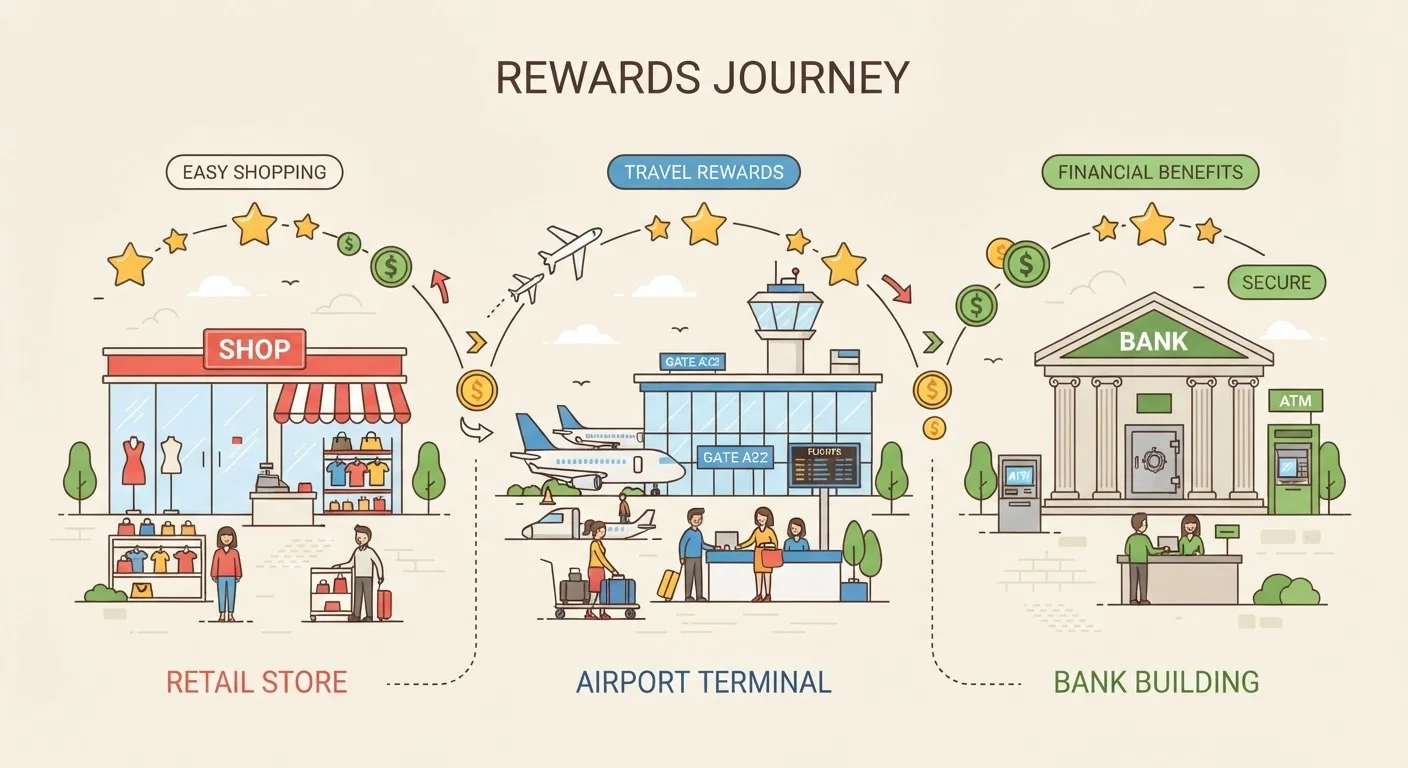
How Retail Rewards Programmes Are Structured
Retail loyalty programmes are generally the most accessible and straightforward. Shoppers earn points per dollar spent at a particular store or chain, then redeem those points for discounts, store credit, or merchandise. The earn rate is usually fixed and visible - for example, one point per dollar - and redemption thresholds are relatively low.
The key structural feature of retail programmes is closed-loop design: points earned at one retailer are almost always redeemable only within that retailer's ecosystem. This keeps spending concentrated but limits flexibility. Supermarket programmes are a prominent example; see our guide to how supermarket points programmes are structured for a detailed breakdown of their mechanics.
Expiration policies in retail schemes tend to be more forgiving than in travel programmes, though inactivity windows - typically 12 to 18 months - can still result in forfeiture. Bonus multiplier events, often tied to sales or seasonal promotions, are common tools retailers use to accelerate earning without changing the base rate.
| Retail Programmes | Travel Programmes | Financial Cashback | |
|---|---|---|---|
| Earn structure | Fixed points per dollar spent | Variable by fare class or tier | Flat or category-based percentage |
| Redemption flexibility | Store-only, closed ecosystem | Limited to travel or partners | Cash, statement credit, transfers |
| Value per unit | Fixed, low variability | Highly variable by redemption | Predictable dollar equivalent |
| Expiration rules | Inactivity-based, often 12-18 months | Strict, often 12-24 months | Varies; some never expire |
| Complexity to maximise | Low - straightforward earn/redeem | High - requires strategy | Low to moderate |
| Best fit for | Loyal single-store shoppers | Frequent brand-loyal travellers | General everyday spenders |
Travel Loyalty Schemes: Complexity in Exchange for Potential Value
Travel programmes - airline frequent flyer schemes and hotel loyalty programmes - introduce considerably more complexity. Earning is rarely as simple as a flat points-per-dollar rate. Airlines typically award miles based on fare class, distance flown, or a combination; budget fares on the same flight may earn significantly fewer miles than premium fares.
Redemption value is also variable. A mile or point in a travel programme does not have a fixed dollar equivalent. Its value depends on how it is redeemed: long-haul business class redemptions often yield far higher per-point value than gift card conversions. This variability is central to what makes travel programmes both powerful and difficult to evaluate. Our plain-language explainer on travel rewards points covers these quirks in detail.
Status tiers - elite levels unlocked by annual flying or spending thresholds - create a layered incentive structure. Higher-status members earn points faster, access better redemption inventory, and receive service benefits. This design strongly favours high-frequency participants and can feel unrewarding for occasional travellers.
Check Expiration Rules Before Committing
Travel programme points and miles often expire after 12 to 24 months of account inactivity - a shorter window than most retail schemes. Before enrolling, review the specific inactivity policy. Some programmes reset the expiration clock with any qualifying activity, including partner purchases or credit card spend, which can extend point life significantly.
Financial Cashback and Credit Card Rewards: Flexibility vs. Complexity
Financial rewards programmes, primarily structured around credit cards, offer two dominant models: flat-rate cashback and tiered category rewards. Flat-rate cards apply a single earn percentage - commonly 1.5% to 2% - across all purchases. Tiered cards offer elevated rates in specific spending categories such as dining, groceries, or travel, with a lower base rate on everything else.
The defining advantage of cashback is transparency: a stated percentage of spending is returned as real currency, requiring no point valuation calculations. For readers new to rewards, our practical starting-point guide explains how to evaluate these structures without getting lost in complexity.
For a direct structural comparison of the two financial models, see our comparison of flat-rate cashback vs. tiered category rewards. The critical trade-off: flat-rate cards are simpler to maximise; tiered cards can deliver higher returns for spending that aligns with their bonus categories, but require more active management.
3.3B
US loyalty programme memberships
According to Loyalty One's Bond Brand Loyalty report, American consumers hold billions of loyalty memberships, though active engagement rates are significantly lower.
~50%
Loyalty memberships considered active
Industry research consistently finds that roughly half of enrolled loyalty memberships show little to no engagement within a 12-month window.
Key Structural Differences Worth Understanding
Across all three sectors, four structural variables determine real-world value: earn rate, redemption flexibility, expiration rules, and programme ecosystem depth. Travel programmes score highest on potential value per point but lowest on simplicity and redemption predictability. Retail programmes score high on ease of use but low on flexibility. Financial cashback programmes offer the most predictable, transferable value.
Understanding the vocabulary used across these programmes is foundational. Terms like earn rate, redemption threshold, bonus category, and tiered status mean different things in different contexts. Our loyalty scheme glossary defines these terms precisely. For a broader conceptual overview of how cashback, points, and miles compare as reward types, the three pillars of rewards explainer is a useful companion read.
No programme type is objectively superior. The most valuable programme is the one aligned with where you actually spend - and one whose rules you understand clearly enough to avoid common pitfalls like point expiration or suboptimal redemptions.
This article is for general informational purposes only and does not constitute financial or investment advice. Programme structures, earn rates, and terms vary by provider and may change. Consult a licensed financial professional regarding decisions suited to your individual circumstances.