How Each Structure Actually Works
Understanding the mechanics of each card type is the starting point for any meaningful comparison. For a broader look at how cashback fits into the wider rewards landscape, see how cashback, rewards, and loyalty points each operate.
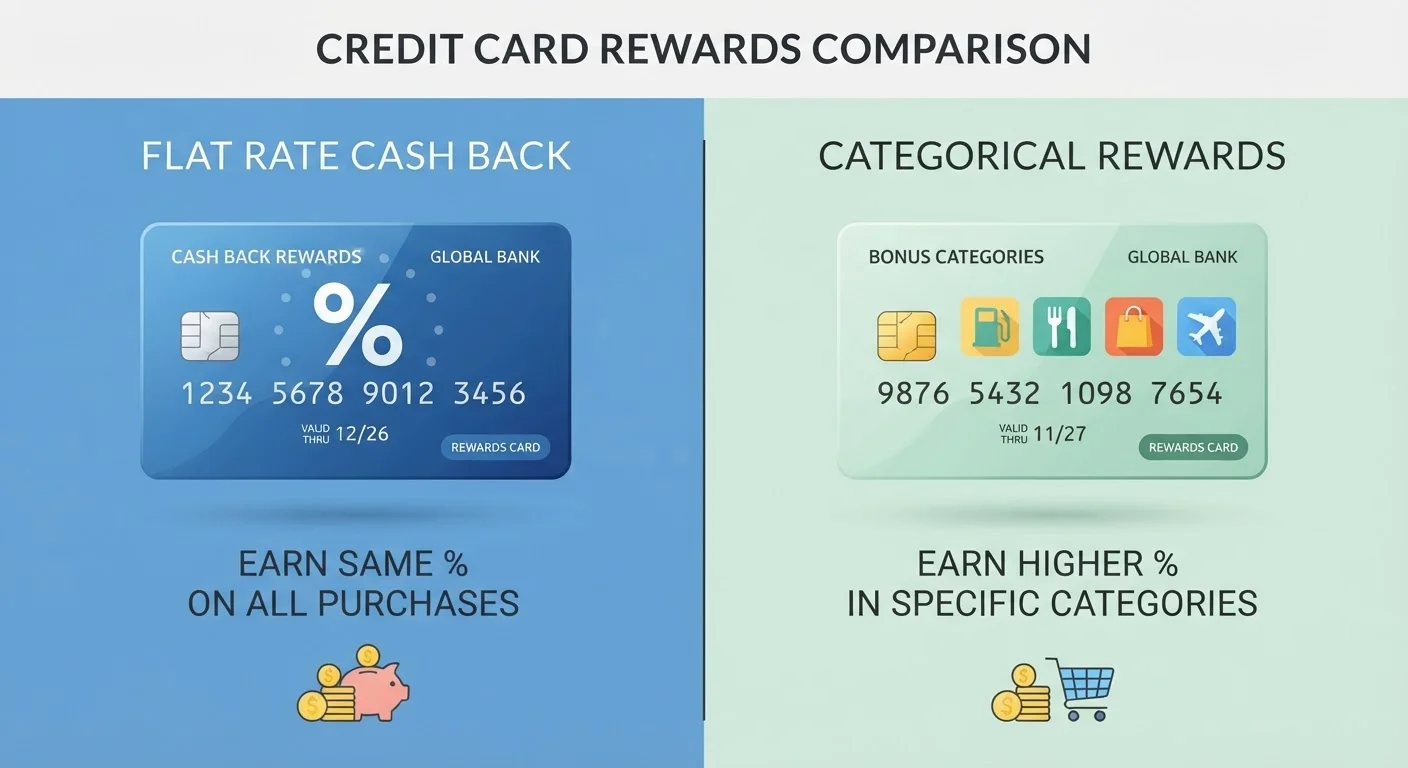
Flat-rate cashback cards apply a single, fixed percentage - commonly 1.5% or 2% - to every eligible purchase. Groceries, utilities, travel, streaming subscriptions: all earn at the same rate. There's no enrollment process, no rotating calendar, and no category cap to monitor. You swipe, and a consistent fraction comes back to you.
Tiered category rewards cards segment spending into groups - typically groceries, dining, gas, travel, and a catch-all "other" bucket. Each tier carries a different earn rate. A card might return 3%-6% at grocery stores, 2% on gas, and 1% on everything else. The elevated rates exist because card issuers design tiers around high-frequency spending where cardholders are motivated to consolidate purchases.
Some tiered structures are fixed (the categories never change), while others rotate quarterly, requiring cardholders to activate categories each period and potentially cap bonus earnings at a set dollar amount per quarter. This distinction has real implications for how much effort the card demands.
| Criterion | Flat-Rate Cashback | Tiered Category Rewards |
|---|---|---|
| Earn rate structure | Single rate on all purchases | Variable rates by spending category |
| Typical bonus rate | 1.5%-2% across the board | 3%-6% on top categories |
| Management effort | Minimal - no activation needed | Low to moderate; some require quarterly enrollment |
| Spending caps | Rarely applies | Common on bonus categories |
| Best performer when... | Spending is spread across many categories | Spending concentrates in bonus categories |
| Annual fee likelihood | Often none or low | More common; varies by card |
| Predictability of returns | High - consistent every month | Variable - depends on spending mix |
Running the Numbers: When Each Card Pulls Ahead
The headline rate on a tiered card - say, 6% on groceries - looks compelling, but that figure only matters if groceries represent a substantial share of your spending. Consider a household spending $1,200 per month: $400 on groceries, $100 on gas, and $700 on miscellaneous purchases. A tiered card at 6%/2%/1% yields roughly $37 per month. A flat 2% card on the same total yields $24. The tiered card wins - in this scenario.
Shift the mix so that $900 is miscellaneous and only $200 is groceries, and the flat card often closes the gap or overtakes. The crossover point depends entirely on individual spending distribution. Before assuming a tiered card is superior, map your actual monthly spending against the card's tier structure to estimate real returns, not hypothetical ones.
~$1,000
Average annual US household grocery spend per adult
According to the USDA's food spending reports, grocery costs represent one of the largest consistent household expenditure categories, making grocery bonus tiers particularly impactful.
1%
Typical non-category base rate on tiered cards
Most tiered rewards cards revert to a 1% earn rate on purchases outside their bonus categories, which can significantly dilute overall returns for mixed spenders.
Spending caps on bonus categories add another variable. If a tiered card caps grocery bonuses at $1,500 per quarter, any grocery spending above $500 per month earns the base rate only. High-volume grocery spenders may find those caps significantly compress real-world returns.
For a broader comparison of how different reward types - cashback, points, and miles - compare in value, this overview of the three reward pillars is a useful reference.
Practical Considerations Beyond the Earn Rate
Earn rates are only part of the picture. Annual fees, redemption thresholds, and card management overhead all affect the true value of either structure.
Flat-rate cards tend to carry lower or no annual fees, which raises their net value for moderate spenders. A tiered card charging a $95 annual fee needs to consistently outperform a no-fee flat card by more than $95 per year just to break even on fees alone - a threshold not every cardholder reaches.
Management burden is a real cost too. Quarterly-rotating tiered cards require active enrollment each period. Missing an activation window means earning the base rate - often just 1% - during that quarter. For cardholders who prefer set-and-forget simplicity, this friction is a genuine drawback.
Watch for Category Definition Fine Print
Tiered cards define bonus categories using merchant category codes (MCCs) assigned by payment networks, not by store name. A grocery purchase at a supercenter may not qualify as 'grocery' if that retailer's MCC is classified differently. Before relying on bonus earnings from a specific store, confirm how the card issuer classifies that merchant. This is a common source of unexpected shortfalls in tiered card returns.
One common strategy is pairing card types: using a tiered card for specific high-earning categories and a flat-rate card for all remaining purchases. This approach can extract the best available rate on every dollar spent, though it requires tracking two accounts. If that kind of optimization interests you, stacking rewards across multiple programs explores the mechanics in detail.
It's also worth noting that rewards structures vary considerably across sectors. How rewards programs differ across retail, travel, and finance outlines the key structural distinctions worth understanding before committing to any single program.
This article is for general informational purposes only and does not constitute financial or credit advice. Consult a qualified financial professional regarding decisions specific to your circumstances.