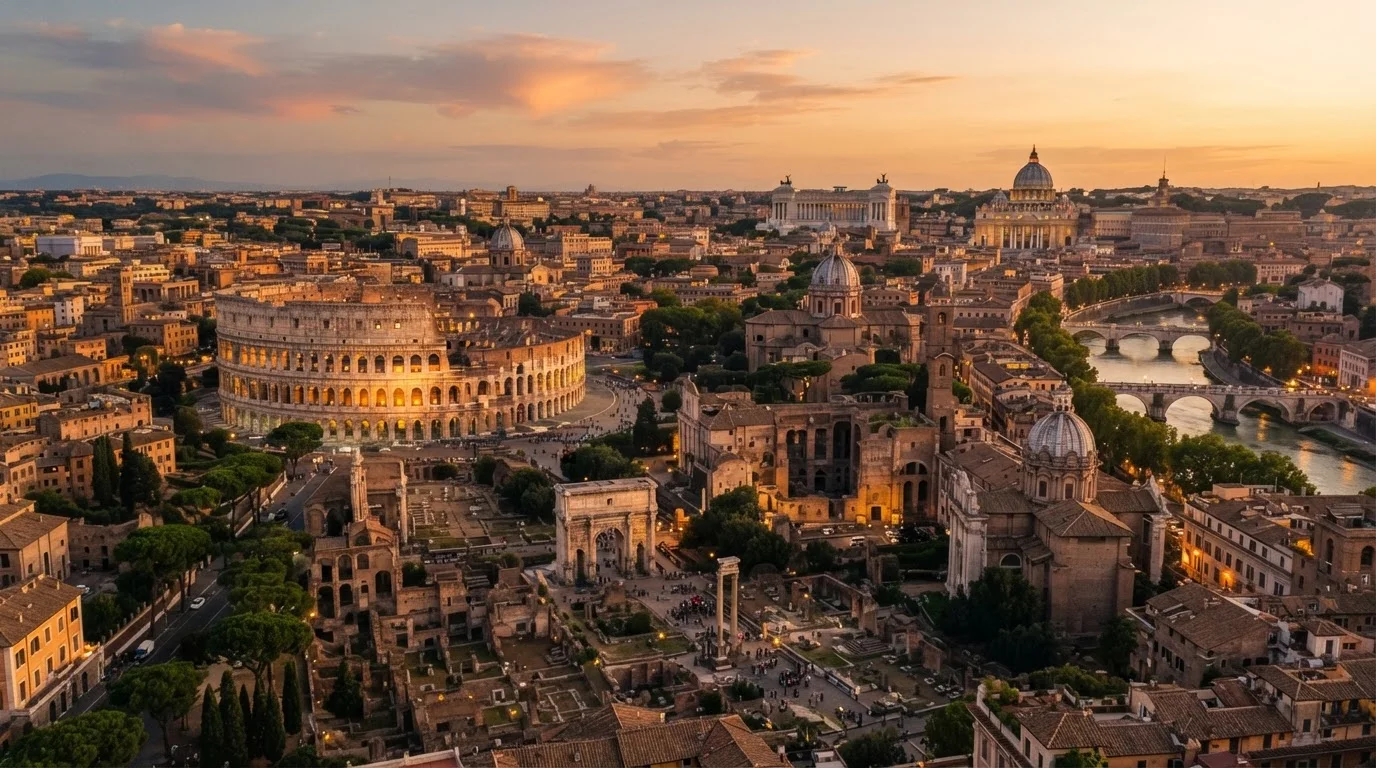
How Rome Is Actually Organized
Most visitors approach Rome as a list of monuments rather than a city with distinct neighborhoods. That framing leads to exhausting days of criss-crossing the map. A more useful mental model: Rome clusters into roughly five zones relevant to first-time visitors, each walkable internally but separated by 20-40 minutes on foot or a short bus ride.
- The Ancient Core - Colosseum, Roman Forum, Palatine Hill. Budget at least a half-day here, ideally a full day if you want to absorb the Forum properly.
- Centro Storico - Pantheon, Piazza Navona, Campo de' Fiori. Rome's most pedestrian-friendly cluster; easily three to four hours of wandering.
- The Vatican - Vatican Museums, Sistine Chapel, St. Peter's Basilica. A standalone full-day destination.
- Trastevere - Rome's most atmospheric neighborhood for an evening; few must-see monuments but excellent local rhythm.
- Borghese & Prati - The Villa Borghese gallery (requires advance booking) and the quieter Prati neighborhood adjacent to the Vatican.
Plan each day around one anchor zone, then let the afternoon bleed into a neighboring area naturally. See how to structure a realistic itinerary to apply this zoning logic systematically.
A Day-by-Day Framework for Seven Days
This is a framework, not a fixed script. Swap days based on your accommodation location and personal pace.
Book your Colosseum and Vatican tickets before you book your flights if traveling April through October. Sold-out time slots are a real constraint that will reshape your entire itinerary.
During peak season, popular timed-entry slots at both sites routinely sell out well in advance, leaving travelers with awkward gaps or forced changes to their day-by-day plan.
Start major monument visits at opening time, not mid-morning. The Colosseum at 9 a.m. and at 11 a.m. are two entirely different crowd experiences.
Tour groups typically arrive after 10 a.m., meaning early-entry visitors often have the first hour with dramatically thinner crowds and better photo conditions.
- Day 1 - Arrival & Orientation: Walk from your accommodation toward the nearest piazza. Do not attempt a major monument on arrival day. Locate your nearest bus stop and get oriented.
- Day 2 - The Ancient Core: Colosseum in the morning (pre-booked timed entry), Roman Forum and Palatine Hill through midday, then rest. The Circus Maximus is a five-minute walk for a low-effort evening add-on.
- Day 3 - Vatican: Vatican Museums and Sistine Chapel in the morning (again, pre-booked), St. Peter's Basilica in the afternoon. Climbing the Basilica dome adds roughly an hour but delivers one of the city's best views.
- Day 4 - Centro Storico: Pantheon (timed entry now required), Piazza Navona, Campo de' Fiori. This zone is compact enough that you can walk all three comfortably before lunch, leaving the afternoon free.
- Day 5 - Trastevere & Janiculum Hill: Morning in Trastevere's streets, climb to Janiculum Hill for panoramic views, back to the neighborhood for a long lunch. Low-intensity day - intentionally.
- Day 6 - Borghese Gallery & Prati: The Borghese is one of Rome's finest museums; it strictly limits visitor numbers, so book two to four weeks ahead. Spend the afternoon in Prati, which has less tourist pressure than Centro Storico.
- Day 7 - Flex Day: Return to anything you rushed, visit a church you passed but skipped (Rome has hundreds worth stepping into - Santa Maria Maggiore and San Clemente are often overlooked), or simply sit in a neighborhood bar and read.
For travelers weighing a longer slow-travel approach against a focused week, comparing city-break and slow-travel styles lays out the honest trade-offs.
Sites That Reward Extra Time (And Those That Don't)
Not every famous sight requires the same investment. Being selective is what separates a satisfying week from a frantic one.
Avoid the 'Monument Marathon' Mistake
Attempting to visit the Colosseum, Vatican, Borghese Gallery, and Pantheon in the same day is a common itinerary error. Each of these sites requires significant mental energy and physical time. Packing them together produces a blur rather than meaningful experience - and leads to the kind of exhaustion that ruins the following day too.
Worth lingering at
- The Roman Forum: Most visitors walk through in 45 minutes. Spend two hours reading the site maps and tracing the Via Sacra; the context transforms what looks like rubble into a coherent city.
- The Borghese Gallery: Small rooms, world-class Bernini sculpture. Two hours is the maximum allowed and the right amount.
- Trastevere at dusk: No monument required - the neighborhood itself is the experience. Arrive around 6 p.m. and stay through dinner.
Can be done efficiently
- Trevi Fountain: It's crowded at almost every hour. See it, photograph it, leave. Fifteen to twenty minutes is plenty.
- Spanish Steps: A pleasant piazza, not a museum. Worth walking through on your way between zones.
- Castel Sant'Angelo: Interesting if you have a half-day to spare; skip it if your schedule is full.
Logistics That Make or Break a Rome Trip
Rome's logistics are manageable once you understand a few consistent realities.
Reservations
The Colosseum, Vatican Museums, and Borghese Gallery all require advance timed-entry tickets. The Colosseum often sells out days ahead during peak season (roughly April through October). Book before you finalize your day-by-day schedule, then build the itinerary around confirmed slots.
Getting around
Rome's historic center is largely ZTL - a restricted traffic zone that bars most private vehicles. This works in your favor: the central areas are highly walkable, and buses fill the gaps. The metro has only two main lines relevant to tourists (Line A and Line B), but they connect key transfer points. Walking between the Pantheon and the Colosseum takes about 25 minutes and passes interesting streets.
Church etiquette and closures
Many of Rome's churches are free to enter but close midday (typically 12-3 p.m.). Covered shoulders and knees are required at the Vatican and most other churches. Carry a scarf or light layer.
See the key phases of trip planning for a pre-departure checklist that covers reservations, documents, and packing logistics end to end.
Keeping Costs Under Control
Rome has a reputation for tourist-zone price inflation, and that reputation is earned - but avoidable with basic awareness.
- Sit-down vs. stand-up: In Italy, al banco (standing at the bar counter) typically costs significantly less than table service. A counter espresso near the Pantheon costs a fraction of what the surrounding outdoor terraces charge.
- Lunch over dinner: Many restaurants offer a pranzo (lunch) fixed menu that includes a first course, second course, and sometimes wine for a flat price. The same meal ordered à la carte at dinner costs considerably more.
- Free monuments: The Pantheon charges a modest entry fee, but many of Rome's finest churches - including Santa Maria Maggiore, San Giovanni in Laterano, and the Basilica di Santa Maria in Trastevere - are free. The Roman Forum's exterior and the Circus Maximus are also free to view.
- Water: Rome's public drinking fountains (nasoni) are fed by ancient aqueduct systems and are safe to drink. Refill a reusable bottle and skip bottled water purchases entirely.
For a broader spending framework that applies across the full trip - flights, accommodation, and daily expenses - stretching a travel budget across an entire trip offers a practical end-to-end approach.
All travel conditions, entry requirements, and monument access policies can change. Verify current information directly with official site operators and relevant government sources before your trip.