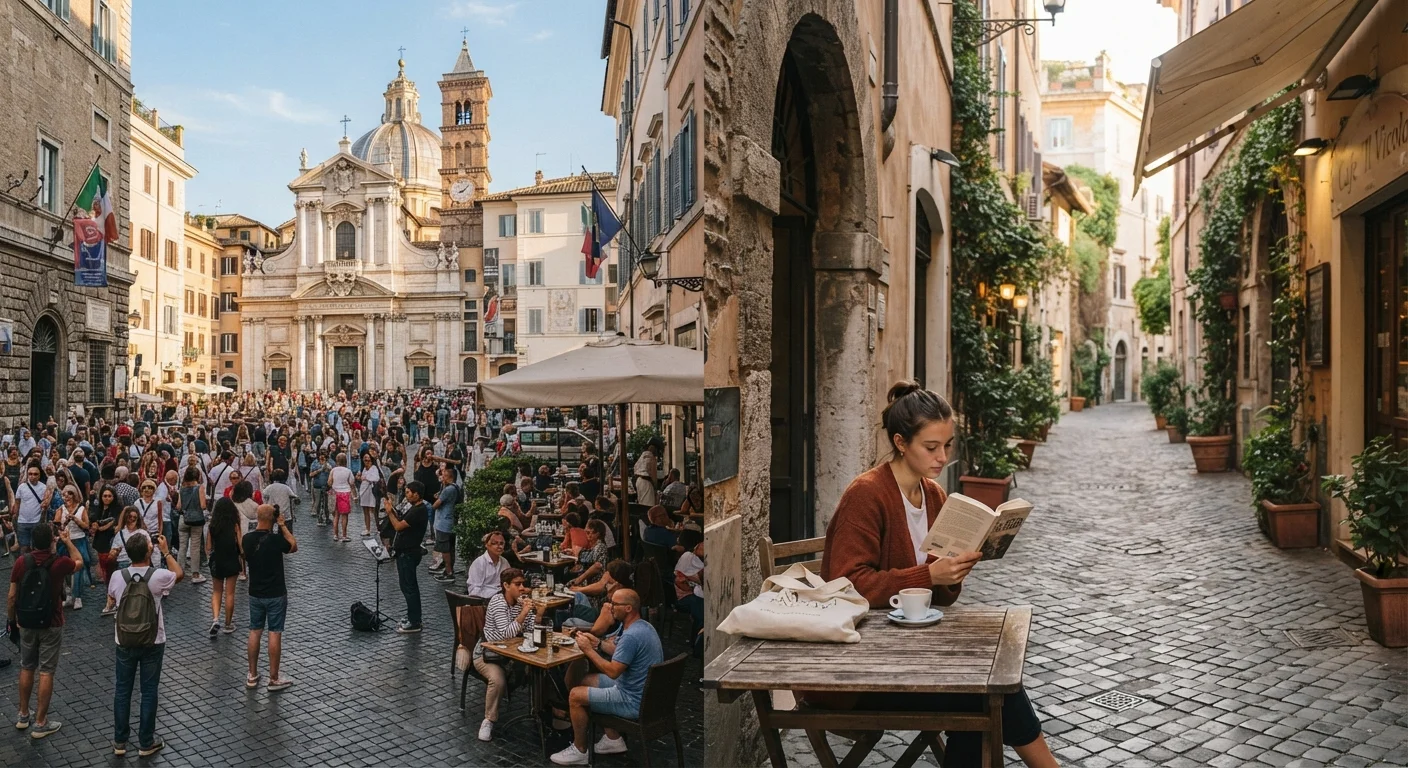
What Each Travel Style Actually Means
A city break typically means two to five days in one place - enough time to hit the major landmarks, eat at a handful of well-regarded spots, and get a feel for a neighborhood or two. It's the dominant mode for long-weekend travel and suits destinations with concentrated highlights: a historic center, a famous museum, a recognizable skyline.
Slow travel has no fixed definition, but it generally means staying in one place - or a small cluster of places - for two weeks to several months. The pace shifts from sightseeing to something closer to temporary residency. You develop routines, learn where locals actually eat, and notice things that three-day visitors simply don't have time to find.
Both styles are legitimate. The mistake is treating one as inherently superior. What matters is matching the approach to your actual constraints - time off, budget, destination type, and what you want the trip to deliver. For a deeper look at how to structure either kind of trip, see the guide to building a travel itinerary that actually works.
The Case for City Breaks
When vacation days are finite, a city break is often the most rational use of them. You can visit Rome over a long weekend, cover the Colosseum, Vatican, and Trastevere, and return to work Monday having genuinely experienced something. Compare that to spending those same days on a slow trip where the first two days are often consumed by orientation and jetlag recovery.
Maximizes limited vacation time efficiently
For travelers with two to five days, a focused city break can cover a destination's core highlights without wasting a day on orientation or slow settling-in.
Simpler logistics and booking process
Short stays involve fewer moving parts - one accommodation, a tight set of activities, and predictable daily costs, which reduces planning overhead significantly.
Works well for high-density, compact destinations
Cities with a concentrated historic center or a defined cluster of major sites often deliver their best value in three to five focused days rather than a stretched-out stay.
Low commitment - ideal for testing a destination
A short visit lets you assess whether a place warrants a longer return trip, without the financial or logistical investment of an extended stay.
City breaks also compress the decision-making burden. Booking three nights in one hotel is simpler than managing an extended stay with fluctuating accommodation needs. For destinations with a tight core of must-see sites - think a city organized around a historic center - three focused days can deliver a surprisingly complete picture.
The format also works well as reconnaissance. A short visit to a place you're uncertain about lets you assess whether it warrants a longer return trip, without the commitment of an extended stay. See how a week in Rome can be structured realistically for a practical example of time-constrained planning done right.
The Case for Slow Travel
Slow travel changes the economics of a trip in ways that aren't immediately obvious. Daily costs typically fall after the first week - you're no longer paying tourist-area restaurant prices for every meal, you're cooking occasionally if you have a kitchen, and you stop paying for activities just to fill limited days. Stretching a travel budget across an entire trip becomes considerably easier when your per-day accommodation rate drops with a longer booking.
Higher daily costs compared to extended stays
Short stays rarely benefit from weekly or monthly accommodation discounts, and travelers often default to restaurants and paid activities for every meal and hour, which drives up per-day spending.
Surface-level experience of most destinations
Three to five days rarely allows time to move beyond tourist-facing neighborhoods or well-documented attractions - the texture of daily local life stays largely out of reach.
Travel fatigue can consume a significant portion of the trip
For long-haul destinations, jetlag and airport-to-accommodation transit can absorb a full day or more, shrinking the effective time available for exploration.
Difficult to build genuine neighborhood familiarity
Understanding how a place actually functions - local shops, markets, community rhythms - typically takes more time than a city break allows, leaving visitors with a curated rather than authentic impression.
Beyond cost, slow travel shifts what you actually see. Neighborhoods reveal themselves over days rather than hours. You start noticing the bakery that only locals use, the Friday market that doesn't appear on any tourist map, the rhythm of a place on a Tuesday morning versus a Saturday afternoon. This is the version of a destination that city-break visitors rarely reach.
Accommodation also changes character. Extended stays make apartment rentals practical in a way they aren't for a three-day visit. This in turn changes how you cook, shop, and move around - which itself changes the travel experience. The guide to accommodation beyond hotels covers the trade-offs across different stay types.
Slow Travel Isn't the Same as Doing Nothing
A common misconception is that slow travel means an unstructured or passive trip. In practice, it often involves more deliberate exploration - researching a neighborhood's history, attending a local market on its actual day, or taking a day trip to a surrounding area that a city-break visitor would never have time for. The pace is slower, but the engagement can be deeper. If you're new to planning longer trips from scratch, this planning framework walks through the process step by step.
Matching Style to Destination
Not every destination rewards slow travel equally. A city organized around a concentrated historic core - Dubrovnik, for instance - can feel limiting after a week, once you've walked every lane and the novelty has worn off. But a sprawling city like Tokyo, with dozens of distinct neighborhoods, can sustain weeks of exploration. See Tokyo's lesser-known neighborhoods for a sense of how layered that city actually is.
Rural and regional destinations often favor slow travel more than cities do. A rural area in Portugal's Alentejo interior, for example, unfolds slowly - the interest is in landscape, food culture, and pace rather than a list of attractions. That context shapes which style fits. Coastal Portugal vs. the interior illustrates how the same country can call for entirely different approaches depending on which region you choose.
2-3 weeks
Typical threshold where daily costs start falling
Travel cost researchers and long-term travelers broadly observe that accommodation and food costs per day tend to decline meaningfully after the first one to two weeks, as weekly rental rates and local shopping habits replace tourist-tier pricing.
1 in 3
Travelers who say trips feel too rushed
Surveys of international leisure travelers consistently find that a significant share report wishing they had spent more time in fewer places rather than covering more ground.
If you're planning to cover multiple cities in a single trip, neither pure slow travel nor a series of disconnected city breaks may serve you well. Organizing a multi-city trip requires its own framework - sequencing matters, and transit time is often underestimated.