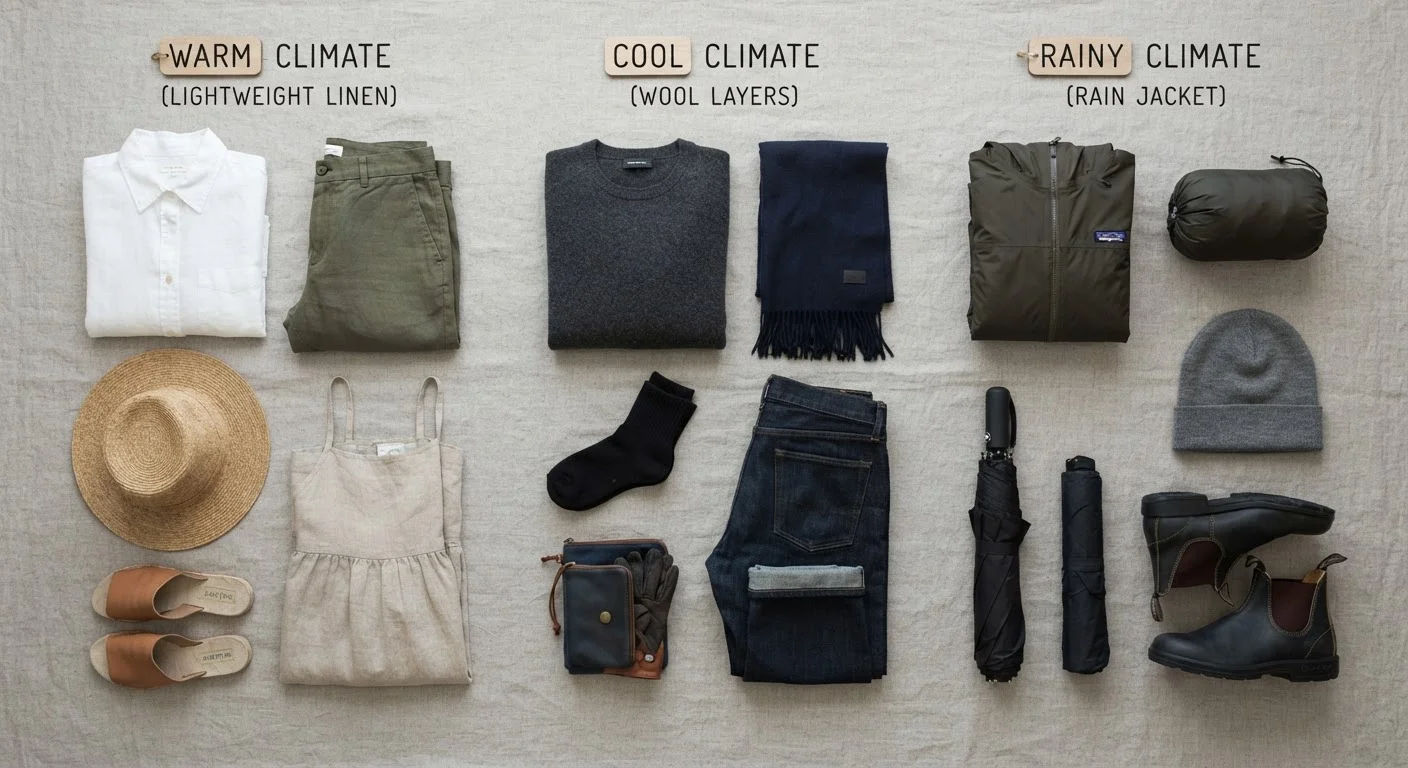
Why Climate Zones Beat Generic Packing Lists
Most packing advice treats every trip the same way. It shouldn't. A week in Bangkok and a week in Copenhagen require entirely different wardrobes, even if both trips are the same length. The zone-by-zone framework below organizes clothing decisions around four broad climate categories - tropical, temperate, cold, and arid - so you pack what actually works rather than covering every hypothetical scenario.
The core principle: build a base layer, add a functional mid-layer, and include one weather-specific outer layer. That three-part structure holds across all zones; only the materials change. This approach pairs naturally with a carry-on-only strategy - see what carry-on travel actually demands if you're trying to minimize bag size.
Zone-by-Zone Clothing Framework
Tropical Climates (Hot, Humid, Often Rainy)
Think Southeast Asia, Central America, and much of sub-Saharan Africa. Heat and humidity are the primary problems; your clothing should wick moisture and dry fast. Pack lightweight fabrics - linen, bamboo, or moisture-wicking synthetics - in breathable cuts. Avoid heavy cotton: it absorbs sweat, stays wet, and takes overnight to dry. A compact packable rain shell (not a heavy anorak) handles afternoon downpours without bulk.
- Base: 3-4 lightweight tops that dry in under 2 hours
- Bottoms: 2 pairs of light trousers or convertible pants; 1 pair of shorts
- Mid-layer: A light long-sleeve layer for air-conditioned transport and temples
- Outer: Packable rain shell (doubles as a sun layer)
- Footwear: Sandals with arch support + closed-toe shoes for wet cobblestones
Temperate Climates (Mild, Variable, Four-Season Transitions)
Western Europe, the US Pacific Coast, and parts of East Asia fall here. Layering is your tool - temperatures shift throughout the day by 15-20°F in shoulder seasons. Merino wool tops are particularly useful: they regulate temperature, resist odor between washes, and compress well. A mid-weight fleece or structured sweater and a water-resistant jacket cover most scenarios.
- Base: 3 merino or synthetic tops (mix short- and long-sleeve)
- Bottoms: 2 pants (one casual, one versatile enough for a restaurant)
- Mid-layer: Fleece or compact down vest
- Outer: Waterproof or water-resistant shell
Cold Climates (Below Freezing, Snow-Possible)
Scandinavia in winter, high-altitude destinations, and Canadian cities in January demand insulation over quantity. The temptation is to pack bulky items for every cold day - resist it. A single well-rated insulated jacket paired with thermal base layers handles most conditions more efficiently than multiple heavy sweaters. Wool socks, a packable beanie, and liner gloves add minimal weight for significant warmth.
- Base: Thermal underlayer (top and bottom), 2-3 merino tops
- Mid-layer: Heavyweight fleece or down sweater
- Outer: Insulated, wind-resistant jacket rated for the expected temperature range
- Accessories: Beanie, neck gaiter, liner gloves
Arid/Desert Climates (Dry Heat, Cold Nights)
The Southwestern US, North Africa, and parts of the Middle East share extreme day-to-night temperature swings - often 30-40°F between afternoon and midnight. Loose, breathable layers for daytime and a compact fleece for evenings cover both ends. Light-colored, full-coverage clothing also reduces sun exposure without adding heat.
- Base: Loose linen or synthetic tops; lightweight long-sleeve for sun protection
- Bottoms: Light trousers (shorts are often impractical culturally and physically in desert sun)
- Mid-layer: Compact fleece for evenings and high-altitude cold
- Outer: Not typically needed, but a light wind layer handles canyon gusts
Base layer
The clothing worn closest to skin. Its job is moisture management - moving sweat away from the body - rather than warmth. In warm climates, the base layer is often the only layer.
Mid-layer
A garment worn over the base layer to trap body heat. Fleece, down vests, and wool sweaters are common mid-layers. Usually removable when conditions warm up.
Packable shell
A lightweight, compressible outer jacket - typically waterproof or water-resistant - that stows into its own pocket or a stuff sack. Useful when weather protection is occasional rather than constant.
Moisture-wicking fabric
Textiles engineered to pull sweat away from the skin and disperse it across the fabric's surface, where it evaporates more quickly. Synthetic blends and merino wool are the most common travel options.
Merino wool
A fine-grade natural wool from merino sheep. It regulates temperature in both warm and cool conditions, resists odor longer than synthetics or cotton, and compresses well for packing.
Convertible pants
Trousers with zip-off lower legs that convert to shorts. Practical for destinations where temperatures swing significantly during the day or where dress codes vary by context.
Multi-Zone Trips: How to Merge Without Overpacking
If your itinerary crosses climate zones - say, a flight from cold-weather Montreal to tropical Cancún - the instinct is to pack for both in full. That quickly fills a bag. Instead, identify which zone you'll spend the most time in and pack for that as your primary, then add one or two items for the secondary zone only.
Merino wool tops and neutral-colored lightweight trousers are the most cross-zone pieces: they work in temperate and cool arid conditions, layer under cold-weather gear, and aren't wildly out of place in moderate tropical settings. Shoes are where most travelers over-pack: one pair of walking shoes and one pair of sandals or lightweight dress shoes covers 95% of trips.
Multi-Zone Packing: The One-Bag Rule
For trips spanning two climate zones, limit yourself to one dedicated item per transition - not a full secondary wardrobe. For example, if crossing from temperate to cold: bring your normal layers and add only a compact insulated jacket. Trying to fully cover both zones independently is where bags get heavy fast.
If you're also building out your trip logistics from scratch, the framework in The Anatomy of a Well-Planned Trip shows how packing decisions fit into the broader planning sequence - and how to time your gear choices alongside booking and budgeting steps.