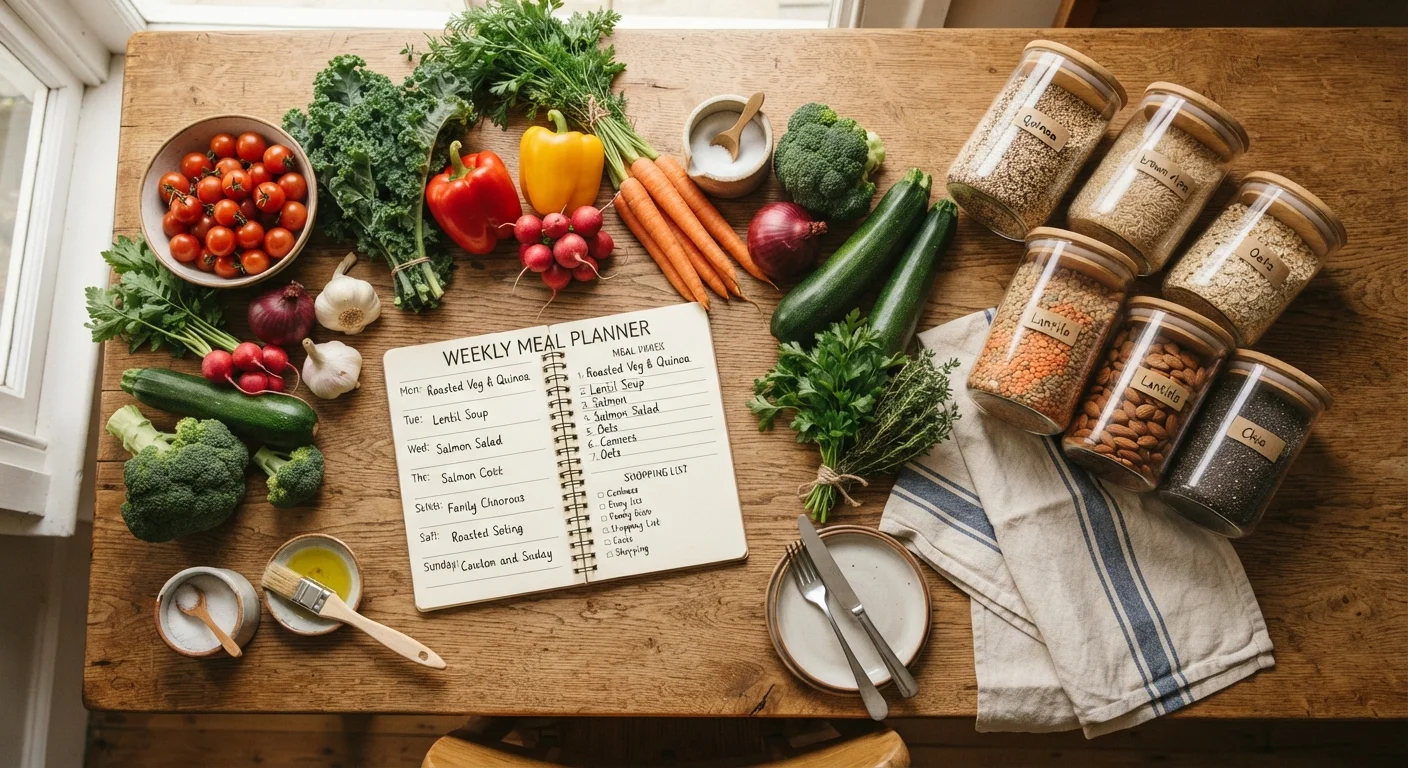
Why Most Meal Plans Fall Apart
The most common reason meal plans fail isn't willpower - it's that they're built for ideal conditions rather than real ones. A plan that demands hour-long weekday cooking sessions or precise calorie counts for every meal creates friction that compounds quickly. By Wednesday, the plan is abandoned and the drive-through wins.
Effective meal planning isn't about control; it's about reducing the number of decisions you need to make when you're tired and hungry. Research in behavioral science consistently shows that decision fatigue leads people toward convenience over nutrition. A simple, adaptable plan removes that daily bottleneck.
Before building your plan, it helps to understand what a nutritionally sound eating pattern actually looks like. Our guide on building a nutritionally sound diet covers the fundamentals - macros, micros, and meal patterns - that give any weekly plan its backbone. It's also worth being aware of the nutrition pitfalls that quietly undermine healthy eating, so your plan accounts for them from the start.
What you will need
How to Build Your Weekly Meal Plan
The steps below are designed for a Sunday planning session of 20-45 minutes, though you can adapt the timing to any day that suits your schedule. The goal is a lightweight system you'll actually repeat week after week.
Audit what you already have
Before writing a single meal idea, open your refrigerator, freezer, and pantry. Note any proteins, grains, canned goods, or produce that need to be used. Building meals around existing inventory reduces waste and trims your grocery list before you've even planned anything.
Map out the week's constraints
Identify the nights when cooking time will be limited - late meetings, kids' activities, social commitments. Mark those evenings as "quick meal" slots (15 minutes or under) or designate them as your planned flexible nights. Trying to schedule a complex meal on your busiest evening is where most plans break down.
Select meals using the anchor method
Choose one meal to anchor each main slot: one breakfast idea, one lunch concept, and three to four dinners. Apply a simple nutritional check: does each meal include a protein source, a fiber-rich carbohydrate or vegetable, and a small amount of healthy fat? This isn't a rigid formula - it's a quick structural scan. Meals that pass this check tend to support sustained energy and satiety without requiring precise tracking.
Write a consolidated grocery list by category
Group your list by store section - produce, proteins, dairy and eggs, grains and legumes, pantry staples - rather than by meal. This prevents doubling up on items and cuts down on time spent backtracking through the store. Check off anything already in your kitchen from the audit in Step 1.
Do focused batch prep - not marathon cooking
After shopping, set a timer for 30-45 minutes and prepare only the components that will save the most time during the week: cook a batch of grains, hard-boil eggs or marinate a protein, wash and chop vegetables you'll use across multiple meals. Avoid trying to fully cook every meal in advance - that's where prep sessions become unsustainable.
Review and adjust at week's end
Spend five minutes on Saturday or Sunday noting what worked and what didn't. Which meals got skipped? Which nights did you end up ordering out? Did any ingredients go unused? This brief review makes each subsequent week's plan incrementally more accurate and less effortful. Over a month, a plan built on honest feedback becomes genuinely easy to maintain.
Keep a Short List of 'Always Works' Meals
Every household has three to five meals that everyone reliably eats, that are quick to prepare, and that use affordable ingredients. Identifying these and keeping them on a visible list - on your phone or a whiteboard - means you always have a fallback when planning energy is low. These aren't boring defaults; they're the foundation of a sustainable system.
Pair your meal plan with a practical grocery approach. Our article on building a grocery budget that holds up week to week offers a complementary framework for keeping food costs consistent alongside your planning habits.
If you're thinking about how eating patterns - not just food choices - affect your week, it's worth exploring what the evidence says about different meal timing approaches. And for a broader look at sustainable healthy eating principles, our companion piece outlines evidence-informed approaches that hold up over time.
Troubleshooting Common Sticking Points
Even well-built plans hit friction. Here are the most common sticking points and how to navigate them without abandoning the system.
- "I never know what I want on Sunday." Keep a running list of 10-15 meals your household actually enjoys and rotate from it. You're not curating novelty - you're reducing friction.
- "Prep takes too long." Limit batch prep to three tasks maximum: one grain, one protein source, and one chopped vegetable or sauce. Everything else can be assembled in under 15 minutes on the day.
- "We always end up ordering out mid-week." Build one intentional flexible night into the plan - a night designated for leftovers, simple eggs-and-toast, or a healthy convenience option. Removing the guilt removes the spiral.
- "Portions are hard to gauge." You don't need a food scale. See our practical guide to portion awareness without obsessing over every bite for visual and tactile cues that work in real kitchens.
Meal planning sits naturally alongside other weekly routines. If you're also building structure around movement, our article on building a weekly movement routine without a gym offers a similarly low-friction framework. See also the broader Healthy Habits hub for practical daily wellness routines.
This article is for general informational and educational purposes only and does not constitute medical or dietary advice. Consult a qualified healthcare professional or registered dietitian for guidance specific to your health needs and circumstances.