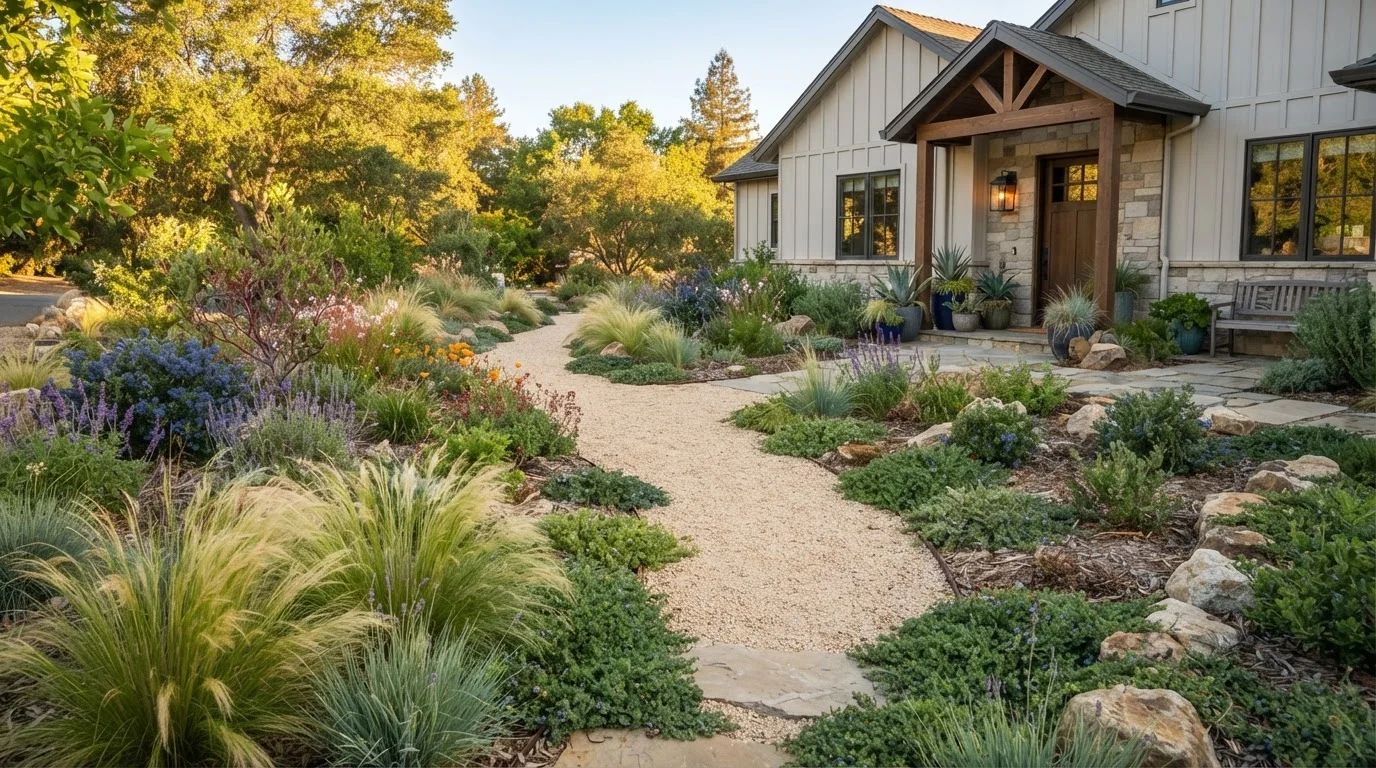
Why Low-Maintenance Landscaping Is Worth Planning Carefully
A yard that looks sharp without demanding hours of upkeep each weekend isn't an accident - it's the result of deliberate design decisions made at the start. The most common mistake homeowners make is planting what looks attractive in a nursery without considering how much ongoing care each species requires. Water-hungry annuals, invasive groundcovers, and sprawling shrubs that need constant shaping can quietly consume dozens of hours a season.
Low-maintenance landscaping doesn't mean a bare or boring yard. It means choosing the right plants for your soil and climate, reducing the square footage that demands frequent attention, and building in systems - like mulch layers and efficient irrigation - that do background work for you. The strategies below address the most common sources of yard labor: watering, weeding, mowing, and seasonal replanting.
Prioritise native and regionally adapted plants
Plants native to your region have evolved alongside local rainfall patterns, soil conditions, and temperature swings. Once established - typically after one to two growing seasons - they generally require little to no supplemental watering, are resistant to local pests, and don't need fertilizer to thrive. A lawn border planted with native ornamental grasses or wildflowers can look intentional and attractive while demanding a fraction of the care that traditional flower beds require.
When selecting natives, research species that are specifically suited to your USDA hardiness zone and your soil type (clay-heavy, sandy, or loam). Many cooperative extension programs by state or county publish free plant lists tailored to local conditions - these are reliable, unbiased starting points. Native plants also tend to support local pollinators, which is a worthwhile bonus; see our guide to creating a wildlife-friendly garden for more on that dimension.
Native plants, once established, rarely need supplemental watering or fertilizer to look their best.
Replace high-maintenance turf with groundcovers or hardscaping
Traditional lawn grass is among the most labor-intensive surfaces in any yard - it needs mowing, edging, fertilizing, aerating, overseeding, and irrigation. Replacing even a portion of your lawn with a low-growing groundcover or a gravel/stone hardscape area can meaningfully reduce weekly work. Groundcovers such as creeping thyme, clover, or low-growing sedges handle foot traffic reasonably well, suppress weeds once established, and require mowing only occasionally or not at all.
Hardscaping alternatives - decomposed granite paths, flagstone patios, or gravel borders - eliminate biological maintenance entirely in those zones. They do require occasional raking or edging to stay tidy, but that effort is far less frequent than turf care. Keep in mind that extensive hardscaping can affect stormwater runoff on your property; permeable options like gravel or spaced pavers allow water to filter through and are worth prioritising where drainage is a concern. Check with your local municipality, as some areas have guidelines on impervious surface coverage.
Swapping even a quarter of your lawn for groundcover or gravel can cut mowing time substantially.
Shift toward perennials over annuals
Annuals bloom prolifically for a season but die at the end of it, requiring you to replant each year. Perennials return from their root systems year after year, which means a one-time planting investment pays dividends in reduced effort over multiple seasons. While perennials may have a shorter individual bloom window than some annuals, strategic plant selection - choosing species that bloom in staggered sequences from spring through fall - can maintain visual interest throughout the growing season.
A useful approach is to anchor your beds with reliable perennials and reserve a small portion of space for a few annuals where you want seasonal color control. This balance gives you long-term stability without sacrificing flexibility. Our article on annual vs. perennial plants breaks down this trade-off in practical detail.
Perennials return each year from their roots, eliminating the annual cost and labor of replanting.
Apply mulch consistently across planting beds
A 2-3 inch layer of organic mulch - such as wood chips, shredded bark, or straw - is one of the most effective investments a gardener can make. It suppresses weed germination by blocking light from reaching the soil surface, retains soil moisture so you water less frequently, moderates soil temperature, and gradually breaks down to improve soil structure. In practice, a well-mulched bed may need weeding only a few times per season compared to an unmulched bed that requires weekly attention.
The key is applying mulch in spring before weeds establish, and topping it up as it decomposes - typically once per season for organic types. Avoid piling mulch against plant stems or tree trunks, which can encourage rot and pest harboring. Inorganic mulches like gravel or landscape fabric offer longer-lasting weed suppression but don't improve soil health over time. For a thorough look at technique and material selection, see our dedicated guide on mulching your garden.
Two to three inches of mulch can cut your weeding time dramatically over the course of a season.
Install efficient irrigation to water smarter, not more
Overhead sprinklers are convenient but waste significant water through evaporation and often wet foliage unnecessarily, which can promote fungal disease. Drip irrigation systems and soaker hoses deliver water directly to root zones slowly and consistently, which is more effective for most garden plants and greatly reduces the need for manual watering. Once installed, a timer-equipped drip system can operate without any daily intervention from you.
Efficient irrigation also reduces weed pressure: by wetting only the soil around your plants rather than broad surface areas, you avoid inadvertently sprouting weed seeds across open ground. Our comparison of drip irrigation vs. sprinkler systems covers the cost and installation trade-offs in detail so you can choose what works for your layout.
Drip irrigation delivers water precisely to roots, reducing both water waste and weed germination across beds.
Choose slow-growing or compact shrubs for structure
Structural shrubs are the backbone of a low-maintenance yard - they provide year-round form and screening without seasonal replanting. The problem arises when fast-growing or large-maturing varieties are planted in spaces too small for them, requiring frequent pruning to keep in check. Choosing compact or slow-growing cultivars suited to their intended space from the outset eliminates much of that ongoing shaping work.
When selecting shrubs, note the mature size on the plant tag and design with those dimensions in mind rather than the nursery pot size. A shrub that naturally matures at 3 feet wide doesn't need to be pruned into that shape - it will hold it on its own. Evergreen options provide visual structure through winter without leaf cleanup, which is an added labor savings in fall.
Choosing shrubs whose mature size fits your space eliminates most routine pruning from your schedule.
Making It All Work Together
The real power of low-maintenance landscaping comes from combining these approaches rather than adopting them one at a time. For example, native plantings perform even better when surrounded by a deep mulch layer - you can learn more in our guide to mulching your garden - and efficient irrigation makes drought-tolerant plants even more forgiving during unusually dry stretches. If you're weighing whether to commit to in-ground planting at all, our comparison of raised beds vs. in-ground planting may help clarify which setup suits your effort tolerance.
Think of each strategy as a building block. A yard redesigned with even two or three of these approaches in place typically sees a meaningful reduction in weekend work within the first full growing season. Start with the area that demands the most from you right now - whether that's a thirsty lawn section, an overgrown border, or a slope that's constantly eroding - and build outward from there.
Start With an End-of-Season Review
Before redesigning any part of your yard, walk through it at the end of the growing season and note which areas consumed the most time and resources. Problem zones - perpetually dry slopes, persistently weedy borders, or turf that struggles in shade - are the highest-value candidates for a low-maintenance redesign. Our autumn garden wind-down checklist includes prompts that make this kind of assessment easier to do systematically.