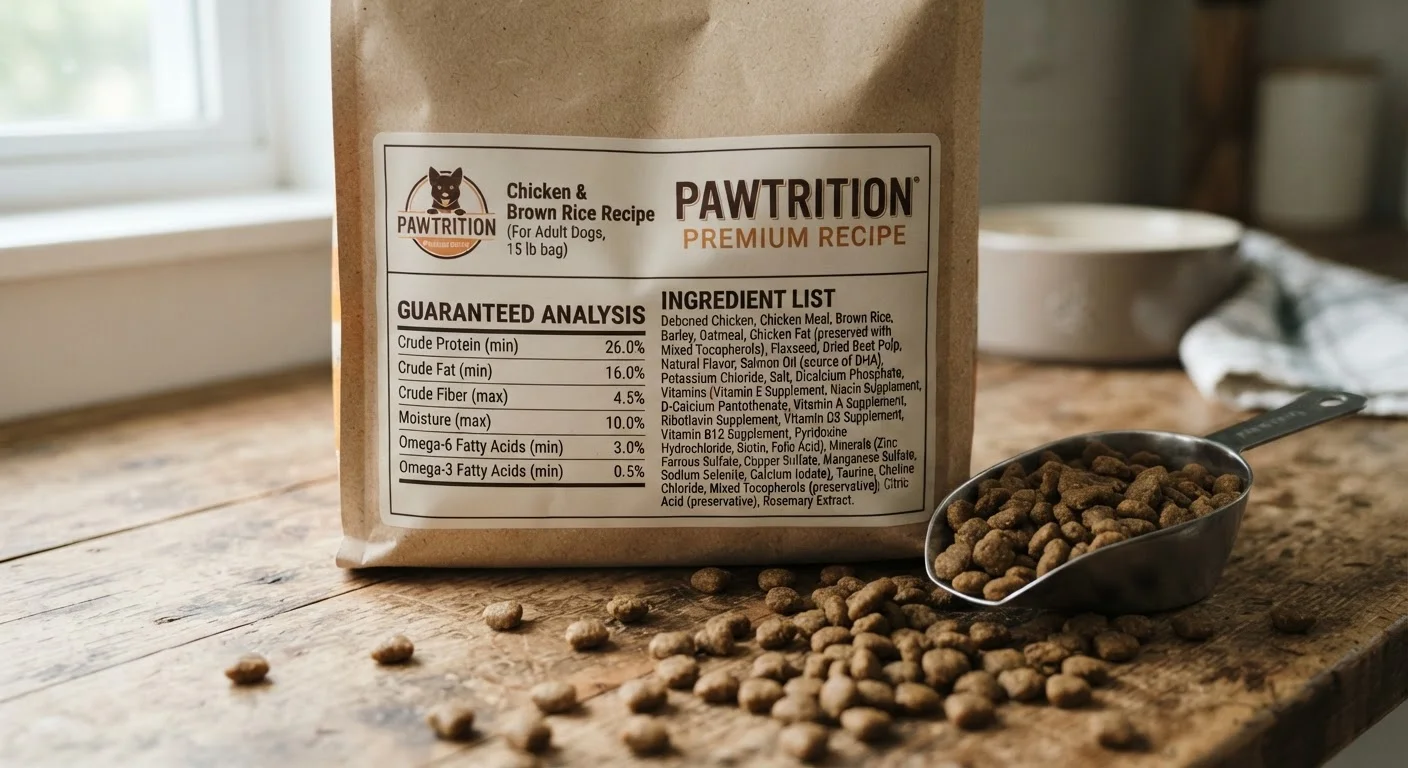
The Anatomy of a Pet Food Label
Every commercially sold pet food in the United States must meet labeling standards set by two overlapping authorities: the AAFCO and the FDA. Together, they require that labels include the product name, net weight, ingredient list, guaranteed analysis, nutritional adequacy statement, feeding directions, and manufacturer contact information. Knowing what each panel actually communicates - and what it deliberately omits - is the foundation of informed pet feeding.
The product name is more regulated than most owners realize. AAFCO's naming rules create a de facto ranking system:
- 95% rule: If a product is called "Chicken for Dogs," chicken must make up at least 95% of the total product weight (excluding water used in processing).
- 25% or "dinner" rule: Names like "Chicken Dinner" or "Chicken Entrée" require that ingredient to constitute only 25-94% of the food.
- 3% or "with" rule: "Dog Food with Chicken" needs just 3% chicken by weight.
- "Flavor" rule: "Chicken Flavor" carries no minimum percentage - only enough to be detectable.
This hierarchy means a bag labeled "Salmon Dinner" may contain far less salmon than a bag simply called "Salmon." For a deeper look at how ingredient sourcing and quality interact with cost, see our guide on stretching your pet food budget without cutting nutritional corners.
| Governing bodies | AAFCO (model regulations) + FDA (federal oversight) (FDA & AAFCO official guidance) |
| "With" rule minimum | 3% of total formula by weight (AAFCO Pet Food Labeling Guide) |
| "Dinner" rule minimum | 25% of total formula by weight (AAFCO Pet Food Labeling Guide) |
| "Natural" - regulated? | Yes, by AAFCO definition (with exceptions for synthetic vitamins) (AAFCO Model Regulations) |
| "Holistic" or "premium" - regulated? | No standardized definition exists (AAFCO Pet Food Labeling Guide) |
| Life stages recognized | Growth, maintenance, all life stages, gestation/lactation (AAFCO Nutrient Profiles) |
Ingredient Lists and the Guaranteed Analysis Panel
Ingredients are listed in descending order by pre-cooking weight. This sounds straightforward, but moisture content complicates the picture significantly. Fresh chicken, for example, is roughly 70% water - so it appears high on the list partly because of that moisture, not just protein density. Once cooked and dried, chicken meal (which lists lower) may actually contribute more protein per gram than the fresh form. Neither is inherently superior; understanding the difference helps you read context accurately.
Ingredient splitting is a practice where a single ingredient is divided into multiple components - for example, listing "ground corn," "corn gluten meal," and "corn flour" separately. This pushes each corn derivative lower on the list, even though corn collectively may dominate the formula. Watch for this pattern, especially with grains and legumes.
The guaranteed analysis panel reports minimum percentages of crude protein and crude fat, and maximum percentages of crude fiber and moisture. "Crude" refers to the laboratory measurement method, not ingredient quality - it measures all nitrogen-containing compounds, not just digestible protein. This panel is useful for comparing foods, but only on a dry matter basis: strip out the moisture percentage before comparing a wet food to a dry one, otherwise you're comparing apples to oranges.
The guaranteed analysis tells you what is present but not how digestible or bioavailable those nutrients are. Digestibility data is rarely published on consumer packaging.
AAFCO
The Association of American Feed Control Officials is a voluntary membership organization that establishes model regulations for pet food labeling, ingredient definitions, and nutritional standards. While AAFCO itself doesn't enforce laws, its guidelines are widely adopted by state regulators.
Guaranteed Analysis
A required label panel reporting minimum crude protein and fat percentages, and maximum crude fiber and moisture percentages. It reflects measurable nutrient levels but does not indicate digestibility or ingredient quality.
Dry Matter Basis
A calculation method that removes moisture from the equation to allow accurate comparison of nutrient levels between wet and dry pet foods. Divide the nutrient percentage by (100 minus the moisture percentage), then multiply by 100.
Nutritional Adequacy Statement
An AAFCO-required statement indicating whether a pet food is complete and balanced for a specific life stage. It also notes whether that claim was substantiated through feeding trials or formulation against a nutrient profile.
Ingredient Splitting
A formulation practice where one ingredient is listed as multiple sub-forms, pushing each lower on the ingredient list than the total combined amount would suggest. This can obscure how much of that ingredient is actually present.
Crude Protein
A laboratory measurement of total nitrogen-containing compounds in a food, used to estimate protein content. It is a proxy measure and does not directly reflect protein digestibility or amino acid availability.
Marketing Claims: What's Regulated and What Isn't
Pet food packaging carries two types of claims: those with regulatory definitions and those that are purely marketing language. Knowing which is which prevents you from paying a premium for language that has no enforced standard.
"Natural" has an AAFCO definition: ingredients derived solely from plant, animal, or mined sources, without synthetic chemical alteration. However, foods labeled "natural" may still contain synthetic vitamins and minerals - AAFCO permits this with a qualifying disclaimer. The term carries no nutritional superiority on its own.
"Organic" is regulated by the USDA National Organic Program and carries meaningful standards for how ingredients were grown or raised. Look for the USDA Organic seal, not just the word.
"Holistic," "premium," "human-grade," and "ancestral" have no standardized AAFCO definitions and are essentially unregulated marketing language. Their presence on packaging does not guarantee ingredient quality or nutritional completeness.
The single most important regulatory statement on any pet food label is the AAFCO nutritional adequacy statement - often called the "complete and balanced" statement. It specifies which life stage the food is formulated for (e.g., growth, maintenance, all life stages) and whether the claim is based on AAFCO feeding trials or nutrient profile formulation. Foods labeled "for supplemental or intermittent feeding only" are not complete and balanced and should not serve as a primary diet without veterinary guidance.
If you're exploring grain-free options, be aware the science is still evolving - our article on the real story behind grain-free pet diets covers the current research landscape in detail.
This article provides general educational information about pet food labeling and is not a substitute for personalized veterinary nutrition advice. Consult your veterinarian before making significant changes to your pet's diet, especially for animals with health conditions.