Why Service Terminology Is Inconsistent
Walk into three different garages and ask what a "full service" covers, and you may get three different answers. Unlike MOT testing, which has a defined government standard in the UK, vehicle servicing has no legally mandated checklist. Garages set their own scope, which means the label alone tells you little about what you're actually getting.
This matters for your wallet and your vehicle's reliability. Before authorizing any service, ask the garage for a written itemized list of what's included. Cross-reference it with your owner's manual, which specifies manufacturer-recommended intervals. See also our guide on your car's maintenance schedule for a breakdown of what each milestone actually means.
Interim Service: The Essentials Only
An interim service is designed as a mid-year check, not a replacement for a full service. It typically targets the items most likely to need attention between longer intervals.
Commonly included in an interim service:
- Engine oil and oil filter replacement
- Visual brake inspection (pads and discs)
- Tire pressure check and tread depth measurement
- Top-up of screenwash and coolant reservoir
- Check of lights, wipers, and horn operation
- Visual inspection under the hood for leaks or obvious wear
What it typically does not include: air filter replacement, fuel filter, spark plugs, brake fluid change, or a thorough inspection of steering and suspension components. If a garage claims their interim covers all of these, verify with that written checklist - it may be priced accordingly, or some items may be inspected rather than replaced.
Interim services are most useful for drivers covering high annual mileage - generally more than 15,000-20,000 miles per year - who need a safety check between their annual full service.
Ask for a Pre-Service Checklist in Writing
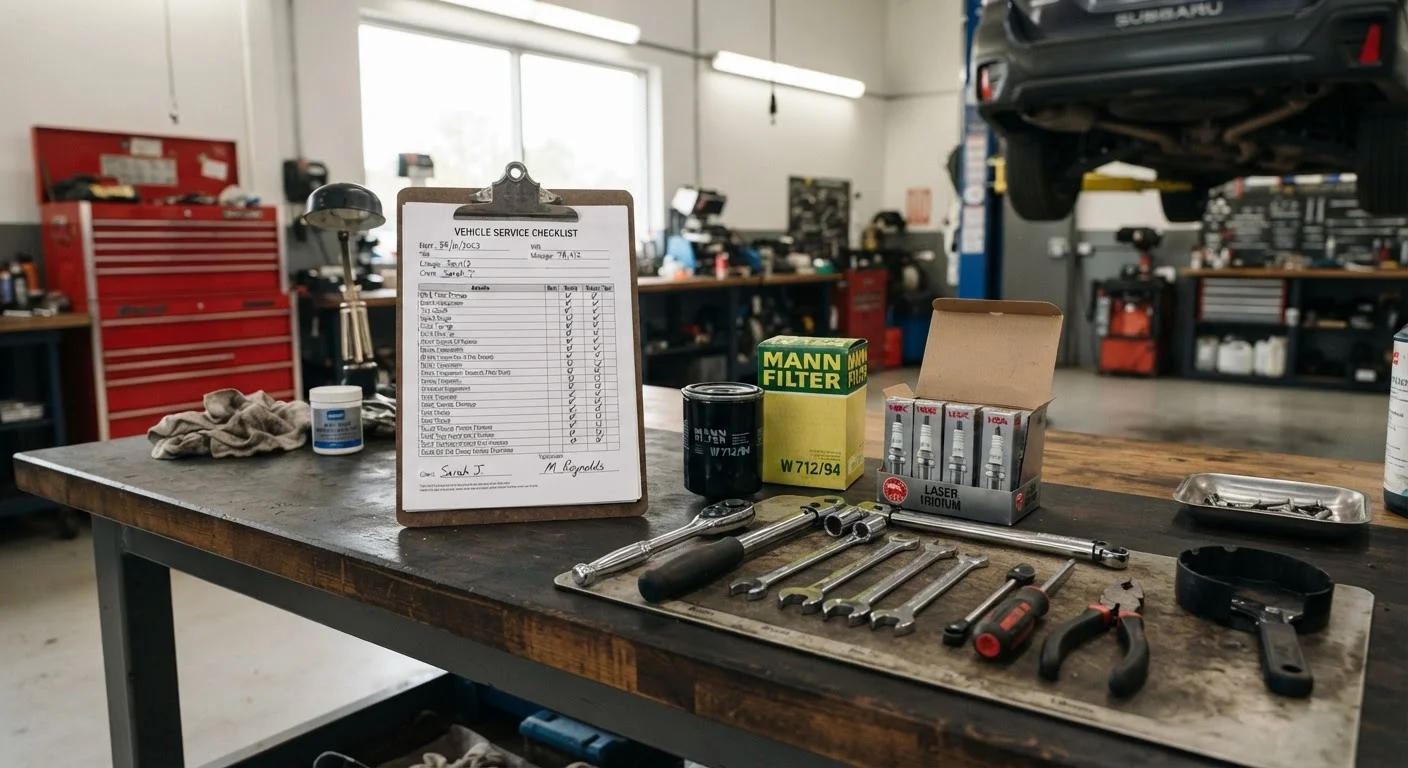
Before any work begins, request the garage's service checklist in writing and compare it against your owner's manual. This takes less than five minutes and ensures you know exactly what you're paying for. If the garage can't or won't provide one, that's a useful piece of information on its own.
Full Service: The Standard Annual Check
A full service is what most drivers should schedule once per year or every 12,000 miles, whichever comes first. It builds on everything in an interim and adds a more thorough examination of safety-critical and wear-prone systems.
What a full service typically adds over an interim:
- Air filter inspection or replacement
- Brake fluid condition test (replacing if moisture-contaminated)
- Inspection of steering rack, wheel bearings, and suspension components
- Serpentine or drive belt visual check
- Battery health test
- Exhaust system visual inspection
- Fuel system visual check
Note that even at this level, spark plugs and cabin air filters are often excluded unless you specifically request them or they fall within your manufacturer's recommended interval. Always clarify this upfront.
For context on how service records can affect insurance and vehicle value assessments, our auto insurance explainer covers how vehicle condition factors into coverage considerations.
| Interim Service | Full Service | Major Service | |
|---|---|---|---|
| Typical interval | 6 months / 6,000-10,000 miles | 12 months / 12,000 miles | 2-3 years / 24,000-36,000 miles |
| Oil & filter change | Yes | Yes | Yes |
| Brake fluid change | Not typically | If contaminated | Yes |
| Air filter replacement | No | Inspect / replace | Replace |
| Spark plugs | No | No | Yes |
| Cabin air filter | No | No | Yes |
| Suspension & steering check | Visual only | Detailed inspection | Comprehensive inspection |
| Coolant flush | No | No | Yes |
Major Service: The Long-Cycle Overhaul
A major service is typically recommended every 2-3 years or every 24,000-36,000 miles, though your owner's manual takes precedence over any general guidance. It covers everything in a full service and targets components with longer wear cycles that most drivers never think about until they fail.
Additional items commonly included in a major service:
- Spark plug replacement (for gasoline engines)
- Cabin air filter replacement
- Fuel filter replacement (where accessible and applicable)
- Coolant flush and refill
- Transmission fluid inspection or change (vehicle-dependent)
- Comprehensive brake system inspection including calipers and lines
A major service at an independent garage versus a dealership can vary significantly in scope and cost. Our comparison of dealership service centres vs independent mechanics walks through the trade-offs in detail.
This article provides general informational guidance on vehicle servicing. Always consult your vehicle's owner's manual and a qualified mechanic for advice specific to your make, model, and driving conditions.
Skipping Intervals Has Real Consequences
Delaying or downgrading a recommended service isn't just a maintenance issue - it can void a manufacturer or extended warranty if documented service records show gaps. Some mechanical failures, such as engine damage from neglected oil changes, are also excluded from insurance claims as maintenance-related issues. Follow your manufacturer's schedule, not just a garage's promotional offering.