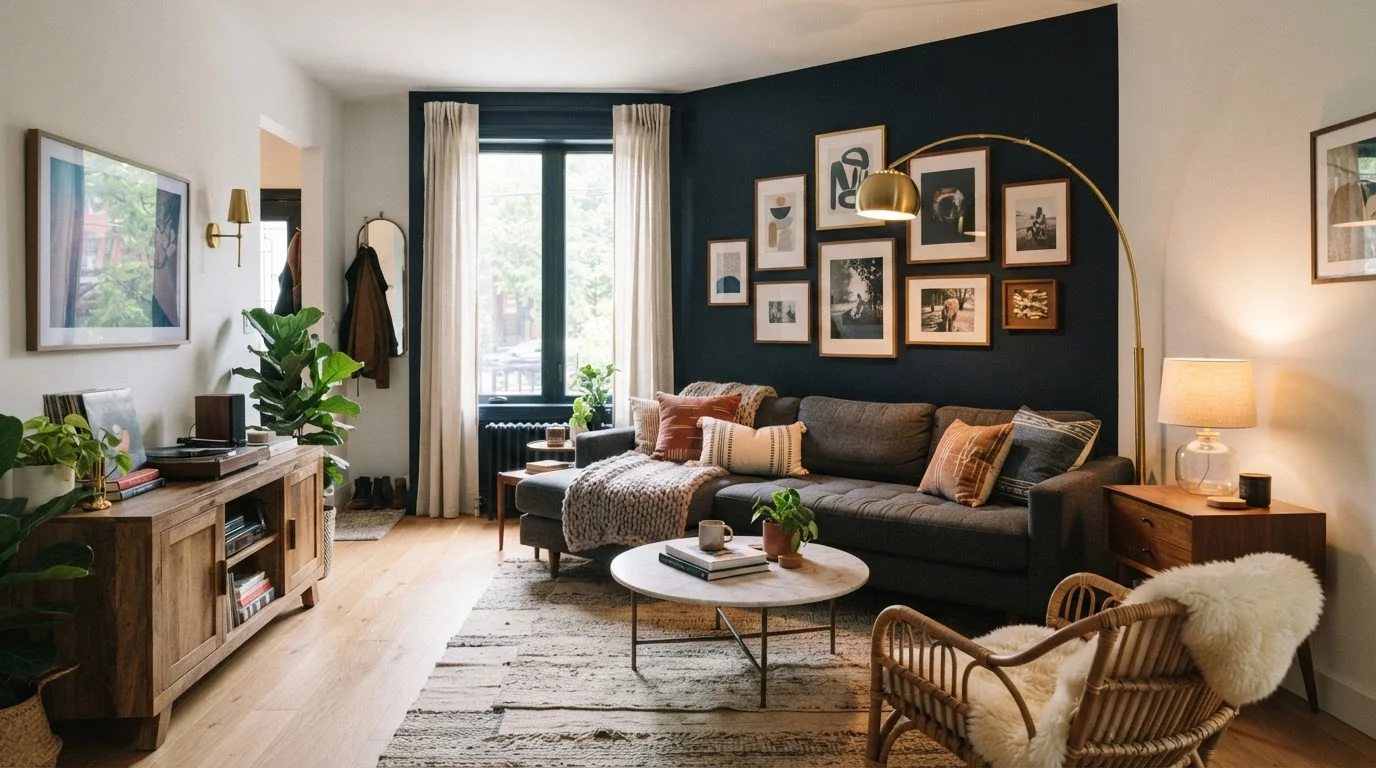
Why Decorating Myths Persist - and What They Actually Cost You
Many home decorating rules passed around in magazines, social media, and even hardware stores were never evidence-based to begin with. Some originated as simplifications that got repeated until they were treated as fact. Others made sense in one context - a particular era of design, a specific room type - and were then applied universally. The result is that a large number of homeowners spend money fixing problems that the "rules" themselves created.
The myths below aren't just harmless conventional wisdom. They lead to furniture purchases that don't fit, paint choices that disappoint, and rooms that never quite come together despite repeated attempts. Understanding what the evidence actually supports - from design practice and spatial reasoning - allows you to make decisions based on your specific space rather than inherited assumptions. For a grounding in the underlying principles, core interior design concepts are worth reviewing before starting any project.
Myth
Small rooms need small furniture to avoid feeling cramped.
Fact
One or two appropriately scaled pieces typically make a small room feel larger and more intentional than a collection of undersized items.
Filling a compact room with petite furniture tends to create visual clutter and makes the space feel busy rather than spacious. A single, well-proportioned sofa or bed anchors the room and provides breathing space around it. Interior designers generally recommend choosing one or two larger, correctly scaled anchor pieces and keeping the surrounding area clear. For more strategies, see practical approaches for compact bedrooms.
Myth
Dark paint colors make a room feel smaller and should be avoided in tight spaces.
Fact
Dark colors can actually make a room feel more enveloping and defined - the effect depends heavily on lighting, sheen, and how the color is applied.
When walls, trim, and ceiling are painted the same deep tone, the boundaries of a room become less distinct, which can create a sense of depth rather than confinement. Rooms with poor natural light may benefit more from warm, reflective neutrals, but a dark color in a well-lit space often reads as intentional and sophisticated. The relationship between color temperature and perceived room size is nuanced and worth understanding before ruling out any palette.
Myth
All furniture in a room should match - same wood finish, same style, same collection.
Fact
Intentional mixing of finishes, eras, and materials produces rooms that look more layered and personal than matched sets.
Furniture sold as a matching set is convenient, but rooms decorated entirely from a single collection can appear flat or showroom-like. Designers typically combine pieces with a unifying thread - a repeated color, material, or silhouette - rather than identical finishes. Mixing a vintage wooden side table with a contemporary upholstered chair, for example, adds visual interest and allows you to spread spending across time instead of buying everything at once.
Myth
A small rug is the safer, more affordable choice in a modest-sized room.
Fact
Undersized rugs are among the most common decorating errors - a rug that's too small makes furniture look unmoored and rooms feel disconnected.
The standard guidance from design professionals is that at minimum the front legs of all major seating should sit on the rug, and ideally the rug should extend several inches beyond the furniture grouping on each side. A small rug floating in the center of a room fragments the visual field rather than anchoring it. Buying one correctly sized rug - even a simpler one - nearly always outperforms two smaller rugs chosen primarily on price.
Myth
You need to redecorate entirely when your style changes or a room feels dated.
Fact
Targeted updates to lighting, textiles, and key accents can transform a room's feel without replacing furniture or repainting.
Swapping out throw pillows, changing window treatments, updating a light fixture, or adding a new mirror can shift a room's character substantially. Seasonal décor refreshes show how this works in practice - the structural elements of a room (upholstery, large furniture, flooring) rarely need to change as often as people assume. For a more systematic approach, working through a room planning checklist before making any purchases can prevent unnecessary spending.
Myth
Accent walls are always a good solution for adding personality to a plain room.
Fact
An accent wall works well in the right context, but applied indiscriminately it can feel dated or visually disjointed.
The accent wall became a popular shortcut for adding color, but its success depends entirely on the room's architecture and layout. A bold wall behind a fireplace or bed headboard follows a natural focal point and generally reads well. A random wall singled out purely for contrast often highlights an awkward proportion or creates imbalance. Consider comparing wall treatment options - including panelling and wallpaper - before defaulting to paint alone.
Rethinking Spending: Where Decorating Money Actually Has Impact
One of the costliest myths isn't about any single decorating choice - it's the assumption that spending more automatically produces better results. In practice, the elements that most transform a room are proportion, lighting, and layout: none of which require a large budget, but all of which require planning.
Proportion Matters More Than Price
Replacing a piece of furniture that's the wrong scale for your room will do more for its appearance than any expensive accessory purchase. Before buying anything new, measure your space carefully and sketch a basic floor plan. Good proportion is the foundation of every well-designed room, and it costs nothing to plan for it.
Lighting in particular is chronically underinvested in. A room lit by a single overhead fixture almost always feels flat regardless of how good the furnishings are. Layering ambient, task, and accent lighting - through floor lamps, table lamps, and wall sconces - changes the character of a space in ways that new furniture rarely does. Using lighting as a decorative layer is one of the highest-return changes available in any room.
Don't Repaint Without Testing First
Paint color looks dramatically different under artificial light, natural daylight, and evening lamp glow. Always apply at least two large swatches to the actual wall and observe them at different times of day before committing to a full can. Skipping this step is one of the most common - and expensive - mistakes homeowners make.
If a room still feels off after multiple rounds of changes, the issue is often spatial or structural rather than aesthetic. Common reasons a living room doesn't come together are frequently rooted in furniture placement and scale rather than style choices. Addressing those foundations first - before adding more décor - is nearly always the more efficient and cost-effective approach. It's also worth noting that shopping decisions in general, not just for home goods, are susceptible to myths: the price comparison myths that cost shoppers money article is a useful companion read before any significant purchase.