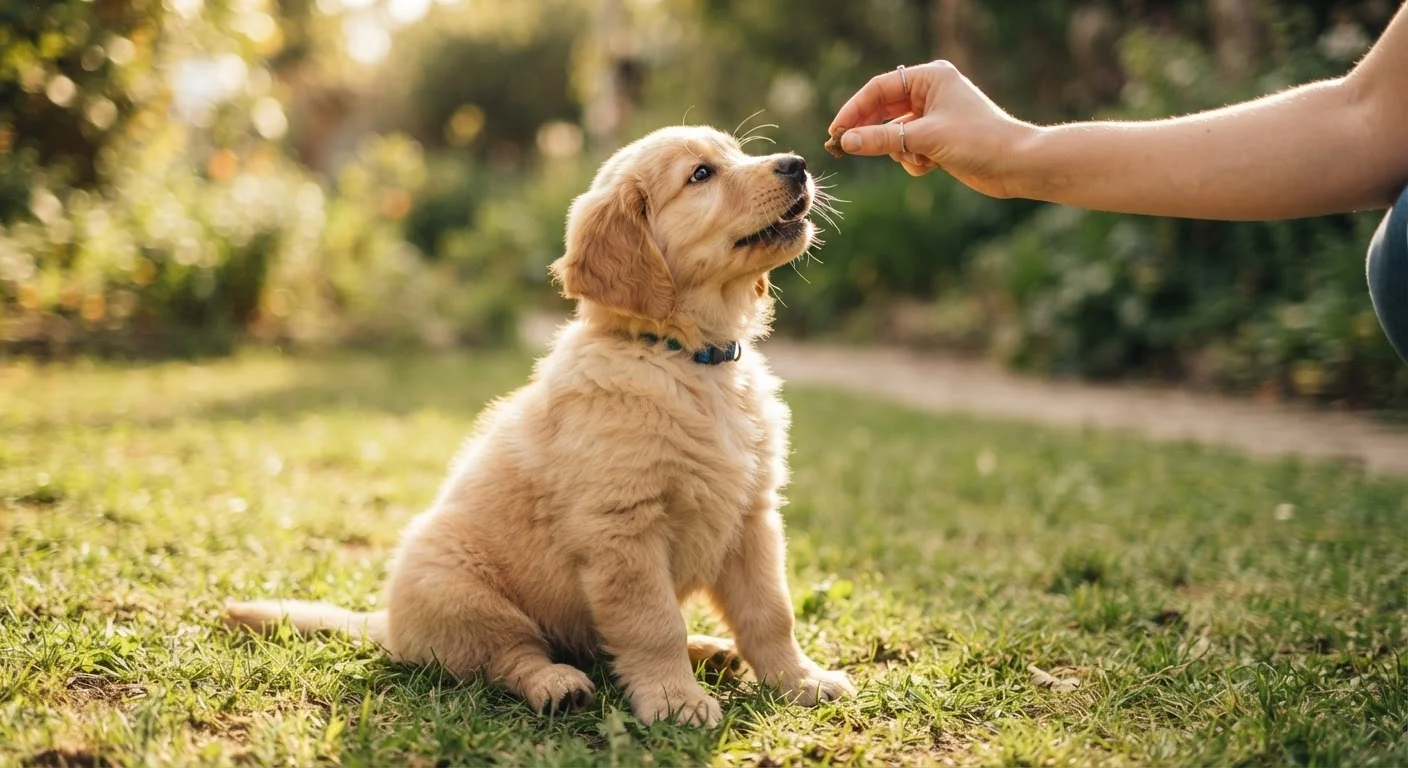
When to Start Training Your Puppy
One of the most common misconceptions new owners hold is that formal training should wait until a puppy is several months old. In reality, learning begins the moment your puppy arrives home. Puppies as young as 7-8 weeks can absorb simple cues, and the habits - good or bad - that form in those first weeks tend to stick.
That said, early training must match a puppy's developmental stage. Very young puppies have limited impulse control and stamina. The goal at first isn't precision obedience; it's building a positive association with the learning process itself. Keep sessions to 3-5 minutes, use high-value rewards (small, soft treats work well), and stop while your puppy is still engaged rather than waiting for frustration to set in.
Positive reinforcement
Adding something rewarding (like a treat or praise) immediately after a desired behaviour to make that behaviour more likely to happen again.
Lure training
Using a treat or toy held in your hand to guide a puppy's body into a desired position, then rewarding once they complete the movement.
Socialisation window
A sensitive developmental period, roughly 3 to 14 weeks of age, during which puppies most readily accept new experiences that shape their long-term temperament.
Bite inhibition
A puppy's learned ability to control the pressure of their mouth - understanding that biting down hard on people is not acceptable, even during play.
Marker training
Using a precise signal - a word like 'yes' or a click from a clicker - at the exact moment of a desired behaviour to communicate clearly to the dog that a reward is coming.
Cue
A word, hand signal, or other signal that tells a dog to perform a specific behaviour - what most people casually call a 'command'.
Owners often wonder how puppy training differs from working with an adult dog. The fundamentals of positive reinforcement remain the same at any age - for a deeper look at what changes and what doesn't, see our article on training an older dog.
Core Commands Every Puppy Should Learn
A handful of foundational cues form the backbone of a well-mannered dog. Mastering these early makes everything else - including vet visits and encounters with strangers - significantly less stressful.
- Sit: The easiest starting point for most puppies. Lure your puppy's nose upward with a treat; their hindquarters will naturally drop. Mark the moment they sit (with a word like 'yes' or a clicker) and reward immediately.
- Stay: Build duration gradually. Start with just one second, then slowly increase. Release with a consistent word like 'free' or 'okay' so your puppy understands exactly when the cue ends.
- Come (recall): Perhaps the most safety-critical cue your puppy will ever learn. Practice in low-distraction environments first, always making 'come' predict something wonderful - never a scolding.
- Leave it: Invaluable for preventing your puppy from ingesting hazardous objects. Teach it as a trade rather than a confrontation: offer something better in exchange for what they're about to take.
- Loose-leash walking: Pulling is normal early behaviour, not defiance. Rewarding your puppy for staying at your side consistently - rather than lunging forward - builds the habit gradually.
Treats are the most practical reward for most puppies, but praise, play, and access to interesting environments also function as powerful reinforcers. Varying your rewards keeps motivation high over time.
Use Treats Wisely to Keep Costs Down
Training treats should be small - roughly the size of a pea - so your puppy gets the reward without filling up quickly or consuming excess calories. Soft, easily chewed options work best for rapid repetition. You can often use a portion of your puppy's regular daily food as training rewards, which keeps both costs and calorie intake in check. Visit our pet nutrition hub for guidance on keeping meals and treats balanced.
Crate Training and House Training Basics
A crate, introduced thoughtfully, becomes a puppy's refuge rather than a punishment. Dogs are naturally inclined to avoid soiling their sleeping area, which makes crate training one of the most efficient routes to reliable house training.
Introduce the crate gradually: toss treats inside, feed meals near or in it, and let your puppy explore without closing the door at first. Once your puppy enters willingly, begin closing the door briefly while staying nearby. Increase duration slowly over several days. A puppy that has been rushed into the crate and left crying will associate it with distress - patience here saves significant struggle later.
For house training, consistency is the operative word. Take your puppy outside first thing in the morning, after every meal, after naps, and after play sessions. When they eliminate outdoors, reward enthusiastically and immediately - the reward needs to land within seconds of the behaviour to be meaningful. Accidents indoors are a management failure, not a moral one; they signal the puppy was unsupervised too long. Clean accidents with an enzymatic cleaner to fully eliminate odour, which can otherwise draw puppies back to the same spot.
Most puppies develop reliable house training between 4-6 months, though some breeds and individuals take longer. If you have persistent concerns, your veterinarian can rule out any underlying health issues - your new pet's first vet visit is a good place to start building that relationship early.
Socialisation: Why It Matters and How to Do It
Socialisation is the process of exposing a puppy to a wide variety of people, animals, environments, sounds, and surfaces during the developmental window when new experiences are most easily accepted. This window - roughly 3 to 14 weeks - closes gradually, and experiences (or their absence) during this time have lasting effects on temperament.
Effective socialisation isn't about flooding a puppy with stimulation. Each new experience should be positive or at least neutral. Watch your puppy's body language: a relaxed, curious puppy is coping well; a cowering, trembling, or frantically trying-to-escape puppy is overwhelmed. Create distance from the trigger and go at the puppy's pace.
Practical socialisation targets include:
- Different types of people - various ages, appearances, and wearing different accessories like hats or umbrellas
- Gentle, vaccinated, temperament-tested dogs
- Common urban sounds: traffic, construction, crowds
- Varied surfaces: grass, gravel, tile, metal grates
- Handling experiences: ears, paws, mouth - essential for future vet and grooming visits
Note that before your puppy's vaccination series is complete, exposure to unknown dogs and public areas where unvaccinated dogs roam carries infectious disease risk. Consult your veterinarian about how to balance safe socialisation with health protection - this is one of the key conversations to have at that first appointment.
Socialisation Must Not Compromise Vaccination Safety
Before your puppy has completed their core vaccine series, exposure to environments frequented by unknown dogs (dog parks, pet store floors) carries a real risk of infectious illness, including parvovirus. Work with your veterinarian to create a socialisation plan that introduces new experiences safely - for example, carrying your puppy in areas with high foot traffic, or arranging visits with known, vaccinated dogs in private settings.
Common Training Mistakes and How to Avoid Them
Even well-intentioned owners fall into predictable patterns that slow progress. Knowing these pitfalls in advance saves weeks of frustration.
- Inconsistency across household members
- If one person allows jumping and another corrects it, the puppy receives conflicting information and the behaviour persists. Agree on rules before the puppy comes home and hold everyone to them.
- Delayed rewards
- Puppies live in the present moment. A treat delivered five seconds after the desired behaviour rewards whatever the puppy is doing at that exact second - not the sit you asked for. Aim to reward within one to two seconds of the behaviour.
- Training only when problems occur
- Reactive training - correcting bad behaviour after it happens - is far less effective than proactive training that builds incompatible good behaviours. Teach your puppy what to do, not just what not to do.
- Expecting too much, too fast
- A 10-week-old puppy does not have the cognitive or physical development of a 6-month-old. Pushing too hard too soon creates frustration on both sides and can undermine confidence.
- Skipping professional guidance
- Self-guided training works well for most basics, but complex behaviour challenges benefit from expert eyes. Our breakdown of DIY training versus hiring a professional can help you decide when outside help makes sense.
Puppy training is a gradual process, not a single event. The consistency and patience you invest in these early months lay the groundwork for a dog who is safe, confident, and genuinely enjoyable to live with for the years ahead.