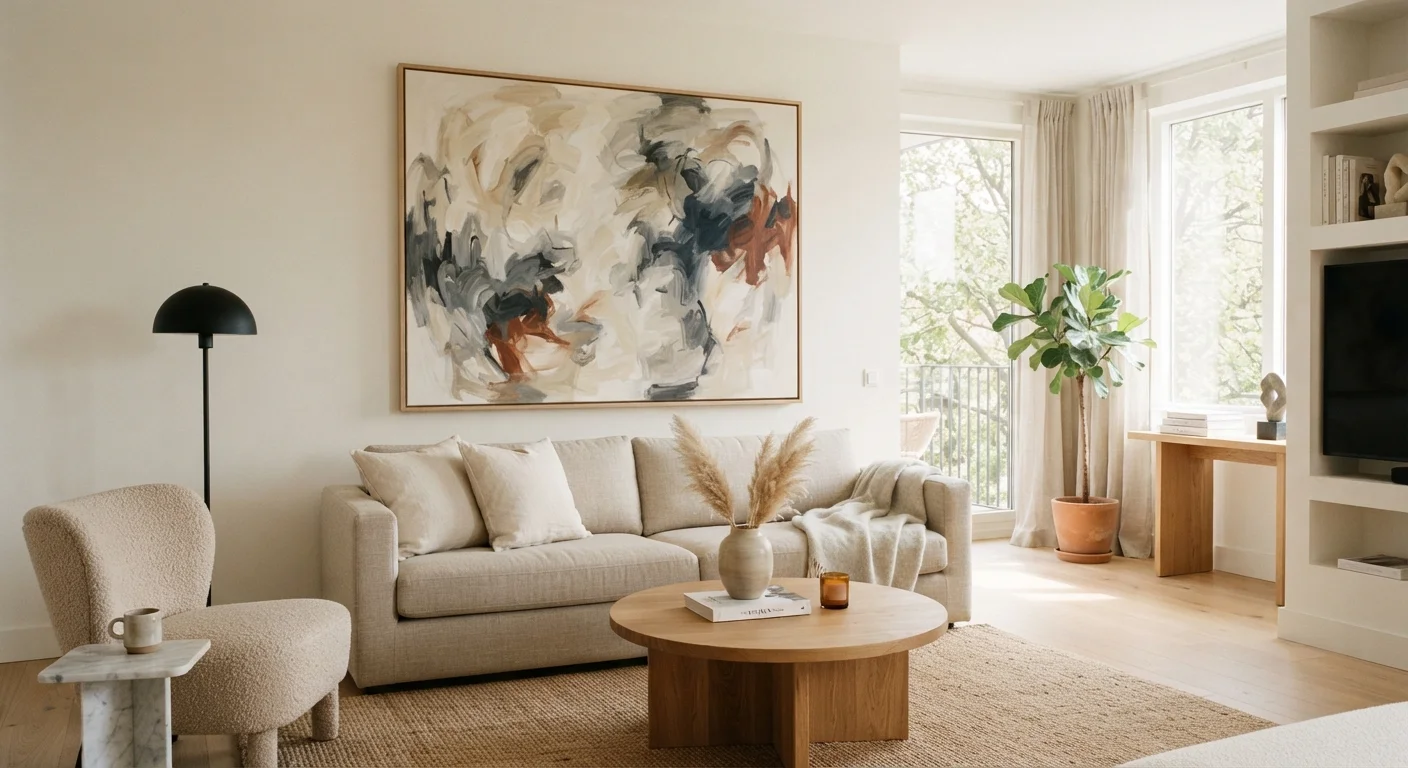
What 'Decorating Around a Hero Piece' Actually Means
A hero piece - sometimes called an anchor or focal item - is a single element that commands the room's visual attention and drives every subsequent design decision. It might be a boldly patterned area rug, an oversized piece of artwork, a sculptural sofa, or even an architectural feature like an ornate fireplace surround.
The idea is straightforward: instead of assembling a room piece by piece and hoping it coheres, you start with the one item that matters most and let its colors, scale, and mood guide everything else. Paint colors are sampled from it. Accent furniture is chosen to complement rather than compete with it. Textiles echo its palette without duplicating it.
If you're new to this approach, our room-by-room introduction to home decorating explains how focal points fit into broader room-planning priorities.
The Real Advantages
When it works, this strategy offers several concrete benefits that make decorating more efficient and the end result more polished.
Gives the room an instant, clear focal point
A hero piece tells both the designer and the visitor where to look first, preventing the visual restlessness that comes from a room where nothing takes precedence. This sense of order tends to read as intentional and polished.
Simplifies every subsequent design decision
When the hero piece sets the palette and mood, secondary choices become easier to evaluate - an item either works with the anchor or it doesn't. This cuts down on deliberation time and reduces the chance of costly mismatches.
Encourages a more restrained, less cluttered result
Supporting pieces are chosen to serve the focal item rather than compete with it, which naturally limits over-purchasing and decorative noise. The result is typically a calmer, more curated-looking room.
Can protect your decorating budget
Investing meaningfully in one well-chosen piece and spending modestly on everything else is often more cost-effective than spreading a budget thinly across many mid-range items that never quite gel together.
Works well with heirloom or sentimental pieces
If you're starting with an inherited rug, a painting you love, or a statement furniture piece, this method gives that item the prominence it deserves while providing a clear framework for building around it.
Perhaps the most underappreciated advantage is budget discipline. When you know the hero piece dictates the palette, you're far less likely to impulse-purchase accent items that don't belong. Every pillow, lamp, and side table earns its place by serving the anchor - which tends to produce rooms that feel considered rather than accumulated.
The Genuine Drawbacks
No design strategy is without trade-offs, and the hero-piece approach has several worth understanding before you commit.
Rigidity when the hero piece needs to change
If you want to swap out, move, or replace the anchor - because your taste evolves, it sustains damage, or it no longer fits a new home - the entire room scheme may need revisiting. This lack of modularity can make the approach feel fragile over time.
Scale misjudgment can undermine the whole room
A hero piece that is too small for the space disappears; one that is too large overwhelms the room. Getting scale wrong at the outset means every supporting choice built on that foundation is also compromised.
Limits stylistic evolution over time
As trends shift or personal taste matures, a room built tightly around one defining piece can feel dated or locked in. Refreshing the space without disturbing the anchor requires careful navigation.
Not suited to every room layout
Rooms with multiple competing architectural features - several windows, an awkward alcove, a fireplace - may not respond well to a single-focal-point strategy, as there is no obvious place to locate or appreciate the hero item.
The most common stumbling block is scale misjudgment. A rug that reads as bold in a showroom may be overwhelmed by a large open-plan living space, or conversely, a dramatic artwork that suits a high-ceilinged gallery wall can feel oppressive in a low-ceilinged bedroom. If the hero piece doesn't fit the room proportionally, the entire scheme falters. This is one of the subtler reasons a room can still feel off after decorating even when considerable effort has gone into it.
When the Strategy Shines - and When to Reconsider
The hero-piece approach performs well in rooms with clear, uninterrupted wall space or open floor plans where a single focal point can be appreciated from multiple vantage points. Living rooms, dining rooms, and primary bedrooms tend to suit this method naturally.
A Note on Feature Walls as Hero Pieces
A statement wall treatment - bold paint, wallpaper, or panelling - can function as a hero piece in its own right, setting the room's palette and character without requiring a freestanding item. However, wall-based heroes are even harder to change than furniture or art, so committing to one requires confidence in the direction. Paint, wallpaper, panelling, and tile each carry different cost and permanence trade-offs worth understanding before you decide.
It's worth reconsidering when the room has several competing architectural features - bay windows, an alcove, a fireplace, and a through-corridor, for instance - because no single piece can realistically anchor such a fragmented layout. Similarly, if you're drawn to layered, eclectic decorating styles, a single-hero framework may feel unnecessarily constraining. Common decorating myths often encourage over-purchasing to fill a space; the hero-piece method is a useful corrective - but only when the space actually calls for a single anchor.
For rooms with limited square footage, the dynamics shift. Styling a small bedroom often means the hero piece must work harder - serving a functional role as well as a visual one - and scale becomes even more critical to get right.
1 in 3
Homeowners cite lack of focal point as a top decorating frustration
Interior design surveys consistently find that rooms without a clear visual anchor rank among the most common sources of decorating dissatisfaction reported by homeowners.
60-30-10
Classic color rule used in hero-led room design
The widely referenced 60-30-10 color ratio - dominant, secondary, and accent - is a practical framework designers use to distribute a hero piece's palette across a room without overwhelming it.