Start With a Floor Plan, Not a Shopping List
The most common mistake in a small bedroom is purchasing furniture before mapping the room. Even a rough sketch drawn to scale - using graph paper or a free online tool - will reveal whether a full bed leaves enough clearance to open a closet door, or whether a dresser blocks natural light. Before buying a single item, complete a thorough measurement of floor space, ceiling height, window positions, and door swings.
Our room planning checklist walks you through exactly what to measure and assess before committing to any purchases. Getting this step right eliminates the expense of returning oversized pieces or rearranging a room repeatedly.
Pay close attention to traffic flow. Interior designers often recommend a minimum of 24 inches of clearance around the bed - enough to move comfortably and make bedding without feeling cramped. If your room cannot accommodate that around a queen-size frame, a full or twin-XL may serve you better and still look intentional rather than like a compromise.
Choose Furniture That Does Double Duty
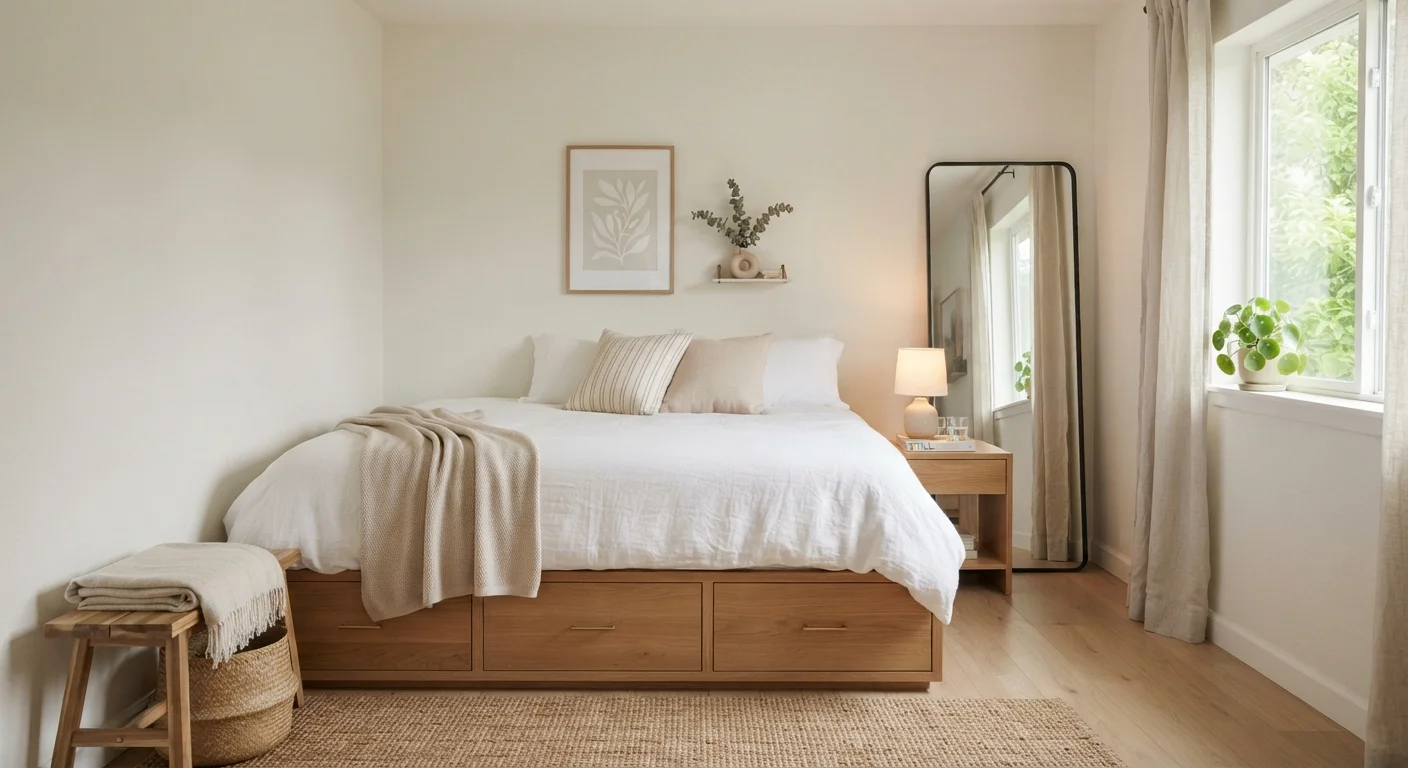
In a small bedroom, every piece of furniture should justify its footprint. Beds with integrated drawers underneath eliminate the need for a separate dresser. Ottoman benches at the foot of the bed provide seating and hidden storage simultaneously. Nightstands with shelves or drawers keep surfaces tidy without adding bulk.
Wall-mounted nightstands and floating shelves free up floor space entirely and are particularly useful when the gap beside a bed is too narrow for a standard table. If you need a desk, consider a fold-down wall-mounted version that tucks flat when not in use - a practical option for a bedroom that doubles as a home office.
For renters who want to keep changes reversible, our guide on decorating a rented home without losing your deposit covers freestanding and non-permanent solutions that work just as well.
Use Light, Color, and Mirrors to Open Up the Space
Visual perception of space is heavily influenced by light and color. Lighter wall tones - soft whites, warm creams, pale grays - reflect more light and generally make a room feel more open. That said, a single darker accent wall, when used deliberately, can add depth rather than shrink a space. If you've heard otherwise, our article on decorating myths that cost you money and space addresses this and other common misconceptions.
Mirrors are among the most effective tools in a small bedroom. A large mirror leaned against a wall or mounted opposite a window reflects natural light and doubles the apparent depth of the room. Mirrored wardrobe doors serve a functional purpose while achieving the same visual effect. Keep window treatments simple and light-filtering rather than heavy and opaque - the more daylight enters the room, the more spacious it will feel.
Consistent color use also matters. A palette of two or three tones - applied across bedding, walls, and a rug - creates visual cohesion. Too many competing colors and patterns make a small room feel chaotic. If you're decorating around a standout piece, our piece on decorating around a single hero piece offers a balanced look at when that approach works.
Work Vertically and Edit Ruthlessly
Vertical space is one of the most underused assets in a small bedroom. Tall wardrobes that reach close to ceiling height draw the eye upward and maximize storage without expanding the room's footprint. Shelving installed above a desk or doorway captures otherwise idle space for books, baskets, or decor.
Editing is equally important. Clutter - even small amounts - makes a compact room feel smaller and more stressful. A useful habit is to assess every decorative item with a simple question: does this earn its place? A few well-chosen pieces read as intentional styling; many mismatched items read as overflow. For guidance on artwork placement specifically, the complete picture-hanging playbook covers scale, height, and arrangement in practical detail.
Storage decisions - particularly open versus closed options - also affect how tidy a small bedroom looks at a glance. Our overview of open shelving versus closed cabinetry can help you decide which approach suits your organizational style and the room's aesthetic. The goal in a small bedroom isn't minimalism for its own sake - it's deliberate curation that keeps the space feeling restful rather than crowded.