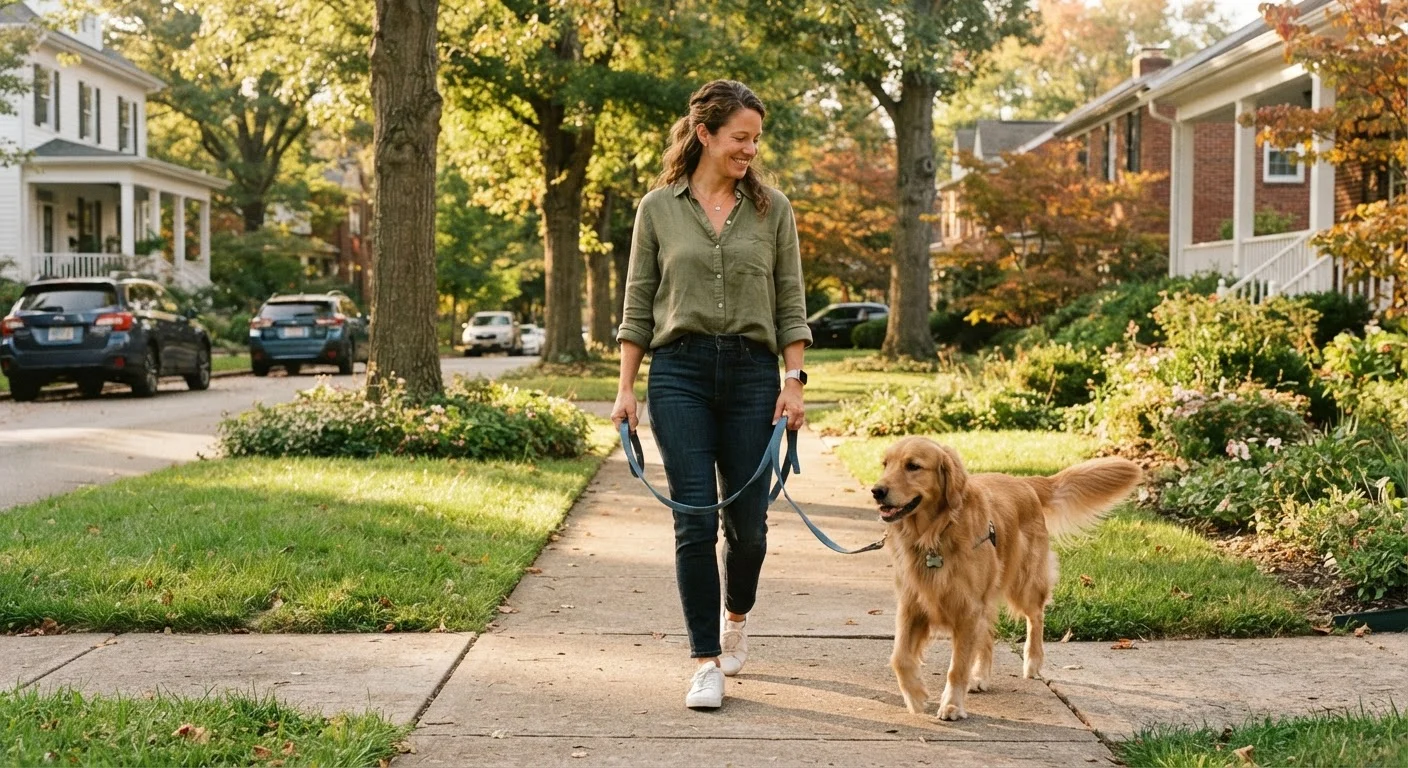
Why Dogs Pull - and Why It's Not About Dominance
Lead pulling is among the most common complaints dog owners bring to trainers, yet it is frequently misunderstood. Dogs do not pull because they are trying to dominate their owner or assert leadership. They pull for a much simpler reason: it works. Moving forward is the reward, and the dog has learned that lunging ahead gets them there faster.
This is a self-reinforcing loop. Every time a dog pulls and reaches the interesting smell or the other dog down the street, the pulling behavior is strengthened. The good news is that the same principle - behavior that produces good outcomes gets repeated - works in your favor when you redirect it intentionally.
If you have a new puppy, establishing good habits early makes this process considerably faster. See our complete puppy training guide for foundational skills to build alongside loose-leash walking. For adult or older dogs, the process takes longer but is absolutely achievable - the realistic expectations for training older dogs article covers what to anticipate.
What you will need
What You'll Need Before You Start
Gathering the right equipment and setting realistic expectations before your first session will save significant frustration. Lead-walking success depends on mechanics as much as motivation.
Front-clip harness
Redirects the dog toward you when they pull forward, reducing pulling force without discomfort.
Standard 4-6 foot fixed leash
Provides a consistent, predictable length that teaches the dog where the boundary of slack is.
High-value training treats
Motivates the dog to maintain position beside you and reinforces loose-leash behavior quickly.
Treat pouch or bait bag
Keeps rewards immediately accessible so you can reinforce the correct behavior within one to two seconds.
Clicker
Marks the exact moment of correct behavior with a precise, consistent sound before delivering the treat.
Make Every Walk a Practice Opportunity
You don't need formal training sessions to reinforce loose-leash walking. Every time you leave the house with your dog is a chance to practice. Consistent rules on daily walks will build the habit faster than occasional dedicated sessions alone. If you're short on time, even a five-minute loop around the block with full attention counts.
Step-by-Step: Teaching the Loose-Leash Walk
Work through these steps in a low-distraction environment - a quiet hallway or backyard - before graduating to the sidewalk. Progress at your dog's pace, not a fixed timeline.
Establish your starting position
Decide which side you want your dog to walk on and commit to it - left is traditional, but either side works. Hold the leash in the hand opposite your dog, with enough slack to form a gentle "J" shape between your hand and the dog's collar. This J-shape is your visual cue: as long as it's there, the leash is loose.
Reward the correct position before moving
Before taking a single step, reward your dog for standing calmly at your side. Say a marker word like "yes" or click, then deliver a treat at your hip - not in front of you. Delivering the treat at hip height keeps your dog's attention at your side rather than out ahead of you.
Take a few steps and stop the moment tension appears
Begin walking slowly. The instant you feel any tension on the leash - even slight - stop completely. Do not yank back or say "no." Simply become a statue. Wait for your dog to release the tension by turning back toward you or stepping back. The moment the leash slackens, mark ("yes" or click) and reward at your hip, then begin walking again.
Build distance gradually
Once your dog can walk 10-15 steps without pulling in a quiet area, extend the distance. Add real-world distractions slowly - move from the backyard to the front sidewalk, then to a quiet street, then to a busier area. Each new environment is a new starting point; expect your dog to need more frequent rewards when the surroundings change.
Reward duration and introduce a release cue
As your dog becomes reliable, gradually increase the number of steps between treats. Instead of rewarding every 3 steps, reward every 10, then every 20. Introduce a release cue like "go sniff" to give your dog designated time to explore freely - this makes the structured walking portion feel clearer by contrast and gives your dog a structured outlet for natural sniffing behavior.
Avoid Retractable Leashes During Training
Retractable leashes teach dogs that pulling extends the line and grants access to more space - the opposite of what you're working to achieve. Use a standard fixed-length leash of 4-6 feet throughout the training process. Once loose-leash habits are solid, you can make different choices for appropriate low-distraction settings.
Troubleshooting Common Setbacks
Even with consistent practice, most owners encounter plateaus. Here are the situations that come up most often and how to address them.
My dog does fine at home but loses focus outside. This is normal. The outdoor environment is exponentially more stimulating. Drop back to shorter distances, increase treat value (try small pieces of chicken or cheese), and practice at the edge of your driveway before attempting a full walk.
My dog lunges at other dogs or bikes. Lunging toward triggers is a distinct challenge from general pulling. Practice "find it" - tossing a treat on the ground to redirect your dog's nose and attention - as the trigger appears at a distance. Gradually decrease the distance over multiple sessions as your dog remains calm.
Progress seems to stall after a week. Check for consistency gaps. If one family member allows pulling while others enforce the stop-and-wait rule, the dog receives mixed signals. Our article on why dogs ignore commands explains how inconsistency undermines even solid training. Align all household members on the same rules before each session.
To keep your dog motivated and sessions fresh as training progresses, explore strategies to keep training sessions engaging.
This article provides general pet training information for educational purposes. For dogs displaying anxiety, aggression, or persistent behavioral challenges, consult a certified professional trainer or your veterinarian.