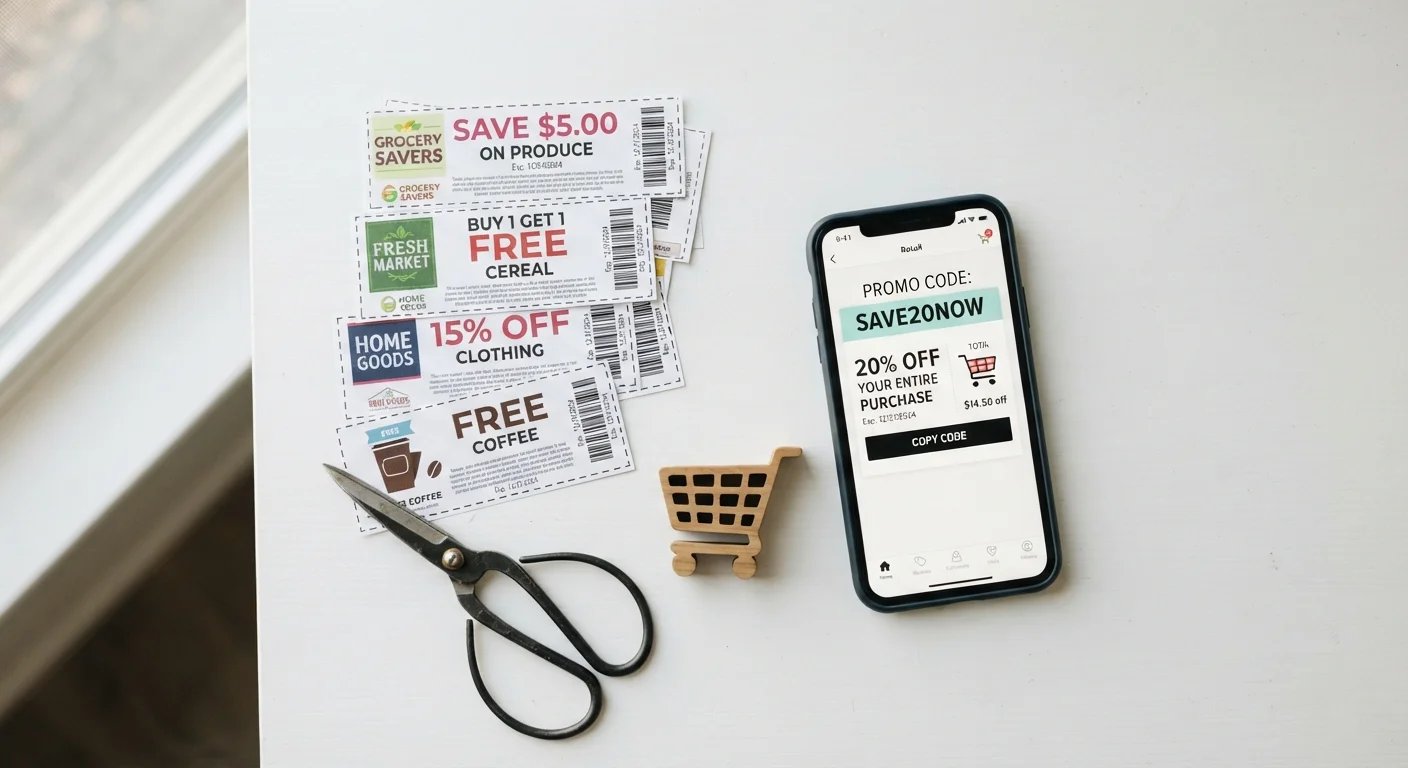
How Coupons Are Created
Every coupon starts as a deliberate business decision. Retailers and brands issue them to achieve specific goals: clearing slow-moving inventory, attracting first-time customers, rewarding loyalty, or competing with a rival's promotion. The mechanics behind creation differ depending on whether the coupon is paper-based or digital.
For digital promo codes, a retailer's promotions team typically works within a commerce platform (such as Shopify, Salesforce Commerce Cloud, or a proprietary system) to define the code's parameters: the discount type (percentage, fixed dollar amount, or free shipping), eligible products or categories, usage limits per customer, and the active date range. Each rule is encoded at the database level, which is why a code that worked yesterday may legitimately fail today.
Paper coupons - still common in grocery and CPG (consumer packaged goods) categories - follow a similar logic but are issued through print runs coordinated with distributors, newspapers, or direct-mail campaigns. For a broader explanation of how these formats differ, see Coupons & Promo Codes Explained.
Sign up for a retailer's email list with a secondary address dedicated to deals - this keeps promotional codes organized and prevents your primary inbox from becoming cluttered while ensuring you don't miss time-sensitive offers.
Cart abandonment and new-subscriber codes are among the highest-value discounts a retailer issues, but they're only sent to email subscribers, making list membership a prerequisite for accessing them.
Before applying a promo code, activate a cashback portal session first - most cashback platforms track the purchase based on the click-through, and the discount code is applied after tracking is established.
Applying the code before activating the cashback session can sometimes result in the cashback not being credited if the portal detects a modified cart total; the sequence matters for ensuring both savings stack correctly.
Distribution: How Coupons Reach Shoppers
Once created, coupons enter a distribution phase that can take many forms. The channel a retailer chooses is rarely random - it's tied to the target audience and the behavior the retailer wants to reward or trigger.
- Email newsletters: Loyalty subscribers often receive exclusive codes not available publicly.
- Cart abandonment emails: Automated systems detect when a shopper leaves without purchasing and send a follow-up discount as an incentive to return.
- Loyalty program portals: Earned codes tied to point thresholds or tier status.
- Browser extensions: Tools that automatically surface available codes at checkout.
- Social media and influencer campaigns: Codes shared to a specific audience, often with limited redemption counts.
- Physical inserts: Included in packaging for a previous order, encouraging repeat purchases.
Knowing these channels matters practically. Many of the richest discounts never appear on public coupon aggregator sites. Places Discount Codes Actually Hide covers the less-obvious sources in detail. The targeting logic behind who receives which code is explained in How Retailers Decide Who Gets a Promo Code.
~$90B
Annual US coupon redemptions by face value
Industry estimates from coupon processing firms suggest tens of billions of dollars in face value are redeemed annually across US retail channels, with digital redemptions growing as a share.
60%+
Shoppers who search for a code before checkout
Multiple consumer surveys indicate a majority of online shoppers habitually search for a discount code before completing a purchase, making code availability a competitive factor for retailers.
Validation: What Happens at Checkout
When a shopper enters a code, the retailer's system runs a series of checks before applying any discount. Understanding this process helps diagnose why a valid-looking code might be rejected.
- Code existence check: The system confirms the code string exists in its database.
- Active date check: The current date must fall within the promotion's start and end window.
- Eligibility check: Cart contents are compared against the code's product or category restrictions.
- Minimum order threshold: Many codes require a minimum subtotal before activating.
- Usage limit check: If a code is single-use or has a global cap, the system verifies remaining redemptions.
- Account-level check: Some codes are tied to a specific account email and will fail if applied while logged out or from a different account.
If a code fails, working through this checklist systematically is more effective than assuming the code is fraudulent or expired. Start by confirming the cart meets minimum requirements and that you're logged into the correct account.
Stacking and Combining Discounts
Stacking - applying multiple discounts to a single order - is one of the more powerful tactics available, but it requires knowing what a retailer's system permits. Most platforms allow only one promo code per order, though some retailers explicitly support stacking a promo code with a store credit, a loyalty reward, or a cashback portal.
Common stackable combinations include:
- A percentage-off promo code applied before a cashback portal tracks the purchase.
- A category-specific code combined with a sitewide free-shipping code (where the platform permits two codes).
- A manufacturer coupon layered with a retailer's own store coupon at physical checkout - a practice common in grocery.
The order in which discounts apply also affects the final price. Typically, a percentage-off code is calculated on the pre-tax, post-shipping subtotal, while cashback is calculated on the final charged amount - meaning the sequence matters for maximizing savings. Pairing coupon use with cashback programs is discussed further in the Cashback & Rewards hub.
Before checkout, running through a quick verification process prevents leaving money on the table. See Before You Check Out: A Coupon-Readiness Checklist for a structured approach.
Expiry and Retirement: When Coupons Die
Expiry is built into the coupon's creation from the start. Retailers set end dates for commercial reasons: promotional budgets have limits, seasonal campaigns have windows, and allowing a discount to run indefinitely erodes margins. When a code's end date passes, the system's active-date check (see the Validation section) automatically rejects it.
Some specific expiry scenarios to know:
- Hard expiry: The most common type. The code stops working at midnight on the stated date, with no grace period.
- Redemption-cap expiry: A code expires when its maximum number of uses is reached, regardless of the calendar date. These can disappear mid-day without warning.
- Single-use codes: Issued uniquely to one account; once used, they're permanently retired.
- Rolling codes: Some loyalty programs issue codes that expire a set number of days after issue (e.g., 30 days from email receipt), rather than on a fixed date.
For shoppers, the practical implication is straightforward: treat expiry dates as firm deadlines. Codes found on aggregator sites are frequently outdated - the site may not remove them promptly after retirement. Always verify the source and date before building a checkout strategy around a specific code. For a broader look at how coupon practices have shifted, Coupon Culture: What's Changed provides useful context.
Practical Takeaways for Shoppers
Understanding the full coupon lifecycle shifts you from a passive deal-finder to an informed one. Here's what to carry forward:
- Source matters: Codes from retailer emails and loyalty portals are more likely to be current and applicable than codes from third-party aggregators.
- Read the fine print: Eligibility rules, minimum thresholds, and exclusions are set at creation and enforced at validation - there's no workaround.
- Act before the deadline: Hard expiry dates are enforced automatically. Don't assume a code will still work after the stated date.
- Layer strategically: Check whether a retailer permits stacking before building a multi-discount checkout plan. When permitted, combining a promo code with a cashback portal is one of the more reliable ways to compound savings.
- Stay organized: Keep active codes in one place - a notes app, a browser bookmark folder, or a dedicated deals inbox - so you can apply them before they retire.
For more context on how saving strategies fit into broader financial habits, the Saving & Deals hub covers practical cost-cutting approaches across everyday spending categories.
This article is for general informational purposes only and does not constitute financial or legal advice. Coupon terms, policies, and availability vary by retailer and change frequently; always verify current terms directly with the retailer before making a purchase decision.