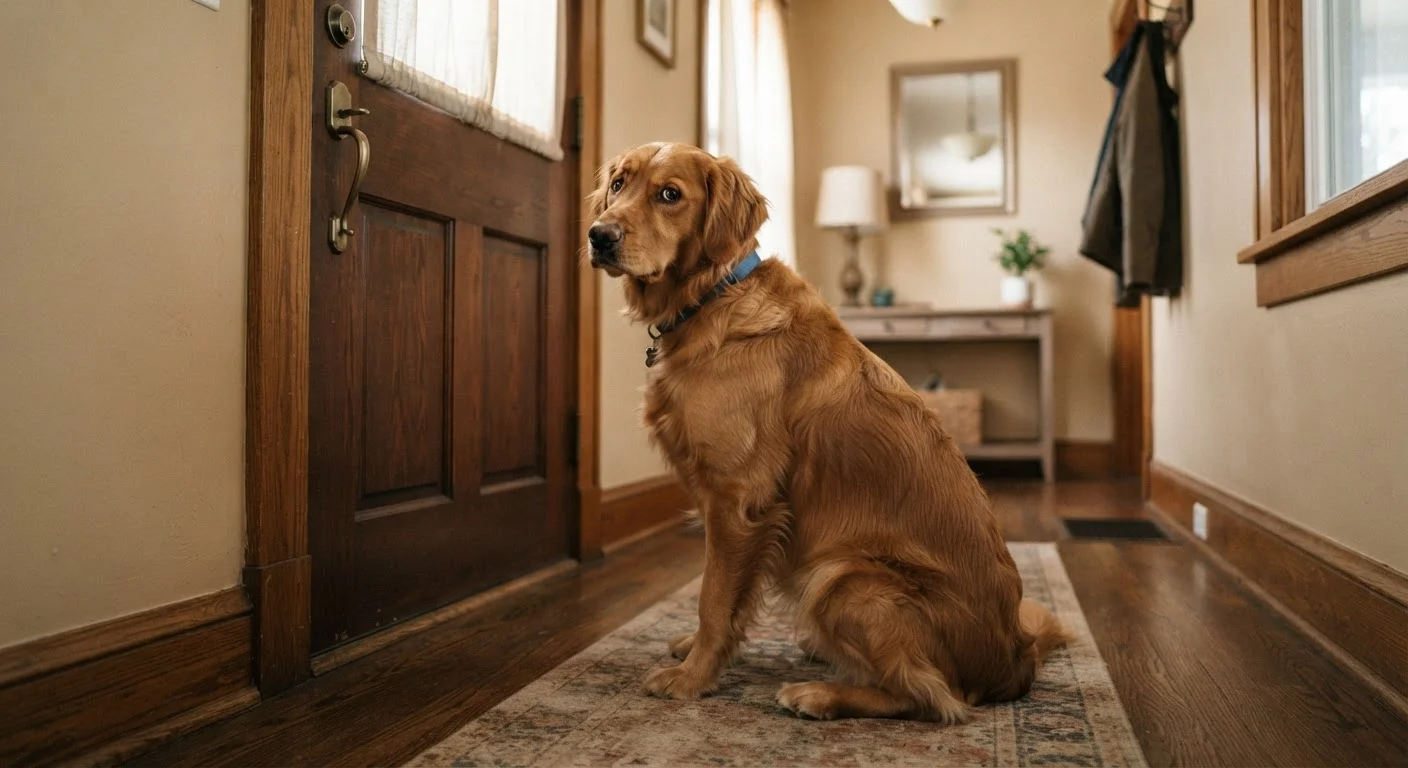
What Is Separation Anxiety in Dogs?
Separation anxiety is a condition in which a dog experiences significant distress when left alone or separated from the person - or people - they are bonded to. It is not a training failure or a sign of a spoiled pet. It reflects a genuine stress response rooted in the dog's attachment system.
The condition exists on a spectrum. Some dogs show mild restlessness; others exhibit severe, persistent distress that can result in property destruction, self-injury, or noise complaints. Understanding where your dog falls on that spectrum is essential before choosing an approach, because mild unease and clinical separation anxiety require meaningfully different responses.
Certain factors appear to increase susceptibility, including early-life experiences, periods of change (such as a new home or altered owner schedule), and individual temperament. Some breeds with strong working or bonding histories are also more commonly affected, though any dog can develop the condition.
Recognising the Signs
Signs of separation anxiety typically occur only when the dog is alone - or anticipates being alone - and resolve when the owner returns. Common indicators include:
- Destructive behaviour directed at exits (doors, window frames)
- Excessive vocalisation - barking, howling, or whining
- House soiling despite being reliably house-trained
- Pacing, drooling, or repetitive behaviours
- Attempts to escape that may result in self-injury
- Hyper-attachment behaviours when the owner is present (following constantly, refusing to settle independently)
A home camera or recording device can be invaluable for identifying what actually happens after you leave, since many owners only see the aftermath. This evidence also helps a veterinary professional assess severity accurately.
Set up a camera before you assess your dog's behaviour - what owners witness on return (guilt, submission) is not the same as what happens during the absence. Video evidence removes guesswork and makes your intervention much more targeted.
Dogs do not display anxiety retrospectively; their body language on owner return reflects the current social context, not what occurred while alone. Accurate baseline data is the starting point for any effective protocol.
Keep departures and arrivals low-key. Long, emotional goodbyes and enthusiastic greetings elevate the contrast between presence and absence, which can intensify the dog's distress at the transition point.
Minimising the emotional salience of coming and going reduces the dog's anticipatory arousal - a key driver of the anxiety cycle - without requiring any additional equipment or cost.
It is worth distinguishing separation anxiety from boredom or under-stimulation, which can look similar on the surface but respond differently to intervention. A dog that chews furniture only when alone may simply need more physical and mental activity, while a dog that vocalises continuously and cannot settle is more likely experiencing genuine anxiety. See our guide to common pet health myths for more on how misreading behaviour can lead owners in the wrong direction.
Desensitisation: The Core Training Strategy
Systematic desensitisation - gradually exposing a dog to the trigger (being alone) in sub-threshold increments - is the most consistently supported behavioural approach for separation anxiety. The principle is straightforward: you expose the dog to absences so brief they do not trigger distress, then increase duration very slowly over time.
How to Begin
- Identify your dog's threshold. This is the duration at which distress begins. For some dogs, this is seconds; for others, several minutes. Start well below it.
- Practice departures without leaving. Pick up your keys, put on your coat, then sit back down. Repeat until these cues no longer trigger a stress response.
- Build duration incrementally. Step outside for five seconds, re-enter calmly, and ignore the dog briefly before greeting. Extend to ten seconds, thirty, one minute - but only when the previous duration produces no anxiety.
- Never return to a distressed dog. Returning when the dog is panicking reinforces that distress brings the owner back. Instead, move backward to a shorter, manageable duration.
Avoid Punishment-Based Responses
Scolding, using aversive tools, or confining a distressed dog as a consequence of anxiety-driven behaviour does not address the underlying emotional state and can significantly worsen the condition. Separation anxiety is driven by fear, not defiance. Punishing fearful behaviour increases fear. If a training approach relies on correction for anxiety-related actions, it is not aligned with current behavioural science and should be reconsidered.
Progress is rarely linear. A bad day - a thunderstorm, a workman at the door - can reset progress temporarily. This is normal and does not mean the approach is failing. Patience and consistency over weeks, not days, are what produce lasting change.
For broader training foundations that complement this work, our complete puppy training guide covers how to build a dog's confidence from the ground up.
Supporting Strategies That Reinforce Progress
Desensitisation works best when supported by a broader environment that reduces overall stress and builds independent coping skills.
Independence Training
Encourage the dog to settle in a separate room or on a designated mat while you are still home. Reward calm, independent behaviour consistently. This reduces hyper-attachment and makes brief separations feel less significant. Short, positive training sessions also build the dog's confidence and focus - see our article on keeping training sessions engaging for practical ideas.
Predictable Routines
Dogs are highly attuned to routine. Consistent departure and arrival times, regular feeding, and predictable exercise windows all reduce background anxiety. When a dog can anticipate what happens next, the environment feels safer.
Physical and Mental Enrichment
Adequate exercise before an absence can reduce the intensity of the stress response. Puzzle feeders, food-stuffed toys, and scent work provide mental engagement that helps the dog occupy itself calmly. Offer these consistently - not only when you are leaving - so they do not become departure cues themselves.
Safe Spaces
A comfortable, enclosed resting area (a crate introduced positively, or a quiet room) can serve as a genuine refuge rather than a confinement - but only if the dog has been trained to view it that way. Forcing a distressed dog into a crate can escalate anxiety.
~17%
Dogs estimated to experience separation anxiety
Research published in veterinary behaviour literature consistently places prevalence estimates in the range of 14-20% of the domestic dog population.
Weeks to months
Typical timeframe for desensitisation progress
Behavioural professionals note that meaningful, stable improvement generally requires sustained, consistent practice over a period of weeks to several months, not days.
When to Involve a Veterinary Professional
Behavioural strategies alone are highly effective for mild to moderate cases, but severe separation anxiety - marked by self-injury, total inability to settle, or distress that does not decrease with consistent desensitisation - warrants veterinary assessment.
A veterinarian can rule out underlying medical contributors (pain, neurological issues) that may be worsening anxiety, and in appropriate cases may discuss whether medication could support the behavioural work. Medication for anxiety is not a substitute for training; it is a tool that can reduce the dog's baseline arousal enough for learning to occur. Any decisions about medication should be made with and managed by a licensed veterinarian.
For complex cases, a referral to a certified veterinary behaviourist (a veterinarian with specialist training in animal behaviour) or a certified applied animal behaviourist may be recommended. These professionals can design individualised protocols and monitor progress. If your dog also has other chronic needs, our guide to caring for a pet with a chronic condition has relevant practical guidance on managing long-term care sustainably.
This article provides general educational information about canine behaviour and is not a substitute for professional veterinary or behavioural advice. If your dog is experiencing significant distress, please consult a qualified veterinarian.
Building Long-Term Resilience
Managing separation anxiety is rarely a one-time fix. Even dogs who respond well to treatment can experience setbacks during life changes - moving home, a new family member, disruptions to routine. Maintaining occasional practice of independence exercises and departure desensitisation, even after the dog appears comfortable, builds resilience against future regression.
The goal is not a dog that tolerates being alone under duress, but one that genuinely settles comfortably because it has learned, through consistent positive experience, that solitude is safe and temporary. That shift in the dog's emotional state - not just its behaviour - is the marker of lasting progress.
If you are also managing introductions to a new household member that may be affecting your dog's stress levels, our guide to introducing a new pet addresses the behavioural dynamics involved. And for dogs whose anxiety also manifests during walks, building calm leash behaviour can be a complementary focus.